Marketers are under increasing pressure to justify every dollar spent on paid acquisition. Rising CPMs, stricter privacy regulations, and fragmented user journeys make precision more important than ever. Data enrichment has emerged as a practical solution for improving targeting accuracy, increasing conversion rates, and maximizing return on ad spend (ROAS).
What Is Data Enrichment in Paid Advertising?
Data enrichment is the process of enhancing existing customer or prospect data with additional attributes such as firmographic, demographic, behavioral, or technographic information. Instead of relying solely on basic identifiers (e.g., email or job title), enriched datasets allow advertisers to build highly segmented and performance-driven audiences.
In paid advertising environments such as Meta Ads and Google Ads, enriched data enables:
-
More accurate custom audience creation
-
Advanced lookalike modeling
-
Improved exclusion logic
-
Refined bid optimization strategies
The result is better alignment between advertising spend and high-intent users.
The Cost Problem in Modern Paid Advertising
Digital advertising costs continue to rise. According to industry benchmarks:
-
Average CPC in competitive B2B industries often exceeds $5–$9.
-
Poor audience targeting can waste up to 26% of advertising budgets due to irrelevant impressions.
-
Increasing CPM volatility has driven year-over-year cost increases in many industries.
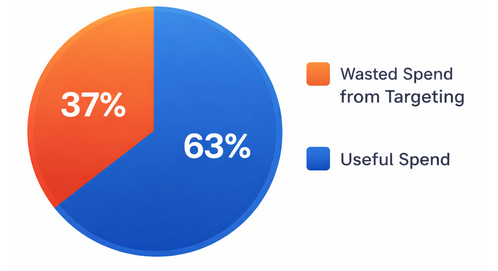
Percentage of digital ad spend lost due to imprecise audience targeting
When targeting is imprecise, advertisers pay for impressions and clicks that do not convert. Even small improvements in audience quality can significantly influence ROI.
How Data Enrichment Improves ROI
1. Higher Conversion Rates
Enriched data enables segmentation based on meaningful buying signals. Campaigns that target refined audience segments typically see measurable improvements in conversion rates.
Industry studies show that segmented and personalized campaigns can increase conversion rates by up to 202% compared to non-segmented campaigns. While results vary by industry, the direction is consistent: relevance increases performance.
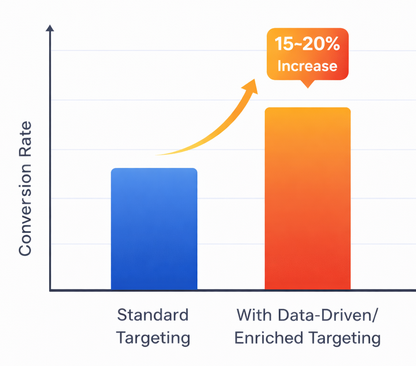
Conversion rate improvement when using enriched, data-driven audience targeting
If a campaign converts at 2% before enrichment and increases to 3% after improved targeting, that 1% lift represents a 50% relative improvement in conversion efficiency.
2. Lower Cost per Acquisition (CPA)
When irrelevant clicks decrease, cost per acquisition drops. Even a 15–25% reduction in wasted spend can materially impact profitability.
For example:
-
Monthly ad budget: $50,000
-
Wasted spend due to poor targeting (20%): $10,000
-
If enrichment reduces waste by half, $5,000 is immediately reallocated toward higher-performing impressions.
That recovered budget effectively increases ROI without increasing total spend.
3. Improved Lookalike Performance
Lookalike modeling depends entirely on seed data quality. If the seed audience contains incomplete or inaccurate records, algorithmic expansion suffers.
Enriched seed audiences produce more predictive signals, resulting in:
-
Higher-quality lookalike audiences
-
Lower frequency waste
-
More stable ROAS over time
This is especially critical in B2B advertising, where firmographic accuracy directly affects campaign profitability.
4. Better Exclusion Logic
Excluding existing customers, low-value accounts, or irrelevant segments prevents cannibalization and budget leakage.
Without enriched data, advertisers often fail to exclude:
-
Current customers
-
Closed-lost accounts
-
Non-qualified job roles
Even modest exclusion improvements can reduce unnecessary impressions by 10–18%, improving overall efficiency.
Quantifying the ROI of Data Enrichment
To evaluate ROI accurately, use the following formula:
ROI = (Incremental Revenue – Enrichment Cost) / Enrichment Cost
Where incremental revenue is calculated by comparing pre- and post-enrichment performance metrics.
Key metrics to track:
-
Conversion rate lift
-
Cost per acquisition reduction
-
ROAS improvement
-
Lead-to-opportunity rate
-
Customer lifetime value (CLV) changes
Example calculation:
-
Enrichment investment: $8,000
-
CPA reduction generates $22,000 in additional qualified revenue
ROI = ($22,000 – $8,000) / $8,000 = 175%
This does not include secondary gains such as improved sales efficiency or reduced manual data cleaning time.
Hidden Financial Benefits
Beyond direct campaign metrics, enrichment improves operational efficiency:
-
Reduced manual CRM cleanup
-
Higher sales productivity due to better-qualified leads
-
Shorter sales cycles when targeting aligns with buying committees
Research suggests that sales teams spend up to 17% of their time correcting or researching contact data. Cleaner, enriched datasets recover that time for revenue-generating activities.
When Data Enrichment Has the Highest Impact
Data enrichment generates the strongest ROI when:
-
Running account-based marketing (ABM) campaigns
-
Scaling lookalike audiences
-
Expanding into new geographic markets
-
Managing high-budget B2B campaigns
The higher the media spend, the more financially significant even small efficiency improvements become.
Implementation Best Practices
To maximize ROI from enrichment:
-
Enrich before campaign launch, not after performance declines.
-
Segment enriched attributes into structured audience layers.
-
Continuously refresh enriched data to prevent decay.
-
Align marketing and sales on qualification criteria.
Enrichment should be treated as a performance multiplier rather than a one-time data project.
Conclusion
Paid advertising ROI is increasingly determined by data quality rather than budget size. As acquisition costs rise and targeting becomes more complex, enriched datasets provide a measurable advantage.
When properly implemented and tracked, data enrichment reduces waste, improves conversion efficiency, and increases profitability. In competitive digital environments, better data is not an operational luxury—it is a financial necessity.