Facebook Ads delivery issues are among the most frustrating challenges for advertisers. Campaigns may remain stuck in the learning phase, experience unstable performance, or fail to spend budget efficiently. In many cases, the root cause is not creative or targeting—but signal quality.
Signals are the data points Facebook uses to understand user behavior and optimize ad delivery. When signals are incomplete, inaccurate, or delayed, the algorithm struggles to find the right audience, leading to poor performance.
What Are Signal Problems in Facebook Ads?
Signal problems occur when Facebook receives insufficient or low-quality data to optimize campaign delivery. These signals primarily come from:
-
Pixel events (e.g., purchases, add-to-cart)
-
Conversion API data
-
User interactions with ads
When these inputs are disrupted, Facebook’s algorithm cannot properly learn, resulting in inefficient delivery.
Key Statistics on Signal and Delivery Performance
-
Campaigns that generate fewer than 50 conversion events per week are significantly more likely to remain in the learning phase.
-
Advertisers using both Pixel and Conversion API report up to a 13% improvement in attributed conversions.
-
Poor signal quality can increase CPA by 20–30% due to inefficient optimization.
Common Causes of Signal Issues
1. Low Event Volume
If your campaign does not generate enough conversion events, Facebook cannot exit the learning phase.
Symptoms:
-
Limited delivery
-
High CPA
-
Frequent learning resets
2. Broken or Misconfigured Pixel
Incorrect pixel implementation leads to missing or duplicated events.
Symptoms:
-
Inconsistent reporting
-
Sudden drops in conversions
-
Event mismatch
3. Missing Conversion API Integration
Relying solely on browser-based tracking reduces signal reliability due to privacy restrictions.
Symptoms:
-
Underreported conversions
-
Declining performance after iOS updates
4. Event Prioritization Issues
Incorrect event prioritization limits optimization effectiveness.
Symptoms:
-
Ads optimizing for low-value actions
-
Poor return on ad spend
5. Audience Fragmentation
Too many small ad sets divide signals across campaigns.
Symptoms:
-
Slow learning
-
Inconsistent delivery
How to Diagnose Signal Problems
Step 1: Check Event Volume
Ensure your campaign generates at least 50 optimization events per week. If not, consider optimizing for a higher-funnel event.
Step 2: Verify Pixel Health
Use Events Manager to confirm:
-
Events are firing correctly
-
No duplication or missing data
-
Consistent event parameters
Step 3: Review Signal Sources
Confirm whether you are using:
-
Browser tracking (Pixel)
-
Server-side tracking (Conversion API)
Combining both improves signal resilience.
Step 4: Analyze Attribution Gaps
Compare Facebook-reported conversions with backend data. Large discrepancies often indicate signal loss.
Step 5: Evaluate Account Structure
Simplify campaigns and consolidate ad sets to strengthen signal density.
How to Fix Signal Issues
Improve Event Volume
-
Broaden targeting
-
Increase budget
-
Optimize for higher-frequency events
Implement Conversion API
Server-side tracking ensures more reliable data collection, especially under privacy limitations.
Consolidate Campaign Structure
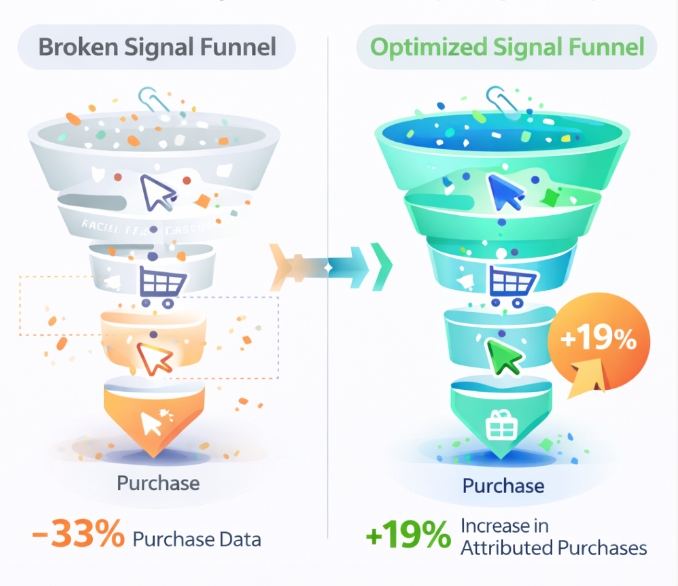
Improved signal tracking restores lost data, increasing attributed conversions by up to 19%
Reduce the number of ad sets to avoid signal fragmentation and allow faster learning.
Optimize Event Prioritization
Focus on events that align with business goals and generate sufficient volume.
Monitor Signal Quality Regularly
Continuously audit events, attribution, and performance trends.
Advanced Optimization Tips
-
Use value-based optimization when sufficient purchase data is available
-
Avoid frequent edits that reset learning
-
Align creatives with conversion intent to improve signal strength
Conclusion
Facebook Ads delivery issues are often symptoms of deeper signal problems. By understanding how signals work and systematically diagnosing weak points, advertisers can restore stability and improve performance. Strong, consistent signals enable the algorithm to learn faster, deliver efficiently, and achieve better results.
Recommended Reading