Audience targeting has always been the backbone of effective advertising. However, with stricter data privacy regulations, signal loss, and platform changes, traditional targeting methods are being re-evaluated. Two of the most widely used approaches—interest targeting and behavioral targeting—have adapted in different ways.
Understanding how these strategies perform today is essential for maintaining campaign efficiency, reducing acquisition costs, and improving return on ad spend (ROAS).
What Is Interest Targeting?
Interest targeting focuses on users’ declared or inferred interests based on their activity, such as pages they like, content they engage with, or topics they follow.
Key Characteristics:
-
Based on long-term preferences
-
Relatively stable audience segments
-
Built using platform-defined categories
Advantages:
-
Easy to set up and scale
-
Effective for top-of-funnel campaigns
-
Works well for brand awareness
Limitations:
-
Less precise in identifying purchase intent
-
Can include outdated or irrelevant interests
What Is Behavioral Targeting?
Behavioral targeting uses real-time or recent user actions—such as website visits, purchases, clicks, or app activity—to segment audiences.
Key Characteristics:
-
Based on recent behavior
-
Dynamic and frequently updated
-
Often relies on tracking pixels and events
Advantages:
-
High relevance and intent
-
Strong performance in retargeting campaigns
-
Better conversion rates
Limitations:
-
Increasingly affected by signal loss
-
Requires reliable data tracking
-
Smaller audience sizes
Key Statistics in 2026
-
Campaigns using behavioral targeting achieve up to 2.5x higher conversion rates compared to interest-based campaigns in retargeting scenarios.
-
Due to privacy changes, up to 35–45% of user-level behavioral data may be unavailable or incomplete on major platforms.
-
Interest targeting audiences remain 3–5 times larger on average than behavioral audiences, making them more scalable.
-
Hybrid campaigns that combine both strategies can improve ROAS by up to 32%.
Interest vs Behavioral Targeting: Head-to-Head Comparison
1. Accuracy
Behavioral targeting is significantly more accurate because it reflects real user actions rather than assumed preferences.
2. Scalability
Interest targeting wins in scale, allowing advertisers to reach broader audiences quickly.
3. Resilience to Signal Loss
Interest targeting is more resilient since it relies less on tracking data.
4. Performance Across Funnel
-
Top of funnel: Interest targeting performs better
-
Middle and bottom funnel: Behavioral targeting dominates
5. Cost Efficiency
Behavioral targeting typically delivers lower cost per acquisition (CPA), but only when sufficient data is available.
What Works Better in 2026?
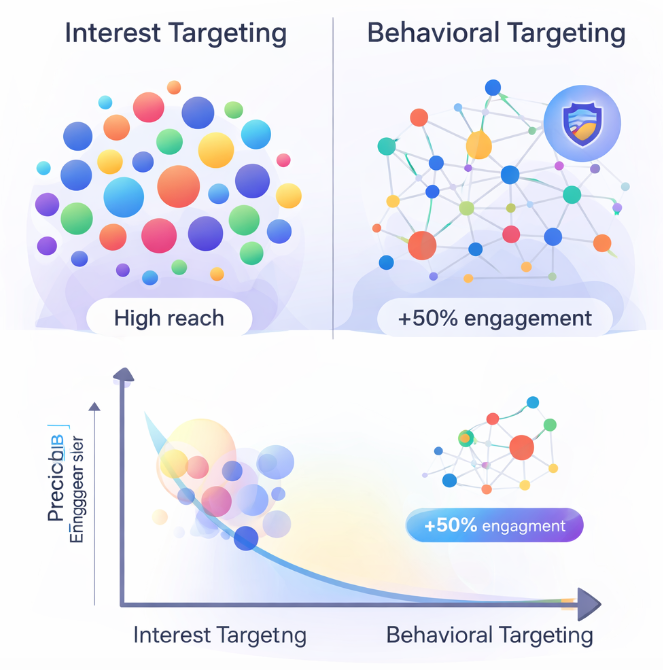
In 2026, advertisers face a trade-off: interest targeting offers scale, while behavioral targeting delivers higher engagement—but with increasing data limitations
There is no one-size-fits-all answer. However, trends clearly indicate that:
-
Behavioral targeting is more effective for conversions and retargeting
-
Interest targeting remains essential for scaling and discovery
-
Signal loss is reducing the reliability of purely behavioral strategies
As a result, advertisers who rely exclusively on one approach are likely to underperform.
The Winning Strategy: Hybrid Targeting
The most effective campaigns in 2026 combine both approaches:
-
Use interest targeting to build large, qualified audiences
-
Layer behavioral signals where available
-
Continuously refresh audience segments
This hybrid model allows advertisers to balance scale with precision while adapting to data limitations.
Practical Recommendations
-
Start with broad interest-based audiences to generate initial data
-
Build behavioral segments from high-intent users
-
Regularly audit tracking quality and signal coverage
-
Test combinations of interest and behavioral layers
-
Optimize campaigns based on funnel stage
Conclusion
Interest targeting and behavioral targeting are not competing strategies—they are complementary tools. In 2026, success depends on understanding when and how to use each one.
Advertisers who adapt to privacy changes, embrace hybrid targeting, and continuously test their approaches will achieve stronger performance and more sustainable results.
Recommended Reading