Facebook advertising is entering a decisive phase. By 2026, automation, privacy regulation, and AI-driven optimization will fundamentally reshape how campaigns are planned, executed, and measured. This article outlines the most important changes marketers should prepare for now to remain competitive.
The Evolution of Facebook Advertising Toward 2026
Over the past few years, Facebook Ads have shifted from manual, granular control toward algorithmic decision-making. By 2026, this transformation is expected to be largely complete. Advertisers will rely more on Meta’s AI to determine targeting, bidding, and creative delivery, while human input will focus on strategy, messaging, and data quality.
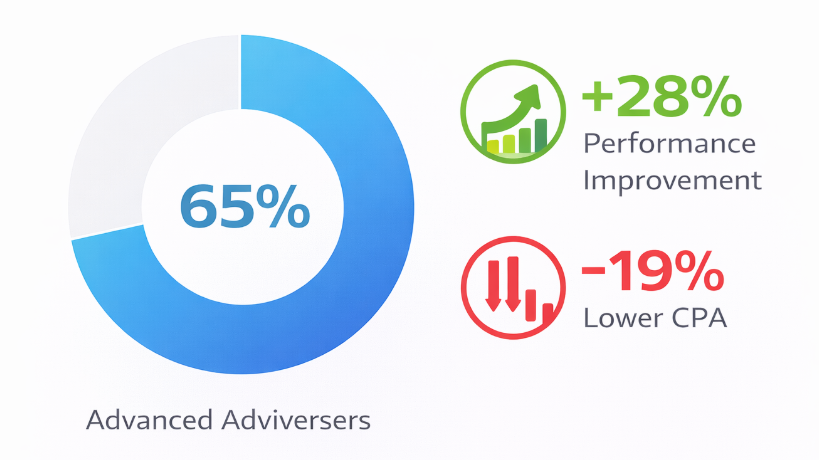
AI adoption among advanced Facebook advertisers and its correlated uplift in performance and reduction in cost per acquisition.
According to Meta’s own performance disclosures, campaigns using Advantage+ shopping formats already show up to 20–30% lower cost per acquisition compared to traditional manually segmented campaigns. This gap is expected to widen as automation improves.
Privacy-First Advertising as the Default
Privacy is no longer a constraint—it is the operating environment. By 2026, third-party data dependence will be minimal, and first-party data will be the primary targeting asset.
Key expectations include:
-
Expanded use of modeled conversions to compensate for signal loss
-
Broader audience definitions replacing interest-heavy targeting
-
Increased reliance on Conversion APIs and server-side tracking
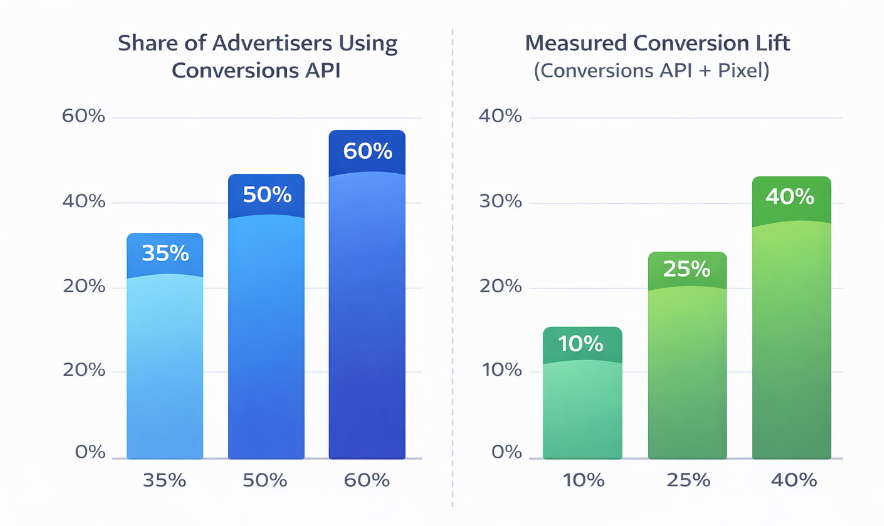
Adoption of Conversions API and its impact on measured conversions compared to pixel-only tracking.
Current industry benchmarks indicate that advertisers using server-side tracking recover 10–20% more conversion data compared to pixel-only setups. By 2026, failing to implement this infrastructure will likely result in systematically underreported performance and weaker optimization.
Creative Becomes the Primary Performance Lever
As targeting options narrow, creative quality will increasingly determine success. Facebook’s algorithms already prioritize creative engagement signals such as watch time, scroll-stopping ability, and post-click behavior.
By 2026, high-performing advertisers will:
-
Produce higher volumes of creative variations
-
Focus on native, creator-style video formats
-
Refresh creatives more frequently to avoid fatigue
Internal Meta data shows that ads refreshed every 2–4 weeks can reduce performance decay by up to 40%. Creative testing frameworks will replace audience testing as the main optimization methodology.
AI-Driven Campaign Structures
Manual campaign architectures with dozens of ad sets will continue to disappear. Instead, advertisers will adopt simplified structures designed to feed algorithms with more data per learning phase.
Expected structural trends include:
-
Fewer campaigns with broader targeting
-
Budget allocation handled primarily by automated systems
-
Predictive optimization based on historical and real-time signals
Industry-wide data from large-scale advertisers suggests that simplified account structures can shorten learning phases by 25–35%, improving both scalability and stability.
Measurement and Attribution in 2026
Attribution models will be less about precision and more about directional insight. Last-click attribution will continue to lose relevance as multi-touch, modeled, and probabilistic systems become standard.
Marketers should prepare for:
-
Greater variance between platform-reported and backend revenue
-
Increased use of blended ROAS and incrementality testing
-
Decision-making based on trends rather than exact figures
By 2026, high-performing teams will evaluate Facebook Ads as part of an ecosystem rather than as a standalone acquisition channel.
Skills Marketers Will Need to Stay Competitive
The role of the Facebook media buyer is evolving. Technical campaign setup will matter less than analytical thinking and creative direction.
Core skills for 2026 include:
-
Interpreting modeled performance data
-
Building strong creative testing roadmaps
-
Aligning messaging with customer lifecycle stages
-
Understanding statistical significance without overreacting to short-term fluctuations
What Marketers Should Start Doing Now
To prepare for Facebook Ads in 2026, marketers should focus on:
-
Strengthening first-party data collection and integration
-
Investing in scalable creative production processes
-
Simplifying account structures to support machine learning
-
Shifting success metrics from precision to profitability and growth trends
Those who adapt early will benefit from more stable performance and lower long-term acquisition costs.
Recommended Reading
To deepen your understanding of Facebook advertising strategy and performance optimization, consider reading these related articles:
Final Thoughts
Facebook Ads in 2026 will reward advertisers who embrace automation, respect privacy limitations, and prioritize creative excellence. The competitive advantage will no longer come from exploiting platform features, but from building systems that work in harmony with them.