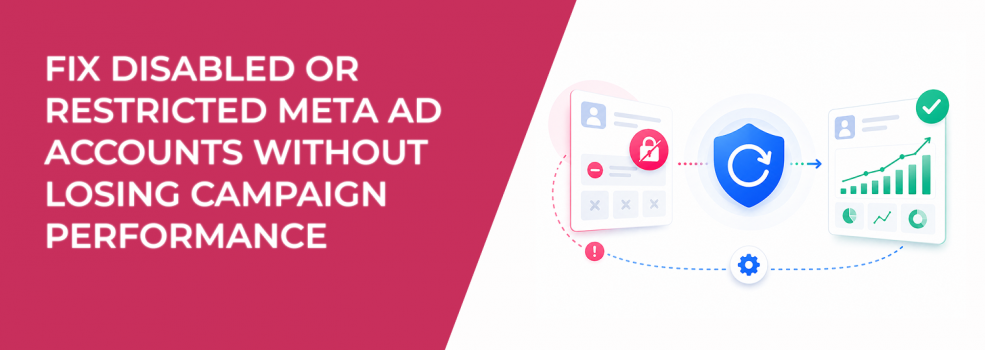
Campaigns rarely fail all at once. But a restricted or disabled Meta ad account changes that instantly.
Spend stops, learning resets, and your best audiences lose momentum within days.
For performance marketers, this is not just access loss. It directly affects revenue, data continuity, and scaling ability.
What Actually Happens When an Account Gets Restricted
Most restrictions are triggered automatically. Meta flags behavior that looks risky, inconsistent, or non-compliant.
In practice, the system limits account functionality rather than shutting everything down immediately.
Typical symptoms include:
- Ads repeatedly rejected even after edits.
- Campaigns active but not delivering impressions.
- Billing or verification checks blocking activity.
- Partial loss of access to assets or tools.
The key issue is not visibility. It’s disruption of signal flow.
Once campaigns stop feeding conversion data, the algorithm loses its recent learning context. That’s where performance damage begins.
Why This Directly Affects Campaign Performance
When an account gets restricted, three systems break at the same time.
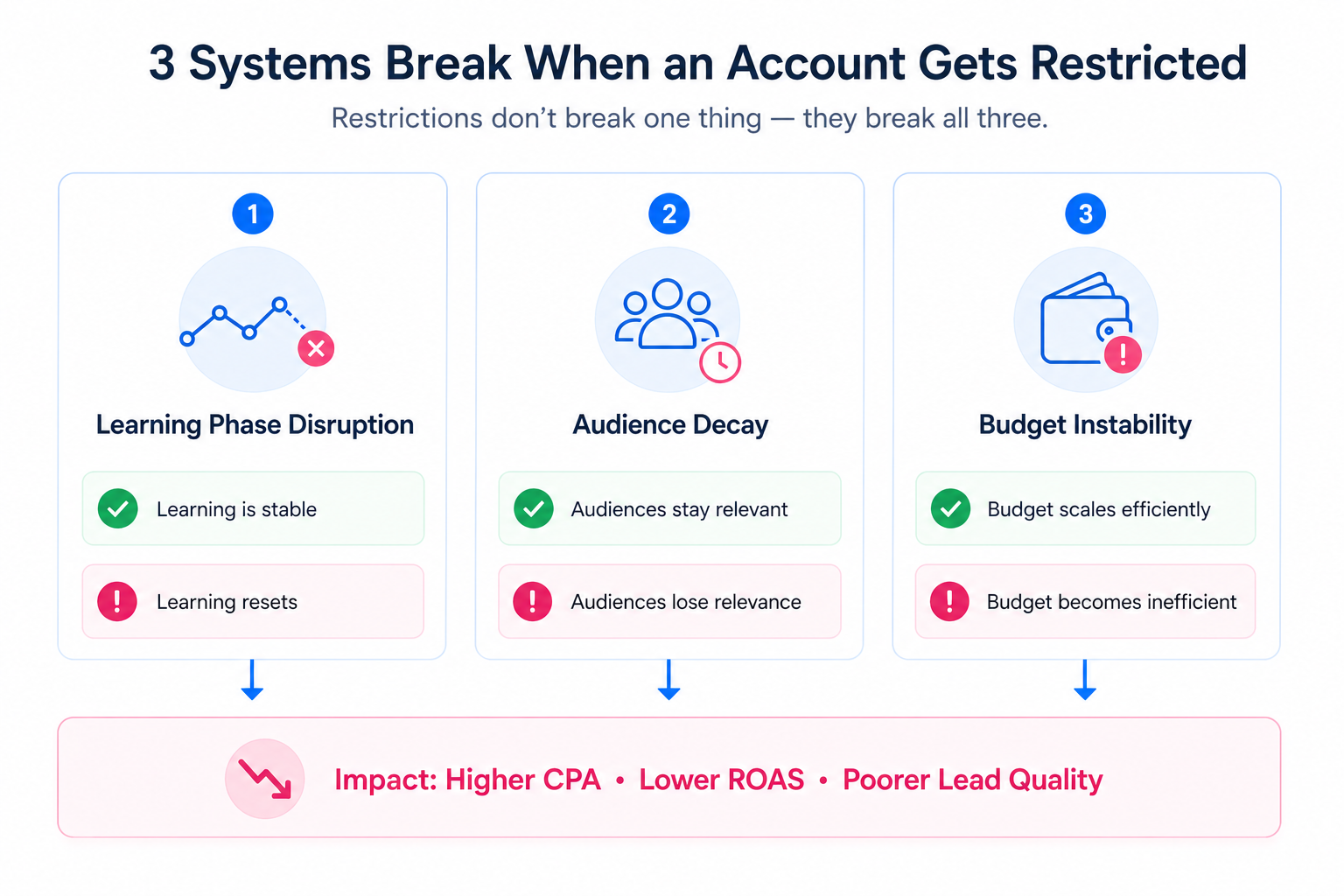
Learning phase disruption
Meta relies on continuous conversion signals to optimize delivery.
When that flow stops, the system loses confidence in who to target. Campaigns often re-enter learning, and costs increase when they restart.
Audience decay
Retargeting audiences are time-sensitive.
High-intent users quickly fall out of short windows, especially in ecommerce or lead generation funnels. By the time campaigns resume, those users are no longer “warm.”
Budget instability
After recovery, Meta reallocates budget cautiously.
Instead of scaling proven segments, it re-tests audiences. This often leads to unstable CPMs and inefficient spend during the first days of recovery.
Business Impact: Where the Loss Actually Happens
The visible loss is straightforward: campaigns stop spending.
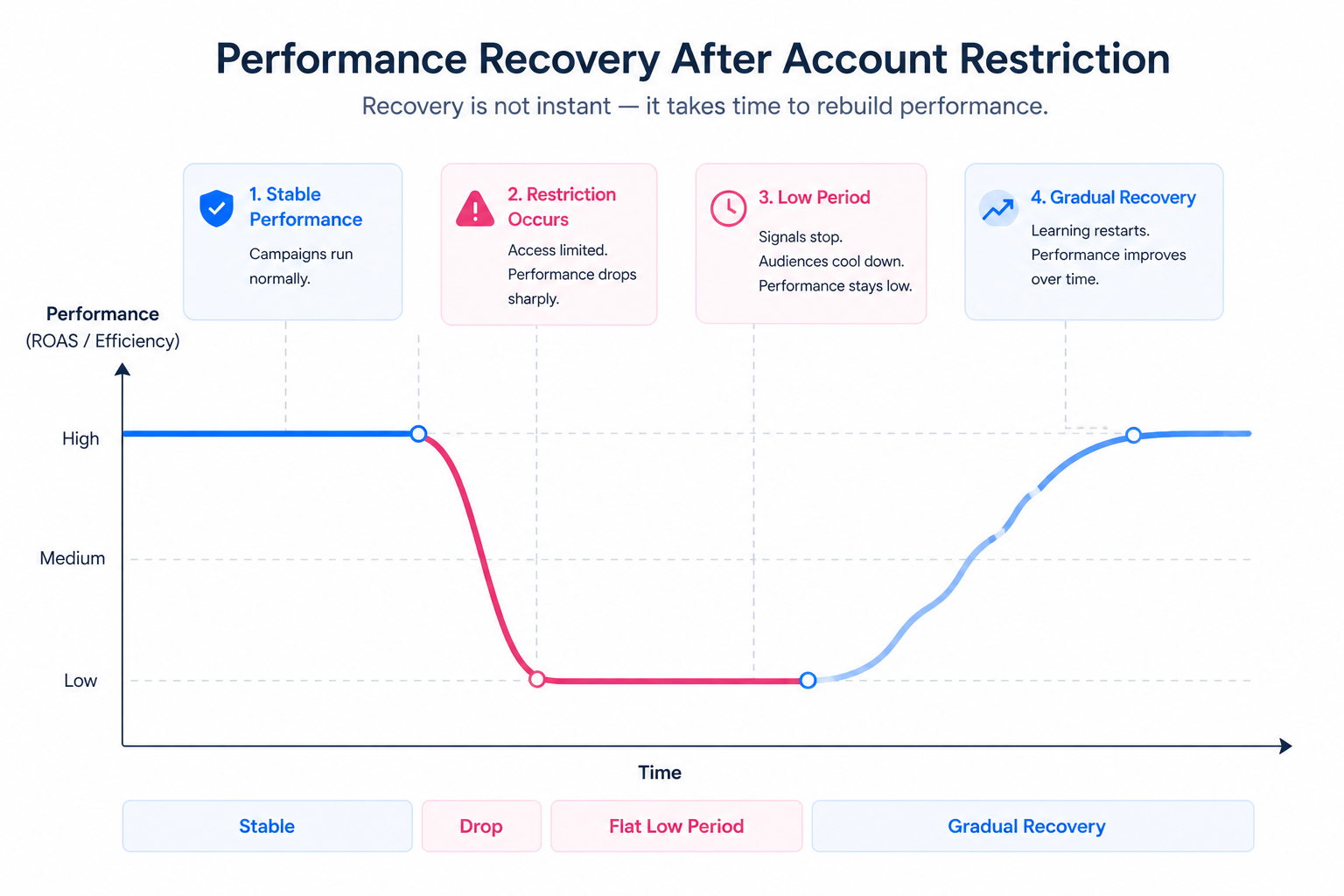
The deeper impact is more expensive and slower to recover.
- CAC increases because campaigns must relearn.
- ROAS drops due to weaker audience prioritization.
- Lead quality declines as signal strength fades.
- Testing slows because campaigns need stabilization first.
This is why recovery is rarely immediate. Even after access returns, performance needs time to rebuild.
Typical Scenarios Where This Happens
Most restrictions follow predictable patterns.
You’ll often see them in accounts that scale aggressively, operate across multiple clients, or lack stable verification signals.
If you want to prevent future issues, it’s worth reviewing how to avoid getting your Facebook ad account disabled
And if your account is already restricted, a structured recovery process like how to get your disabled Facebook ad account back
can help you avoid repeated mistakes.
Risks and What to Check Before Acting
Jumping into fixes without diagnosis often leads to repeated restrictions.
Before taking action, verify a few critical points:
- Identify whether the issue is policy-related, billing-related, or verification-related.
- Check if multiple assets (pages, ad accounts, datasets) are affected.
- Review recent campaign changes that may have triggered automated checks.
- Confirm whether access roles or permissions were modified.
Making large changes too early can reset learning again and delay recovery.
Practical Recommendations for Advertisers
Account restrictions should be treated as system-level signals, not isolated problems.
A more structured approach helps protect performance:
- Diagnose the root cause before making campaign changes.
- Preserve high-performing audiences and creatives wherever possible.
- Restart campaigns gradually instead of scaling aggressively.
- Build alternative audience sources to reduce dependency on one account.
You should also understand broader delivery issues that may look similar.
For example, common Facebook ad account and delivery issues
often overlap with restrictions but require different troubleshooting logic.
Final Takeaway
A disabled or restricted Meta ad account is not just an access issue. It resets your performance system.
The real cost comes from lost signals, broken learning cycles, and weakened audience quality.
Advertisers who recover fastest don’t just restore access. They rebuild structure, stabilize signals, and regain targeting precision.
That’s what protects performance over time.