The deprecation of third-party cookies marks one of the most significant structural shifts in digital marketing over the past decade. For years, advertisers relied on cross-site tracking to build audiences, personalize campaigns, and attribute conversions. That infrastructure is rapidly eroding due to browser restrictions, regulatory enforcement, and rising consumer expectations around privacy.
According to industry research, more than 60% of web traffic already occurs in environments where third-party cookies are restricted or blocked. Additionally, over 70% of consumers say they are more likely to trust brands that clearly explain how their data is used. The implications are clear: competitive advantage will increasingly depend on owned, consented, and intelligently activated first-party data.
What Is First-Party Data?
First-party data is information collected directly from users through owned digital properties and direct interactions. This includes:
-
Website behavior (page views, downloads, session duration)
-
CRM records (account details, deal stages, lifetime value)
-
Email engagement data
-
Product usage analytics
-
Form submissions and gated content interactions
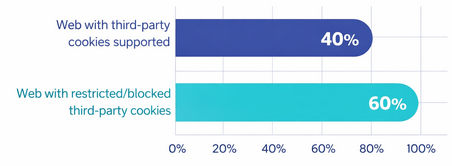
Percentage of web traffic where third-party cookies are restricted versus supported
Unlike third-party data, first-party data is deterministic, consent-based, and highly relevant to your specific business model. It offers higher signal fidelity and improved compliance with evolving privacy regulations.
Why First-Party Data Matters Now
1. Increased Signal Loss in Paid Media
With cookie deprecation, audience targeting precision in open web environments declines. Platforms compensate using modeled conversions and aggregated reporting, but deterministic visibility decreases.
2. Regulatory Pressure
Frameworks such as GDPR and CCPA have reshaped consent management and data governance. Organizations that rely on opaque third-party enrichment face higher compliance risk.
3. Performance Efficiency
Research shows that campaigns powered by first-party audience segments can achieve up to 2x higher return on ad spend compared to broad targeting strategies. Personalized messaging driven by owned behavioral signals increases conversion rates by 20–30% on average.
Building a Scalable First-Party Data Strategy
A successful transition requires more than installing tracking scripts. It demands infrastructure, segmentation logic, and activation workflows.
Step 1: Centralize Data Collection
Unify behavioral, transactional, and CRM data into a single structured environment. Data silos reduce match rates and weaken segmentation quality. A centralized database enables:
-
Account-level profiling
-
Cross-channel campaign coordination
-
Lifecycle-based messaging
Step 2: Prioritize Data Quality and Normalization
Raw data without normalization introduces duplicates, inconsistencies, and fragmented profiles. Implement:
-
Identity resolution processes
-
Standardized field formatting
-
Automated data validation
High-quality data increases audience match rates across advertising platforms and improves deliverability.
Step 3: Segment by Intent and Revenue Potential
Instead of demographic segmentation, shift toward behavioral and revenue-based segmentation:
-
High-intent visitors (repeat product page views)
-
Pipeline-stage accounts
-
Customers with expansion potential
-
Dormant but historically high-value users
Intent-driven segmentation significantly increases marketing efficiency by allocating budget toward accounts most likely to convert.
Step 4: Activate Across Channels
First-party data should inform:
-
Paid social audience creation
-
Email personalization workflows
-
Sales outreach prioritization
-
Lookalike audience modeling
When first-party audiences are synchronized across platforms, message consistency and frequency control improve.
Measuring Impact Post-Cookie Deprecation
Attribution models are evolving toward blended and modeled frameworks. However, organizations leveraging structured first-party data report:
-
Improved pipeline visibility
-
Reduced customer acquisition cost
-
Stronger account-level attribution accuracy
-
Higher retention through lifecycle marketing
Incrementality testing, server-side tracking, and CRM-based revenue attribution should replace last-click dependency.
Competitive Differentiation Through Owned Data
The removal of third-party cookies is not a loss of capability; it is a shift in ownership. Companies that invest in first-party ecosystems gain:
-
Long-term data sovereignty
-
Stronger compliance posture
-
Sustainable targeting precision
-
Higher customer trust
The organizations that treat data as infrastructure rather than campaign fuel will dominate performance marketing in the next decade.
Conclusion
Cookie deprecation is accelerating a transition already underway: from rented audiences to owned intelligence. First-party data enables deterministic targeting, privacy-compliant personalization, and revenue-based optimization. The sooner organizations centralize, normalize, and activate their owned data, the faster they will convert structural disruption into strategic advantage.