Even the most precise audience targeting cannot guarantee sustained advertising performance. Many campaigns experience declining engagement and conversion rates despite keeping the same audience parameters. This article explains why ad relevance deteriorates over time, the data behind the phenomenon, and how to systematically restore performance without changing your targeting criteria.
Marketers often assume that if targeting remains constant, performance should remain stable. After all, if the audience definition does not change, why would results decline?
In practice, advertising performance frequently drops even when:
-
The audience segment is identical
-
Budget allocation remains stable
-
Bidding strategy is unchanged
-
Platform placement settings are consistent
The root cause is simple: audience exposure and perception evolve faster than targeting parameters. Relevance is dynamic, not static.
1. Ad Fatigue: The Primary Driver of Declining Relevance
Ad fatigue occurs when users are repeatedly exposed to the same creative. Over time, engagement decreases because novelty disappears.
According to industry benchmarks:
-
Click-through rates can decline by 15–25% after repeated exposure within the same audience segment.
-
Conversion rates may drop by up to 20% when frequency exceeds optimal thresholds.
-
High-performing creatives often peak within the first 7–14 days before performance tapers.
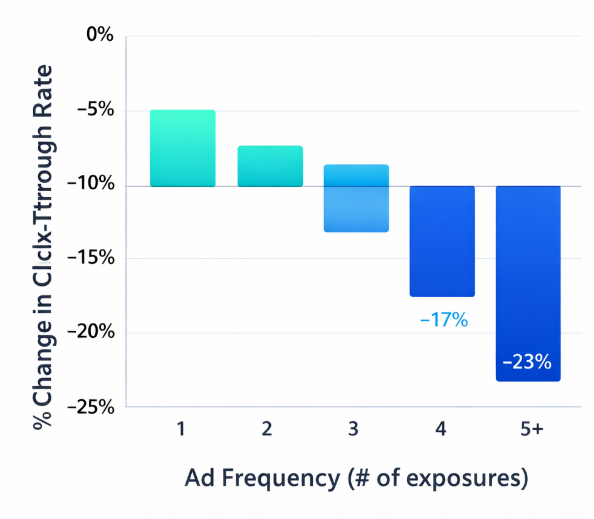
Click-through rate declines as ad frequency increases, demonstrating how repeated exposure reduces engagement
When targeting remains constant, frequency increases naturally. The same people see the same message multiple times. Even highly qualified prospects begin ignoring the ad.
Relevance score declines not because the audience changed, but because psychological response shifted.
2. Message Saturation Within Micro-Segments
Modern targeting tools enable extremely granular segmentation. However, smaller audiences saturate faster.
For example:
-
A 50,000-person B2B segment can reach 80% exposure within days under moderate spend.
-
Once 60–70% of the audience has seen the ad multiple times, incremental engagement becomes harder.
This creates diminishing returns. The targeting remains accurate, but opportunity volume shrinks.
In B2B environments, where decision-makers are limited and well-defined, saturation occurs even faster.
3. Market Context Changes While Targeting Does Not
Audience identity may remain constant, but external conditions evolve:
-
Budget cycles shift
-
Industry trends change
-
Competitor messaging adapts
-
Economic conditions fluctuate
Research shows that 64% of buyers report that timing and internal priorities impact purchasing decisions more than vendor messaging.
An ad that was highly relevant during Q1 planning cycles may become less relevant in Q3 execution phases.
Targeting stability does not equal contextual stability.
4. Algorithmic Learning Plateaus
Advertising platforms optimize delivery based on engagement signals. When engagement declines due to fatigue or saturation, algorithms adjust distribution patterns.
As a result:
-
CPM may increase
-
Reach may decrease
-
Engagement quality may drop
The audience definition remains the same, but the platform’s internal prioritization shifts because performance signals weaken.
This creates a feedback loop: lower engagement reduces optimized delivery, which further reduces performance.
5. Creative–Audience Misalignment Over Time
Audiences evolve in awareness level. A segment that initially required educational messaging may later need proof-driven or comparison-focused content.
Studies in buyer psychology indicate that B2B buyers consume an average of 10–13 pieces of content before making a purchasing decision.
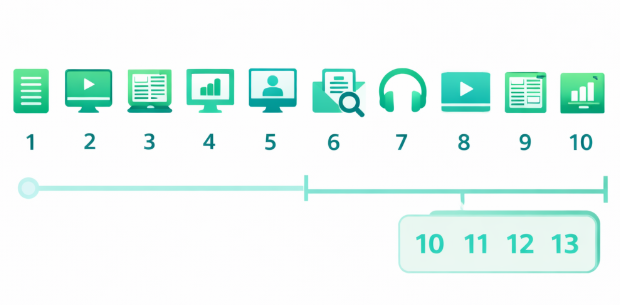
B2B buyers interact with 10 to 13 pieces of content before deciding to purchase — underscoring the need for evolving messaging
If the creative remains static while buyer awareness increases, the message becomes outdated relative to the audience’s position in the decision process.
Targeting remains correct. Messaging relevance does not.
6. Competitive Noise Accumulation
Over time, competitors enter the same audience pool with overlapping targeting.
When multiple advertisers compete for the same professional segment:
-
Auction pressure increases
-
Attention becomes fragmented
-
Differentiation becomes critical
Even if your targeting settings are unchanged, audience perception is influenced by the broader advertising environment.
Relevance is comparative, not absolute.
How to Restore Relevance Without Changing Targeting
If targeting precision is not the issue, optimization must occur elsewhere.
1. Rotate Creative Every 2–4 Weeks
Introduce variations in:
-
Headline framing
-
Visual hierarchy
-
Value proposition emphasis
-
Format (carousel, video, single image)
Creative refresh often restores engagement faster than expanding targeting.
2. Adjust Messaging to Match Buyer Stage
Segment messaging by:
-
Awareness level
-
Industry maturity
-
Decision-making role
Maintain the same targeting filters while aligning content to evolving buyer intent.
3. Monitor Frequency and Engagement Decay
Track:
-
Frequency thresholds
-
CTR trend lines
-
Conversion rate shifts
-
Cost per qualified lead
When frequency rises above optimal ranges and CTR drops by more than 15% from peak performance, creative refresh is typically required.
Conclusion
Advertising relevance declines even when targeting stays the same because:
-
Humans adapt to repetition
-
Markets evolve
-
Algorithms respond to engagement signals
-
Buyer intent shifts over time
Targeting defines who sees your ad. Relevance determines whether they care.
Sustainable performance requires continuous creative and messaging evolution, even within stable audience definitions.
Suggested Reading
For further insights on improving campaign efficiency and precision targeting strategies, explore:
A systematic approach to audience data, message alignment, and performance monitoring ensures that targeting accuracy translates into sustained advertising results.