The distance between a static prospect list and a scheduled sales call often determines whether pipeline targets are met or missed. According to industry research, over 40% of sales representatives report that prospecting is the most challenging part of the sales process. Meanwhile, studies consistently show that organizations responding to leads within the first five minutes are dramatically more likely to qualify them compared to those that delay outreach.
Despite these insights, many teams still operate with fragmented systems, outdated data, and inconsistent follow-up processes. The result: missed opportunities, low response rates, and inefficient use of sales resources.
This article presents a structured workflow that reduces friction, increases contact rates, and accelerates the transition from prospect identification to booked sales calls.
Step 1: Define the Ideal Customer Profile (ICP)
Every streamlined workflow begins with clarity. A prospect list without ICP alignment is simply a database.
Key ICP dimensions include:
-
Industry and sub-industry
-
Company size (employee count and revenue range)
-
Geographic focus
-
Technology stack
-
Decision-maker roles
-
Trigger events (funding, hiring growth, expansion)
Organizations that tightly align outreach with a documented ICP see up to 68% higher win rates compared to those targeting broadly. Precision at this stage prevents downstream inefficiencies.
Step 2: Build a Clean, Enriched Prospect List
Data quality directly impacts conversion performance. Research indicates that B2B contact databases decay at an average rate of 22–30% per year. Without enrichment and validation, outreach effectiveness deteriorates rapidly.
A high-performance prospect list should include:
-
Verified contact information
-
Direct decision-maker identification
-
Role-based segmentation
-
Firmographic and technographic data
-
Recent activity or trigger signals
Enrichment ensures relevance. Validation ensures deliverability. Together, they improve email engagement and call connection rates.
Step 3: Segment and Prioritize
Not all prospects deserve equal effort.
Segment based on:
-
Revenue potential
-
Strategic fit
-
Buying intent signals
-
Urgency indicators
A tiered approach (Tier 1, Tier 2, Tier 3 accounts) allows teams to allocate time strategically. Studies show that focused account prioritization can increase meeting booking rates by more than 30%.
Prioritization ensures that top-value prospects receive personalized outreach, while automation supports scalable engagement for broader segments.
Step 4: Align Messaging with Persona and Pain Points
Buyers respond to relevance, not volume. Personalized outreach can increase response rates by up to 32% compared to generic campaigns.
Effective messaging should:
-
Address specific industry challenges
-
Reference measurable outcomes
-
Demonstrate understanding of the prospect’s role
-
Provide clear next steps
Messaging alignment reduces friction and shortens the path to scheduling a call.
Step 5: Orchestrate Multi-Channel Outreach
Relying on a single channel limits performance. Multi-touch, multi-channel sequences consistently outperform single-channel campaigns.
An optimized sequence may include:
-
Email touchpoints
-
Direct phone calls
-
Social engagement
-
Follow-up reminders
Data shows that it often takes 6–8 touches before a prospect responds. Structured cadence increases visibility without overwhelming the contact.
Consistency across channels reinforces credibility and increases recall.
Step 6: Implement Speed-to-Lead Discipline
Timing influences conversion more than many teams realize.
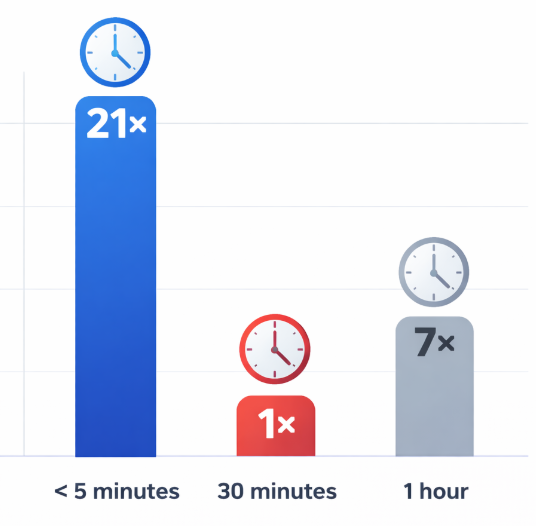
Comparison of lead qualification likelihood based on response time shows how contacting prospects within 5 minutes dramatically improves conversion rates compared to slower follow-ups
Organizations that contact leads within five minutes are up to 9 times more likely to convert them compared to those who wait 30 minutes or longer. Even in outbound workflows, rapid follow-up after engagement signals significantly improves booking rates.
Automated alerts and task routing reduce response delays and prevent qualified prospects from going cold.
Step 7: Track, Measure, Optimize
A streamlined workflow is measurable.
Key performance indicators include:
-
Contact rate
-
Response rate
-
Meeting booking rate
-
Call show rate
-
Pipeline conversion rate
Continuous optimization based on real metrics can improve outbound ROI by 15–25% over time. Analyze sequence performance, refine messaging, and eliminate bottlenecks.
Without measurement, efficiency cannot scale.
Common Bottlenecks That Slow the Workflow
Even well-designed processes fail when execution gaps appear. Typical friction points include:
-
Outdated contact data
-
Unclear account ownership
-
Lack of prioritization
-
Inconsistent follow-up
-
Poor CRM hygiene
Addressing these systematically ensures momentum from list creation to booked call.
The Compounding Effect of a Streamlined Workflow
When ICP clarity, data enrichment, segmentation, messaging, cadence, and measurement operate together, results compound:
-
Higher connect rates
-
Improved response quality
-
More qualified meetings
-
Shorter sales cycles
-
Stronger pipeline predictability
A prospect list becomes more than a static asset. It becomes a revenue engine.
Conclusion
The journey from prospect list to sales call is not accidental. It is engineered.
Teams that rely on fragmented tools and manual processes will continue to experience inconsistent outcomes. Those that implement a structured, data-driven workflow transform prospecting into a predictable system.
The competitive advantage lies not in having more contacts, but in converting the right contacts into conversations efficiently and consistently.
Recommended Reading
For further insights on improving prospecting performance and outbound efficiency, explore these related articles:
A structured approach to prospecting does not just increase activity — it increases impact.