
Audience Match (Customer List Custom Audiences) allows advertisers to upload first-party data—emails, phone numbers, names, locations—and match them with users on Meta platforms. However, the effectiveness of this strategy depends heavily on match quality.
Meta reports that well-prepared customer lists can reach match rates of 60–80%, while poorly formatted or outdated data may fall below 40%. A 20% improvement in match rate can translate into substantial gains in reach efficiency and lower acquisition costs.
Higher match quality leads to:
-
Larger usable audiences
-
Better seed audiences for Lookalikes
-
Lower CPM due to improved relevance signals
-
More stable performance in retargeting campaigns
1. Start with Data Hygiene and Standardization
Poor formatting is one of the most common causes of low match rates.
Normalize All Identifiers
-
Remove extra spaces
-
Standardize phone numbers to international format
-
Use lowercase for emails
-
Separate first and last names into distinct fields
Remove Invalid or Inactive Records
Bounce-prone or outdated records reduce match performance. Regularly validate email lists and suppress hard bounces.
Deduplicate Records
Duplicate entries dilute match efficiency and distort audience size reporting.
Data hygiene alone can improve match rates by 10–25% depending on list quality.
2. Enrich Customer Data Before Upload
Meta’s matching algorithm performs better when multiple identifiers are provided for each contact.
Uploading only email addresses limits match potential. Adding phone numbers, city, state, ZIP/postal code, first name, and last name significantly increases match probability.
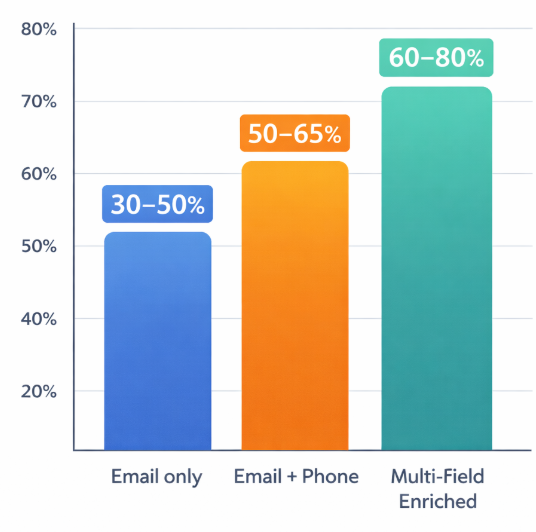
Comparison of audience match rates based on the number of identifiers provided — enriched multi-field lists consistently deliver higher match quality
Industry benchmarks show:
-
Single identifier (email only): 30–50% match rate
-
Two identifiers (email + phone): 50–65%
-
Multi-field enriched profiles: 60–80%
The more accurate and complete the dataset, the higher the deterministic match probability.
3. Segment Before You Upload
Uploading a single large, mixed-quality list reduces targeting precision.
Instead:
-
Separate active customers from cold leads
-
Segment by lifecycle stage
-
Isolate high-LTV customers
-
Create dedicated lists for recent purchasers (last 30/60/90 days)
Segmented lists create stronger seed audiences for Lookalike generation. According to Meta campaign performance benchmarks, Lookalikes built from high-value segments can outperform general lists by 20–35% in conversion rate.
4. Prioritize Recency and Engagement
Audience decay is real. Contact data older than 12–18 months typically produces significantly lower match rates due to account changes, abandoned emails, and inactive users.
Best practice:
-
Refresh custom audiences every 30 days
-
Prioritize users with activity in the last 180 days
-
Exclude stale leads from performance campaigns
Recency-weighted audiences consistently produce lower CPA and higher CTR compared to static legacy lists.
5. Optimize for Value-Based Lookalikes
Once match quality improves, the next leverage point is value optimization.
Upload customer lists with assigned lifetime value or revenue data. Value-based Lookalikes allow Meta’s algorithm to prioritize users similar to your highest-value customers rather than average ones.
Campaign studies show value-based audiences can increase ROAS by 10–30% compared to standard Lookalikes.
6. Monitor Match Rate Diagnostics
Inside Meta Ads Manager, monitor:
-
Match rate percentage
-
Audience size after processing
-
Overlap between audiences
If match rate drops below 50%, audit:
-
Formatting consistency
-
Identifier completeness
-
Recency of records
-
Country mismatches
Continuous diagnostics ensure audience integrity over time.
7. Align Audience Strategy with Campaign Objective
Match quality improvements must support campaign structure:
-
Retargeting: focus on recent, high-intent users
-
Prospecting: build Lookalikes from enriched, high-value segments
-
Retention: use segmented lifecycle-based lists
Audience precision directly impacts algorithmic learning. Clean, structured inputs produce more stable delivery and better cost efficiency.
Common Causes of Low Match Rates
-
Missing country codes in phone numbers
-
Uppercase/lowercase inconsistencies
-
Uploading hashed data incorrectly
-
Using outdated CRM exports
-
Overlapping geographic filters
Correcting these technical issues often yields immediate improvement.
Final Thoughts
Improving Audience Match quality in Meta Ads is not a one-time fix—it is an ongoing data discipline process. Clean formatting, multi-field enrichment, segmentation logic, and recency prioritization collectively determine campaign scalability.
As privacy regulations tighten and third-party tracking weakens, first-party data quality becomes the decisive competitive advantage in paid social advertising.
Continue Reading
To further improve campaign efficiency and data-driven targeting, explore these related topics: