Social media has evolved from a brand awareness channel into a high-impact demand generation environment. With over 5 billion global social media users and more than 80% of B2B buyers using social platforms during their decision-making process, the opportunity to capture active intent has never been greater.
However, most companies still approach social media targeting through demographic filters, job titles, or broad interest categories. While these inputs are useful, they do not capture purchase intent.
High-intent keyword targeting shifts the focus from who the audience is to what they are actively looking for. This distinction is critical for organizations seeking measurable revenue outcomes from social platforms.
What Are High-Intent Keywords?
High-intent keywords are search terms, phrases, or behavioral signals that indicate a strong likelihood of near-term purchasing activity.
They typically include:
-
Product comparison queries (e.g., "CRM vs marketing automation")
-
Solution-focused searches (e.g., "best B2B lead generation tools")
-
Problem-resolution queries (e.g., "how to automate outbound prospecting")
-
Brand-adjacent research (e.g., "enterprise sales engagement platform pricing")
Unlike informational keywords, high-intent keywords correlate with bottom-funnel activity and commercial evaluation.
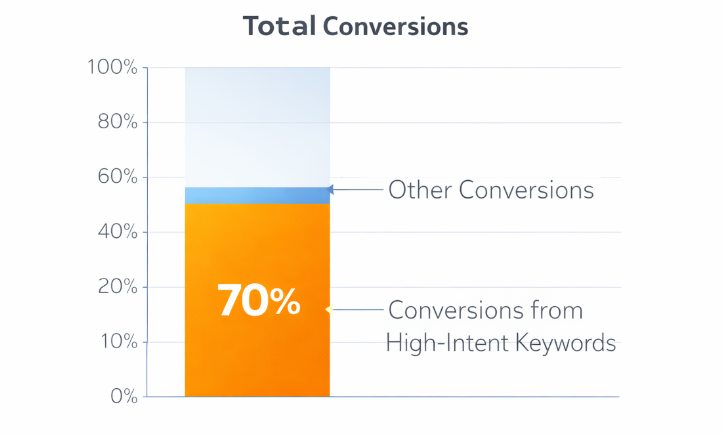
High-intent keywords contribute about 70% of total conversions in B2B campaigns, showing their impact on conversion quality
Research consistently shows that visitors driven by high-intent queries convert at 2–3x the rate of general awareness traffic. In B2B environments, intent-based targeting can reduce cost per acquisition by up to 33% compared to demographic-only campaigns.
Why Social Platforms Now Support Intent Targeting
Historically, keyword targeting was limited to search engines. Today, social platforms offer multiple intent data layers:
-
Search behavior within the platform
-
Engagement with industry-specific content
-
Group participation and topic affinity
-
Hashtag interactions
-
External browsing signals integrated through data partnerships
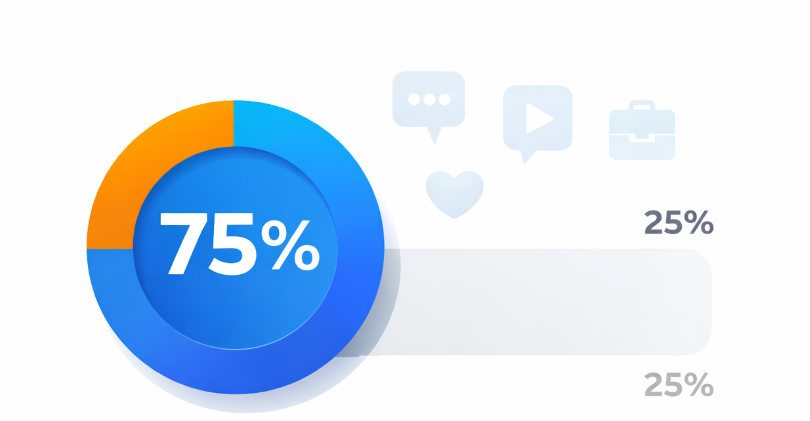
Three out of four B2B buyers use social media to inform or influence purchase decisions, underscoring the importance of intent signals on social platforms
For example, social advertising ecosystems increasingly allow targeting based on:
-
Professional interests and recent activity
-
Content consumption patterns
-
Industry conversations
-
Competitor engagement
This enables advertisers to intercept buyers earlier in the research cycle, often before they perform a formal search.
The Strategic Advantage in B2B
B2B buying cycles are complex. On average:
-
6 to 10 stakeholders participate in a typical B2B purchase decision
-
70% of the buyer journey is completed before direct sales contact
-
77% of B2B buyers conduct independent research before speaking to a vendor
High-intent keyword targeting allows marketers to align messaging with the evaluation stage of the buying committee.
Instead of broadcasting broad value propositions, campaigns can focus on:
-
Competitive differentiation
-
ROI justification
-
Integration capabilities
-
Compliance and security assurances
The result is higher engagement quality, shorter sales cycles, and improved opportunity win rates.
How to Implement High-Intent Targeting on Social Platforms
1. Identify Bottom-Funnel Keyword Clusters
Begin with sales-driven keyword discovery rather than SEO-only research. Sources include:
-
Sales call transcripts
-
Demo request forms
-
Customer success queries
-
Competitive comparison pages
Group keywords into intent tiers:
-
Evaluation intent
-
Solution intent
-
Replacement intent
-
Urgency-driven intent
This classification ensures message-to-intent alignment.
2. Map Keywords to Audience Signals
High-intent keywords must translate into platform-specific targeting signals.
Examples include:
-
Targeting users engaging with industry solution content
-
Building audiences from website visitors viewing pricing pages
-
Retargeting users who consumed comparison-related content
-
Leveraging first-party behavioral data to refine segments
The objective is to replicate search-level intent inside social ecosystems.
3. Align Creative With Decision-Stage Psychology
High-intent audiences expect specificity. Creative should include:
-
Clear outcome statements
-
Data-backed performance claims
-
Direct competitive positioning
-
Transparent pricing signals
-
Strong calls to action
Generic awareness messaging underperforms in high-intent segments.
Campaign data across multiple industries shows that decision-stage messaging can increase click-through rates by 40% compared to generic brand content.
4. Integrate First-Party and CRM Data
Intent targeting becomes significantly more powerful when layered with first-party data.
By integrating:
-
CRM pipeline stages
-
Existing customer exclusion lists
-
Lookalike audiences derived from closed-won accounts
marketers can concentrate spend on accounts statistically similar to revenue-generating customers.
Account-based overlays combined with keyword-driven segmentation often produce higher return on ad spend compared to standalone prospecting campaigns.
Measurement Framework for Intent Campaigns
Standard vanity metrics are insufficient for high-intent targeting.
Key performance indicators should include:
-
Marketing qualified leads (MQLs)
-
Sales accepted leads (SALs)
-
Opportunity creation rate
-
Pipeline value influenced
-
Cost per qualified opportunity
Organizations that adopt revenue-based attribution models report up to 20% higher marketing ROI compared to lead-volume-focused approaches.
Common Mistakes to Avoid
-
Treating intent as static rather than dynamic
-
Using overly broad keyword categories
-
Failing to adjust messaging by funnel stage
-
Ignoring negative intent signals
-
Optimizing only for click-through rate
High-intent targeting requires continuous refinement based on behavioral and revenue data.
The Future of Social Intent Targeting
As privacy regulations reshape third-party tracking, first-party data and contextual behavioral modeling will define competitive advantage.
Artificial intelligence increasingly identifies micro-signals of buyer readiness, including content engagement velocity, topic clustering, and cross-platform activity correlation.
Organizations that combine high-intent keyword frameworks with structured social data enrichment will create more predictable and scalable pipeline generation systems.
Conclusion
High-intent keyword targeting transforms social platforms from passive brand channels into measurable revenue engines.
By focusing on buyer signals rather than demographic assumptions, marketers can:
-
Increase conversion rates
-
Improve pipeline quality
-
Reduce acquisition costs
-
Accelerate sales cycles
Social media no longer serves only awareness objectives. When powered by intent data, it becomes a strategic driver of growth.
Recommended Reading
To continue exploring advanced B2B targeting strategies, consider reading: