
Marketing teams increasingly rely on incrementality testing to understand whether campaigns truly generate additional conversions or simply capture demand that would have happened anyway. Traditional attribution models often overestimate impact because they cannot isolate causal effects.
Two of the most widely used incrementality frameworks are holdout tests and geo experiments. While both are designed to measure causal lift, they differ significantly in methodology, cost, complexity, and accuracy depending on the marketing environment.
Choosing the correct model is essential for obtaining reliable insights and avoiding misleading conclusions.
What Are Holdout Tests?
Holdout testing measures incremental lift by withholding marketing exposure from a controlled segment of the audience and comparing its performance against the exposed group.
In practice, a percentage of users are intentionally excluded from a campaign. The difference in conversion rates between the exposed and holdout groups represents the incremental impact.
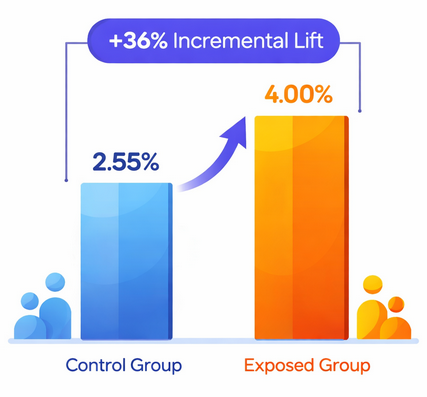
Example of incremental lift measured with a holdout test: comparing conversion rates between exposed and control audiences reveals the conversions directly caused by marketing activity
For example, if 10% of an audience is placed into a holdout group and that group shows a conversion rate of 2% compared to 3% in the exposed group, the campaign's incremental lift can be calculated from the difference.
Key Advantages of Holdout Tests
High precision at the user level
Holdout experiments allow marketers to measure lift on individual users or accounts, which improves statistical accuracy.
Relatively quick implementation
Many marketing platforms support audience exclusions, making holdout testing easier to deploy.
Granular insights
Marketers can analyze results by audience segment, campaign, or creative.
Limitations of Holdout Tests
Audience contamination risk
Users in the holdout group may still be indirectly exposed to marketing through other channels.
Limited channel compatibility
Certain channels, such as programmatic display or CTV, may not support strict holdout structures.
Operational complexity at scale
Managing multiple holdout segments across campaigns can become difficult in large organizations.
According to industry research, user-level holdout testing can reduce attribution bias by up to 30–40% compared to traditional last-click models.
What Are Geo Experiments?
Geo experiments measure marketing incrementality by activating campaigns in selected geographic regions while withholding them from others. The performance differences between test and control regions indicate the incremental impact.
For example, a campaign may run in five cities while five similar cities serve as a control group.
Key Advantages of Geo Experiments
Strong causal measurement
Because entire regions are isolated from campaign exposure, geo tests often produce clearer causal signals.
Channel flexibility
Geo experiments work well for channels where user-level holdouts are difficult, including TV, radio, outdoor advertising, and large-scale digital campaigns.
Reduced cross-channel contamination
Regional isolation can limit overlap from other campaigns.
Limitations of Geo Experiments
Higher cost
Running campaigns in limited regions while excluding others can reduce overall reach and efficiency.
Slower execution
Geo experiments often require weeks or months to gather statistically significant data.
Regional variability
Economic conditions, competition, and demographics can influence performance differences.
Research from marketing measurement studies suggests geo experiments typically require 20–30% larger sample sizes than user-level experiments to achieve statistical significance.
Key Differences Between Holdout Tests and Geo Experiments
| Factor | Holdout Tests | Geo Experiments |
|---|---|---|
| Measurement level | User or account level | Regional level |
| Implementation speed | Faster | Slower |
| Cost efficiency | Higher | Lower |
| Channel coverage | Limited for some channels | Works across most channels |
| Statistical power | Strong with large audiences | Requires larger samples |
In many organizations, the most reliable measurement frameworks combine both methods depending on channel characteristics and campaign scale.
When to Use Holdout Tests
Holdout tests are best suited for:
-
Digital advertising platforms with audience-level targeting
-
Email and CRM campaigns
-
Retargeting campaigns
-
Marketing automation programs
They are particularly effective when marketers have precise audience segmentation and sufficient traffic to generate statistically meaningful results.
When to Use Geo Experiments
Geo experiments are ideal when:
-
Campaigns run across multiple marketing channels
-
Offline media such as TV or radio is involved
-
User-level exclusion is technically impossible
-
The goal is to measure large-scale marketing impact
Many large brands use geo testing to evaluate budget shifts or new market launches.
Statistical Considerations
Reliable incrementality testing requires careful experiment design. Several statistical factors influence accuracy.
Sample size
Experiments must include enough users or regions to detect meaningful differences.
Test duration
Most incrementality experiments run between two and eight weeks depending on traffic levels.
Baseline stability
Pre-test performance should be stable to ensure that changes are caused by the campaign rather than external fluctuations.
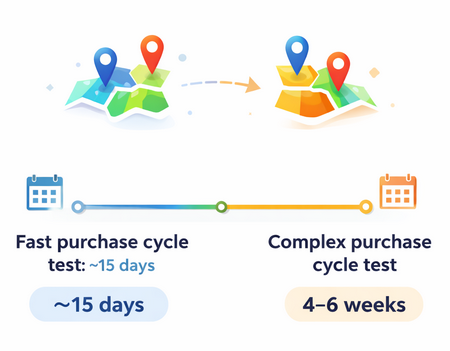
Typical duration of geo experiments: shorter buying cycles may require about two weeks of testing, while more complex markets often need four to six weeks to reach reliable results
Studies from marketing analytics research indicate that improperly designed experiments can overestimate marketing lift by more than 50%.
Building a Reliable Incrementality Strategy
Rather than relying on a single testing method, many advanced marketing teams build layered measurement strategies.
Typical frameworks include:
-
User-level holdout testing for performance channels
-
Geo experiments for large-scale campaigns
-
Continuous experimentation cycles to validate results
Organizations that regularly run incrementality tests often report significantly improved budget allocation decisions and more accurate ROI measurement.
Conclusion
Both holdout tests and geo experiments play a critical role in modern marketing measurement. While holdout testing offers precision and faster results, geo experiments provide broader causal insights across channels that cannot support user-level controls.
The most effective approach depends on campaign scale, channel mix, and available data. By selecting the appropriate incrementality model and designing experiments carefully, marketing teams can move closer to understanding the true impact of their investments.