Lead scoring has long been a cornerstone of effective sales and marketing alignment. By ranking prospects based on their likelihood to convert, organizations can allocate resources more efficiently and increase conversion rates. However, traditional lead scoring models often rely on static rules and limited datasets, which can lead to inaccuracies and missed opportunities.
Artificial intelligence (AI) introduces a new paradigm. By leveraging machine learning algorithms, predictive analytics, and large-scale data processing, AI-driven lead scoring systems continuously learn and adapt—resulting in significantly improved accuracy.
The Limitations of Traditional Lead Scoring
Traditional lead scoring models typically assign points based on predefined criteria such as demographics, firmographics, and basic behavioral signals. While this approach provides a starting point, it suffers from several critical limitations:
-
Static rules: Manual scoring systems require frequent updates and fail to adapt in real time.
-
Limited data utilization: Only a subset of available data is used, ignoring valuable signals.
-
Human bias: Scores are influenced by assumptions that may not reflect actual buyer behavior.
According to research, nearly 79% of marketing leads never convert into sales, often due to ineffective lead qualification processes.
How AI Enhances Lead Scoring Accuracy
1. Data-Driven Insights at Scale
AI models can analyze vast datasets from multiple sources, including CRM systems, website interactions, email engagement, and third-party data providers. This allows for a more comprehensive understanding of each lead.
Organizations using AI-powered lead scoring report up to a 50% increase in lead-to-opportunity conversion rates.
2. Predictive Analytics
Machine learning algorithms identify patterns in historical data to predict future outcomes. Instead of relying on assumptions, AI determines which attributes and behaviors are most strongly correlated with conversion.
Predictive lead scoring can improve sales productivity by 20% or more, as teams focus only on the most promising opportunities.
3. Continuous Learning and Optimization
Unlike static models, AI systems continuously update their scoring criteria based on new data. This ensures that lead scores remain accurate even as market conditions and customer behaviors evolve.
Companies that adopt AI-driven scoring see up to a 30% reduction in customer acquisition costs due to better targeting.
4. Behavioral and Intent Signal Analysis
AI excels at interpreting complex behavioral signals, such as browsing patterns, content consumption, and engagement frequency. It can also incorporate intent data, revealing when prospects are actively researching solutions.
This level of insight allows sales teams to engage leads at the optimal moment, increasing conversion likelihood.
5. Elimination of Human Bias
By relying on data rather than assumptions, AI reduces subjective bias in lead evaluation. This results in more objective and reliable scoring outcomes.
Real-World Impact of AI-Driven Lead Scoring
Organizations that implement AI in lead scoring experience measurable improvements across key performance indicators:
-
Up to 40% higher close rates
-
25–35% increase in marketing ROI
-
30% shorter sales cycles
-
Improved alignment between sales and marketing teams
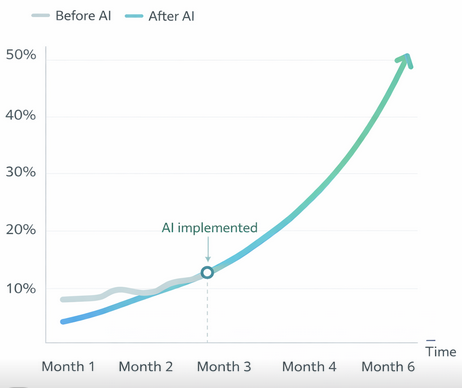
Adopting AI-powered lead scoring leads to steady and measurable increases in conversion rates over time
These benefits demonstrate how AI transforms lead scoring from a static process into a dynamic, revenue-driving system.
Best Practices for Implementing AI Lead Scoring
To maximize the effectiveness of AI-driven lead scoring, consider the following best practices:
-
Ensure data quality: Clean, accurate, and well-structured data is essential for reliable predictions.
-
Integrate multiple data sources: Combine CRM, marketing automation, and external data for a complete view of leads.
-
Align with sales teams: Collaborate to define success metrics and validate scoring models.
-
Monitor and refine models: Continuously evaluate performance and adjust as needed.
The Future of Lead Scoring
As AI technologies continue to evolve, lead scoring will become even more sophisticated. Advances in natural language processing, real-time analytics, and automated decision-making will further enhance accuracy and efficiency.
Organizations that embrace AI-driven lead scoring today will be better positioned to compete in increasingly data-driven markets.
Conclusion
AI is redefining lead scoring by replacing static, assumption-based models with dynamic, data-driven systems. By leveraging predictive analytics, continuous learning, and deep behavioral insights, businesses can significantly improve lead qualification accuracy and drive better outcomes.