Marketing automation has evolved from a convenience into a necessity. As customer journeys become more complex and multi-channel, businesses need workflows that can handle volume without sacrificing personalization.
According to industry research, 76% of companies report a positive ROI within the first year of implementing marketing automation, while organizations that use automation for lead nurturing generate 50% more sales-ready leads at 33% lower cost. These numbers highlight a clear reality: scalable workflows are a competitive advantage.
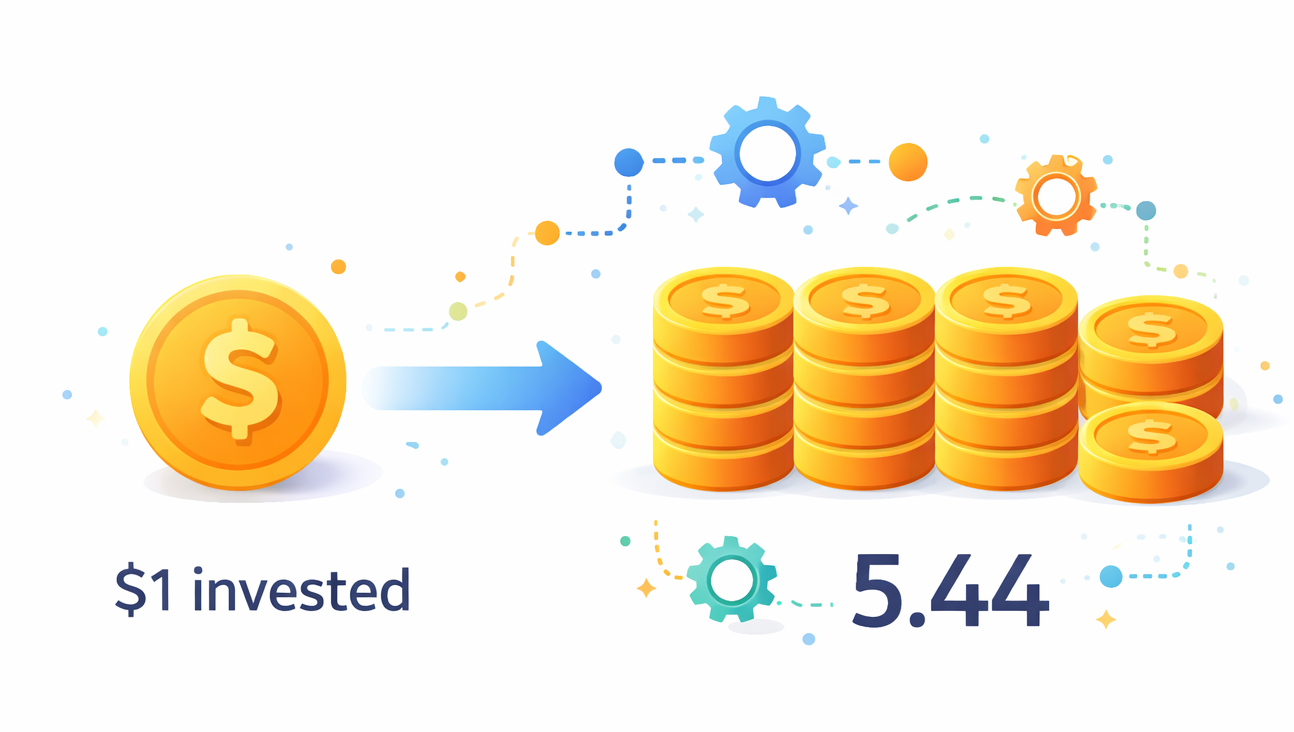
Marketing automation delivers an average return of $5.44 for every $1 invested
This article explores how to design marketing automation workflows that scale effectively, maintain performance, and deliver measurable results.
What Makes a Workflow Scalable?
A scalable marketing automation workflow is not just about handling more leads—it’s about maintaining efficiency, relevance, and performance as complexity grows.
Key characteristics include:
-
Modularity: Workflows are built in reusable blocks rather than rigid sequences
-
Data-driven logic: Decisions are based on behavioral and firmographic data
-
Dynamic personalization: Messaging adapts in real time
-
Performance monitoring: Continuous optimization based on metrics
Without these elements, workflows tend to break down as volume increases.
Core Components of Scalable Workflows
1. Segmentation Framework
Effective segmentation is the foundation of scalable automation. Instead of static lists, scalable systems rely on dynamic segmentation driven by:
-
Behavioral triggers (page visits, clicks, downloads)
-
Lifecycle stage
-
Industry or company size
-
Engagement level
Companies using advanced segmentation report up to a 760% increase in revenue from targeted campaigns.
2. Trigger-Based Logic
Trigger-based workflows ensure that actions are timely and relevant. These triggers can include:
-
Form submissions
-
Website activity
-
Email engagement
-
CRM updates
The goal is to move from batch campaigns to real-time interaction.
3. Lead Scoring and Qualification
Scalable workflows depend on accurate lead prioritization. Lead scoring models assign value based on both explicit and implicit signals, allowing teams to focus on high-intent prospects.
Organizations that implement lead scoring experience a 77% increase in lead generation ROI.
4. Multi-Channel Orchestration
Modern workflows extend beyond email. Scalable automation integrates:
-
Email campaigns
-
Paid advertising audiences
-
CRM touchpoints
-
Sales outreach triggers
Consistency across channels improves conversion rates and reduces friction in the buyer journey.
Designing Workflows That Scale
Start with Lifecycle Mapping
Map the entire customer journey from awareness to conversion and retention. Identify key decision points and define what actions should occur at each stage.
Build for Flexibility
Avoid linear workflows where possible. Instead, design branching logic that adapts based on user behavior. This ensures the system remains effective even as new scenarios emerge.
Prioritize Data Quality
Automation is only as good as the data behind it. Ensure consistent data enrichment, validation, and synchronization across systems.
Poor data quality costs organizations an average of $12.9 million annually, making it one of the most critical risks in scaling automation.
Implement Feedback Loops
Continuously feed performance data back into the system. Metrics such as open rates, click-through rates, conversion rates, and pipeline velocity should inform workflow adjustments.
Common Pitfalls to Avoid
Even well-designed workflows can fail if certain risks are not addressed:
-
Over-automation leading to impersonal experiences
-
Lack of alignment between marketing and sales
-
Ignoring data hygiene
-
Building overly complex workflows that are difficult to maintain
Scalability requires balance—automation should enhance, not replace, strategic thinking.
Measuring Success
To evaluate whether your workflows truly scale, track the following metrics:
-
Lead-to-opportunity conversion rate
-
Customer acquisition cost (CAC)
-
Marketing-sourced revenue
-
Time to conversion
-
Engagement rates across channels
High-performing organizations consistently benchmark and refine these metrics to maintain growth.
Conclusion
Scalable marketing automation workflows are built on structure, data, and adaptability. By focusing on segmentation, trigger-based logic, lead scoring, and multi-channel orchestration, businesses can create systems that grow without losing effectiveness.
The goal is not just automation—it’s intelligent automation that evolves alongside your audience and market conditions.