Privacy regulations and evolving browser policies have transformed the way digital advertising tracking works. One of the most influential mechanisms in this shift is Consent Mode, which directly affects how platforms such as Meta measure ad performance.
Introduction
Accurate tracking is the foundation of effective advertising. Platforms like Meta rely heavily on event data from websites to measure conversions, optimize campaigns, and build audiences. However, privacy laws such as GDPR and increasing user awareness about data collection have led to the widespread adoption of consent banners and consent management platforms.
Consent Mode introduces a conditional data collection framework that changes how analytics and advertising tags behave depending on whether a user grants consent. While this approach helps businesses remain compliant with privacy regulations, it also affects the completeness and precision of ad performance data.
This article explores how Consent Mode works, why it impacts Meta Ads tracking accuracy, and what marketers should understand when interpreting their campaign data.
What Is Consent Mode
Consent Mode is a framework that adjusts the behavior of analytics and advertising tags based on a user's consent choices. When users interact with a consent banner, the website communicates their decision to tracking technologies.
Depending on the consent status, tags may operate in two different ways:
-
Full tracking mode when the user grants consent
-
Limited or modeled tracking when consent is denied
If consent is granted, tracking functions normally and user-level data can be collected and transmitted to advertising platforms. When consent is denied, identifiers such as cookies may not be stored, and the data that platforms receive becomes significantly more limited.
Why Meta Ads Tracking Depends on Website Signals
Meta’s advertising ecosystem depends on signals sent from websites through tracking technologies such as pixels and event APIs. These signals inform Meta about actions users perform after clicking an advertisement, including purchases, sign-ups, or other conversions.
Without sufficient event signals, Meta cannot reliably attribute conversions to specific campaigns or users. This affects several core advertising mechanisms:
-
Conversion tracking
-
Optimization algorithms
-
Retargeting audiences
-
Lookalike audience modeling
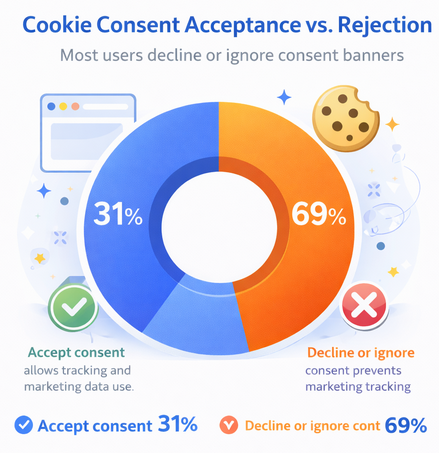
Majority of users decline or ignore cookie tracking consent, significantly reducing observable marketing data
Industry studies suggest that up to 30–50% of website visitors decline marketing cookies, depending on region and consent banner design. When this happens, platforms lose a substantial portion of the behavioral data they previously relied on for attribution.
How Consent Mode Reduces Tracking Accuracy
Consent Mode can significantly reduce the amount of observable conversion data available to advertising platforms. The impact occurs in several ways.
Loss of User Identifiers
When consent is not granted, tracking scripts may be prevented from storing advertising cookies. Without these identifiers, platforms cannot connect ad clicks with subsequent actions on the website.
This leads to underreported conversions and incomplete user journeys.
Modeled Conversions Instead of Observed Events
To compensate for missing data, platforms use statistical modeling. Modeled conversions estimate the number of conversions that likely occurred but could not be directly observed.
While modeling helps recover some insights, modeled data is inherently less precise than direct event tracking.
Delayed Attribution
Consent-related restrictions may cause platforms to rely on aggregated or delayed reporting systems. This can increase the time required for performance metrics to stabilize.
In practice, advertisers may see fluctuations in reported results several days after campaign activity occurs.
Key Statistics on Consent and Tracking Loss
Recent industry analyses illustrate the scale of tracking limitations caused by consent requirements:
-
Approximately 35–45% of European users decline marketing tracking when presented with consent banners.
-
Websites implementing strict consent mechanisms can lose up to 40% of observable conversion signals.
-
Advertisers report conversion undercounting between 15% and 30% when relying solely on browser-based tracking.
-
Server-based tracking approaches can recover 10–20% of otherwise lost events.
These numbers demonstrate why many marketing teams notice discrepancies between internal revenue data and reported advertising conversions.
Impact on Campaign Optimization
Meta’s delivery system uses machine learning algorithms trained on conversion signals. When the number of tracked conversions decreases, optimization efficiency can suffer.
Several consequences may occur:
-
Slower learning phases for campaigns
-
Reduced accuracy of conversion optimization
-
Less reliable audience expansion
-
Higher acquisition costs due to weaker signal quality
Meta recommends maintaining a steady flow of conversion signals to ensure algorithms have enough data for effective optimization.
Strategies to Mitigate Data Loss
Although Consent Mode introduces unavoidable limitations, advertisers can still improve data quality through several strategies.
Improve Event Coverage
Ensure all critical actions on the website are tracked as events. This includes purchases, leads, form submissions, and micro-conversions that help algorithms understand user intent.
Implement Server-Side Tracking
Server-side tracking sends event data directly from the website server rather than relying solely on browser scripts. This approach helps reduce signal loss caused by browser restrictions and cookie blocking.
Maintain Consistent Event Definitions
Conversion events should remain stable over time. Frequent changes in event names or parameters can disrupt learning algorithms and make performance analysis more difficult.
Interpreting Meta Ads Data Under Consent Constraints
Advertisers must adjust their expectations when analyzing campaign performance in a privacy-focused environment.
Instead of relying solely on platform-reported conversions, marketers should compare multiple data sources such as:
-
internal CRM or sales data
-
analytics platforms
-
advertising platform reports
This cross-analysis helps identify discrepancies and provides a more realistic understanding of campaign performance.
The Future of Privacy-First Advertising Measurement
Digital advertising measurement is shifting toward aggregated data, modeled conversions, and server-based tracking systems. Privacy regulations will likely continue shaping how user data can be collected and processed.
As a result, advertisers must adapt their tracking strategies and focus on building resilient measurement frameworks that can function effectively even when user-level data is limited.
Organizations that successfully adapt to this privacy-first environment will maintain better campaign performance visibility and more stable optimization outcomes.