Modern Facebook advertising relies heavily on event tracking to measure user actions such as purchases, sign-ups, and page views. With the introduction of parallel tracking via browser and server (Conversions API), deduplication ensures that the same event is not counted twice. However, when deduplication fails, advertisers may face inflated or inconsistent metrics that distort campaign evaluation.
What Is Event Deduplication?
Event deduplication is the process of ensuring that a single user action—such as a purchase—is recorded only once, even if it is sent through multiple tracking channels (e.g., Facebook Pixel and server-side API). This is typically done using a unique event ID shared between both sources.
When implemented correctly, deduplication improves data reliability. When implemented incorrectly, it introduces significant discrepancies.
How Deduplication Errors Occur
1. Missing or Mismatched Event IDs
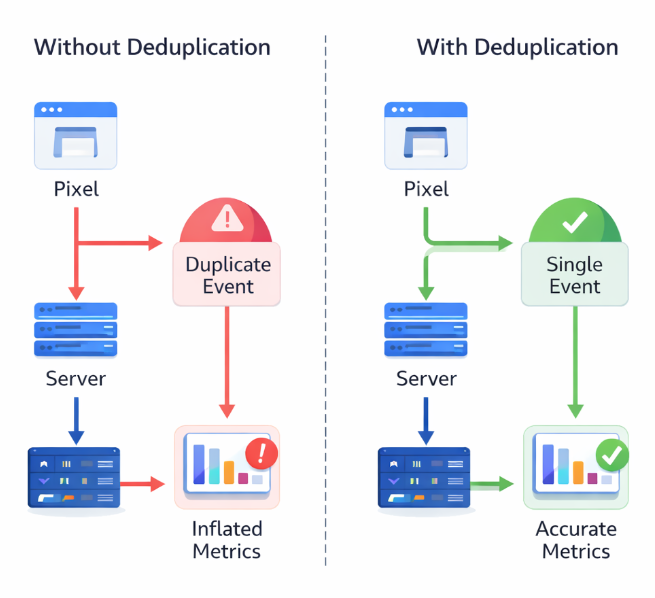
Without deduplication, parallel tracking can inflate conversions by up to 30%, distorting campaign performance data
If the browser and server events do not share the same event ID, Facebook treats them as separate events. This leads to double counting and inflated conversion numbers.
2. Timing Differences Between Events
If server-side events arrive significantly later than pixel events, the system may fail to recognize them as duplicates. Facebook typically allows a short time window for deduplication.
3. Inconsistent Event Parameters
Differences in event names, values, or metadata between sources can prevent proper matching, resulting in duplicate or dropped events.
4. Partial Tracking Setup
Some advertisers implement server-side tracking without properly configuring pixel tracking (or vice versa), creating gaps and overlaps in reporting.
The Impact on Performance Data
Inflated Conversion Rates
Studies show that improper deduplication can inflate conversion metrics by up to 15–30%, leading advertisers to overestimate campaign success.
Misleading Return on Ad Spend (ROAS)
When conversions are overcounted, ROAS appears higher than reality. This can result in scaling campaigns that are not actually profitable.
Budget Misallocation
Incorrect data leads to poor optimization decisions. Campaigns that seem effective may receive more budget, while genuinely high-performing segments are overlooked.
Audience Optimization Issues
Facebook’s algorithm relies on accurate event data to optimize delivery. Duplicated or inconsistent signals can degrade machine learning performance, reducing targeting efficiency.
Detecting Deduplication Problems
Compare Pixel vs. Server Events
Significant discrepancies between browser and server event counts may indicate deduplication issues.
Monitor Event Match Quality
Low match quality scores can signal problems with event consistency or missing identifiers.
Analyze Sudden Metric Spikes
Unexpected increases in conversions or ROAS without corresponding changes in traffic or spend often point to tracking errors.
Best Practices to Prevent Errors
1. Use Consistent Event IDs
Ensure that every event sent via both browser and server includes the same unique event ID.
2. Synchronize Event Timing
Minimize delays between pixel and server event transmission to stay within deduplication windows.
3. Standardize Event Parameters
Keep event names, values, and metadata consistent across all tracking sources.
4. Test Implementation Thoroughly
Use testing tools to verify that events are deduplicated correctly before scaling campaigns.
5. Monitor Continuously
Regular audits of tracking setup and performance data help identify issues early.
Real-World Implications
Advertisers who ignore deduplication issues often face a compounding problem: flawed data feeds into optimization algorithms, which then make increasingly inaccurate decisions. Over time, this can lead to declining campaign efficiency despite seemingly positive metrics.
According to industry benchmarks, advertisers who implement proper server-side tracking and deduplication see up to a 20% improvement in data accuracy and more stable campaign performance.
Conclusion
Event deduplication is not a technical detail—it is a critical component of reliable advertising analytics. Errors in this process can significantly distort performance data, leading to misguided strategies and financial loss. By ensuring consistent implementation and ongoing monitoring, advertisers can maintain accurate insights and make better-informed decisions.
Suggested Articles for Further Reading