Meta Ads campaigns rely heavily on machine learning to optimize delivery and achieve desired outcomes. During the learning phase, the algorithm explores different audience segments, placements, and bidding strategies to determine the most effective combinations. However, instability during this phase can result in unpredictable performance, increased costs, and reduced return on ad spend (ROAS).
Understanding the root causes of learning phase instability is essential for maintaining campaign efficiency and achieving scalable growth.
What Is the Learning Phase?
The learning phase is a period when Meta’s algorithm gathers data to optimize ad delivery. A campaign typically enters this phase when:
-
A new campaign, ad set, or ad is launched
-
Significant edits are made (budget, audience, creative, or optimization event)
Meta recommends achieving at least 50 optimization events per ad set within a 7-day window to exit the learning phase effectively.
Why Learning Phase Instability Happens
1. Insufficient Conversion Volume
Campaigns that fail to generate enough optimization events struggle to provide the algorithm with meaningful signals.
-
Ad sets with fewer than 50 conversions per week are more likely to remain unstable
-
Low data volume leads to inconsistent targeting and delivery
2. Frequent Campaign Edits
Every significant change resets or disrupts the learning phase.
Examples include:
-
Budget adjustments exceeding 20%
-
Changing targeting parameters
-
Editing creatives or placements
Frequent changes prevent the algorithm from stabilizing, causing performance fluctuations.
3. Audience Fragmentation
Splitting budgets across too many ad sets reduces data density.
-
Smaller audiences lead to limited optimization signals
-
Over-segmentation reduces delivery efficiency
4. Budget Constraints
Low budgets limit the number of impressions and conversions.
-
Campaigns with restricted budgets may take significantly longer to exit the learning phase
-
Cost per acquisition (CPA) often increases due to inefficient delivery
5. Competitive Auction Environment
Meta Ads operate within a dynamic auction system.
-
High competition increases CPMs and affects delivery consistency
-
Seasonal spikes (e.g., holidays) can intensify instability
Key Statistics
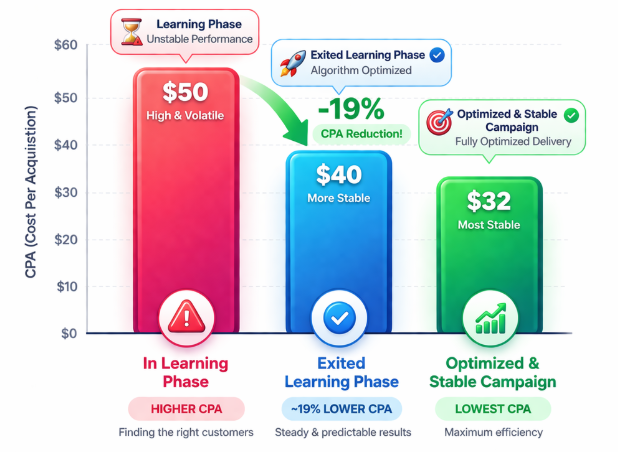
Exiting the learning phase leads to significantly lower acquisition costs and more predictable performance
-
Campaigns that exit the learning phase are up to 35% more cost-efficient compared to those that remain in it
-
Increasing conversion volume by 20% can improve delivery stability by up to 25%
-
Campaigns with fewer than 50 weekly conversions experience up to 50% higher CPA variability
-
Budget increases above 20% can reset the learning phase in most cases
Solutions to Stabilize Performance
1. Consolidate Campaign Structure
Avoid excessive segmentation. Instead:
-
Combine similar audiences
-
Reduce the number of ad sets
-
Focus budget on fewer, higher-performing segments
This improves data density and accelerates learning.
2. Optimize for Higher-Funnel Events (Temporarily)
If conversion volume is low:
-
Optimize for events such as "Add to Cart" or "View Content"
-
Transition to purchase optimization once sufficient data is collected
3. Increase Budget Strategically
-
Scale budgets gradually (no more than 20% at a time)
-
Ensure sufficient spend to generate at least 50 conversions per week
4. Limit Edits During Learning
Allow campaigns to stabilize before making adjustments.
Best practices:
-
Wait 3–5 days before evaluating performance
-
Avoid multiple changes simultaneously
5. Use Broad Targeting
Broader audiences provide more flexibility for the algorithm.
-
Enable automatic placements
-
Avoid over-restrictive targeting
6. Improve Creative Performance
High-quality creatives increase engagement and conversion rates.
-
Test multiple variations
-
Refresh creatives regularly without making excessive simultaneous changes
7. Monitor Auction Dynamics
-
Adjust bids and budgets during high-competition periods
-
Plan campaigns around seasonal demand fluctuations
Practical Example
A campaign generating only 20 conversions per week struggled to exit the learning phase. By consolidating three ad sets into one and increasing the budget by 15%, conversion volume reached 55 per week. As a result, CPA decreased by 28% and delivery stabilized within 6 days.
Conclusion
Learning phase instability is a common challenge in Meta Ads campaigns, but it is manageable with the right approach. By focusing on data volume, minimizing disruptions, and optimizing campaign structure, advertisers can achieve more consistent performance and better returns.
Recommended Articles for Further Reading