Meta’s advertising algorithm has shifted from audience-heavy targeting to a more creative-first optimization model. While audience signals still matter, the system increasingly relies on creative inputs—visuals, copy, and engagement patterns—to determine delivery, ranking, and cost efficiency.
Understanding how Meta evaluates creative signals is essential for marketers aiming to scale performance without over-reliance on manual targeting.
What Are Creative Signals?
Creative signals are data points extracted from ad creatives that help Meta predict user engagement and conversion likelihood. These include:
-
Image or video content
-
Text overlays and primary copy
-
Call-to-action elements
-
Format (carousel, video, static)
-
User interaction patterns
Meta analyzes these signals using machine learning models trained on billions of user interactions.
The Shift Toward Creative-First Optimization
Over the past few years, Meta has reduced reliance on detailed targeting. Campaigns using broad targeting combined with strong creatives often outperform narrowly targeted campaigns.
According to Meta internal insights, advertisers who diversified creative assets saw up to a 32% increase in conversion rates compared to those using limited variations. Additionally, campaigns with at least 5–7 creative variations experienced up to 15% lower cost per acquisition (CPA).
This shift indicates that creative quality and diversity are now primary drivers of performance.
How Meta Interprets Visual Elements
Meta’s algorithm uses computer vision to analyze images and videos. It identifies:
-
Objects and scenes
-
Colors and contrast
-
Brand elements
-
Human faces and emotions
Ads featuring human faces tend to generate higher engagement rates. In fact, studies show that creatives with people can increase click-through rates (CTR) by up to 20% compared to product-only visuals.
Video content is particularly favored. Video ads account for over 50% of time spent on Facebook and Instagram, and campaigns using video often see up to 30% higher engagement rates.
The Role of Text and Messaging
Natural language processing (NLP) allows Meta to interpret ad copy. The system evaluates:
-
Sentiment
-
Relevance to user interests
-
Clarity of value proposition
Short, clear, and benefit-driven messaging tends to perform best. Ads that communicate value within the first 3 seconds see significantly higher retention rates.
Meta also assesses alignment between text and visuals. Mismatched messaging can reduce delivery efficiency and increase costs.
Engagement as a Feedback Loop
Once an ad is live, Meta continuously evaluates user interactions:
-
Clicks
-
Likes and reactions
-
Comments
-
Shares
-
Conversions
This feedback loop helps the algorithm refine delivery. High engagement signals relevance, leading to increased impressions and lower CPM.
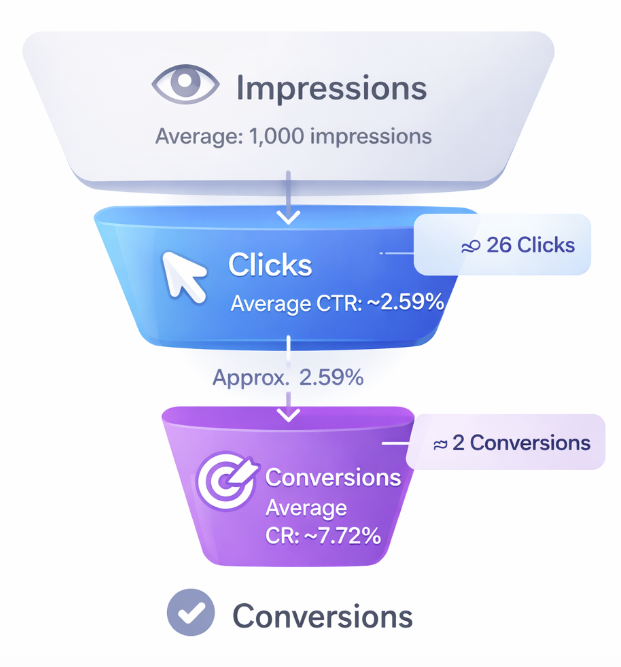
Meta’s algorithm continuously optimizes delivery based on user interactions, with measurable drop-offs from impressions to conversions
On average, ads in the top performance quartile achieve up to 2.5x higher engagement rates and 20–40% lower CPM compared to underperforming ads.
Creative Fatigue and Signal Decay
Creative fatigue occurs when users repeatedly see the same ad, leading to declining performance.
Indicators of fatigue include:
-
Rising frequency
-
Decreasing CTR
-
Increasing CPA
Data suggests that CTR can drop by up to 25% after the same creative is shown multiple times to the same audience.
To combat fatigue, advertisers should refresh creatives regularly and introduce variations.
Best Practices for Aligning with Meta’s Algorithm
1. Prioritize Creative Volume
Use multiple variations of visuals and copy. Aim for at least 5–10 creatives per ad set.
2. Test Different Formats
Experiment with video, carousel, and static formats to identify what resonates most.
3. Focus on Hook and First Impression
Capture attention within the first 2–3 seconds, especially for video ads.
4. Align Visuals and Messaging
Ensure consistency between what users see and what they read.
5. Monitor Performance Signals
Track CTR, CPM, and CPA to identify when creatives need refreshing.
6. Iterate Based on Data
Continuously test and refine creatives using performance insights.
The Future of Creative Signals
Meta is investing heavily in AI-driven creative optimization. Tools like automated creative testing and generative AI will further increase the importance of creative signals.
As targeting becomes more automated, the competitive advantage will shift toward those who can produce high-quality, data-driven creatives at scale.
Conclusion
Meta’s algorithm increasingly depends on creative signals to determine ad performance. Visual quality, messaging clarity, and user engagement all contribute to how ads are delivered and optimized.
Advertisers who embrace a creative-first strategy—focused on variation, testing, and alignment—will be better positioned to achieve sustainable results in Meta’s evolving ecosystem.
Suggested Articles