At first glance, splitting campaigns into numerous ad sets seems logical. It allows advertisers to test multiple audiences, creatives, placements, and bidding strategies simultaneously. The expectation is that more segmentation equals better insights.
In reality, this approach often leads to diluted data, increased competition within your own campaign, and inefficient budget allocation.
How Facebook’s Optimization Algorithm Works
Facebook’s delivery system relies heavily on machine learning to optimize ad performance. The algorithm requires sufficient data to exit the learning phase and begin stable optimization.
Each ad set enters a learning phase when it is created or significantly edited. According to Meta, an ad set typically needs around 50 optimization events (such as conversions) within a 7-day period to exit this phase.
When too many ad sets are created, each one receives only a fraction of the available budget and conversions. As a result, most ad sets remain stuck in the learning phase, preventing effective optimization.
Budget Fragmentation: The Core Problem
One of the biggest issues with excessive ad sets is budget fragmentation.
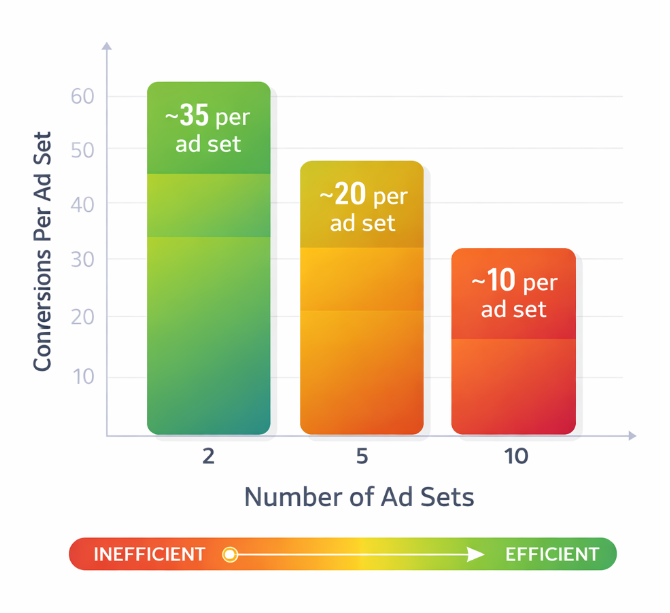
Splitting budget across too many ad sets reduces conversions per ad set, slowing optimization and increasing inefficiency
Instead of allocating a meaningful budget to a few high-potential audiences, advertisers spread their budget thinly across many ad sets. This leads to:
-
Insufficient data per ad set
-
Slower learning
-
Increased cost per result
-
Inconsistent performance
For example, if you have a daily budget of $100 and divide it across 10 ad sets, each ad set receives only $10. In most industries, this is not enough to generate the required 50 conversions per week for proper optimization.
Audience Overlap and Self-Competition
Another critical issue is audience overlap. When multiple ad sets target similar audiences, they end up competing against each other in the auction.
This internal competition can:
-
Drive up CPM (cost per thousand impressions)
-
Reduce delivery efficiency
-
Cause unpredictable performance fluctuations
Studies have shown that campaigns with high audience overlap can experience CPM increases of up to 20–30%, directly impacting ROI.
Learning Phase Reset and Instability
Every time an advertiser makes significant changes to an ad set—such as adjusting budget, targeting, or creatives—the learning phase resets.
With many ad sets running simultaneously, advertisers tend to make frequent adjustments, which continuously disrupts the optimization process.
As a result:
-
Performance becomes volatile
-
Scaling becomes difficult
-
Reliable insights are harder to obtain
Statistical Evidence: Why Fewer Ad Sets Perform Better
Multiple analyses across industries highlight the impact of consolidation:
-
Campaigns with consolidated ad sets achieve up to 25% lower cost per acquisition (CPA)
-
Advertisers using broader targeting with fewer ad sets see up to 30% faster exit from the learning phase
-
Increasing budget per ad set can improve conversion rates by 15–20% due to better algorithmic learning
These findings consistently support the principle that data density is more valuable than segmentation.
Best Practices to Avoid Slowing Down Optimization
To maximize performance, advertisers should focus on simplifying campaign structure and improving data flow.
1. Consolidate Ad Sets
Limit the number of ad sets to those that can realistically generate sufficient conversions. Focus on broader audiences rather than micro-segmentation.
2. Allocate Meaningful Budgets
Ensure each ad set has enough budget to generate at least 50 conversions per week. If that’s not possible, reduce the number of ad sets.
3. Minimize Overlap
Use audience exclusions and broader targeting strategies to reduce competition between ad sets.
4. Avoid Frequent Edits
Allow the algorithm time to learn. Avoid making frequent changes that reset the learning phase unless absolutely necessary.
5. Use Campaign Budget Optimization (CBO)
Let Facebook automatically distribute budget across ad sets based on performance, reducing the risks associated with manual budget fragmentation.
Conclusion
While creating multiple ad sets may seem like a strategy for gaining control and precision, it often produces the opposite effect. Too many ad sets dilute data, fragment budgets, and prevent Facebook’s algorithm from optimizing effectively.
A simplified structure with fewer, well-funded ad sets enables faster learning, more stable performance, and better overall results.
Recommended Reading