Meta’s algorithm is no longer just a content distribution system—it is a predictive engine designed to interpret user behavior and deliver highly personalized experiences. Every interaction, pause, click, and scroll contributes to a complex web of audience signals that determine what content gets seen and what gets ignored.
For marketers and businesses, understanding how these signals are interpreted is critical. Without this knowledge, even high-quality content can fail to reach its intended audience.
What Are Audience Signals?
Audience signals are behavioral and contextual data points collected from users across Meta platforms. These signals help the algorithm predict which content a user is most likely to engage with.
Key types of audience signals include:
-
Engagement signals: likes, comments, shares, saves
-
Consumption signals: watch time, dwell time, click-through behavior
-
Relationship signals: interactions with specific accounts or pages
-
Content-type preferences: video vs. image vs. text
-
Recency and activity patterns
According to industry data, posts that generate meaningful interactions (such as comments and shares) can see up to 3x higher reach compared to passive engagements like likes.
How Meta Prioritizes Content
Meta evaluates content using a ranking system that assigns value based on predicted user interest. The process typically involves three stages:
1. Inventory
All available content that could appear in a user’s feed is gathered. This includes posts from friends, pages, groups, and ads.
2. Signals Processing
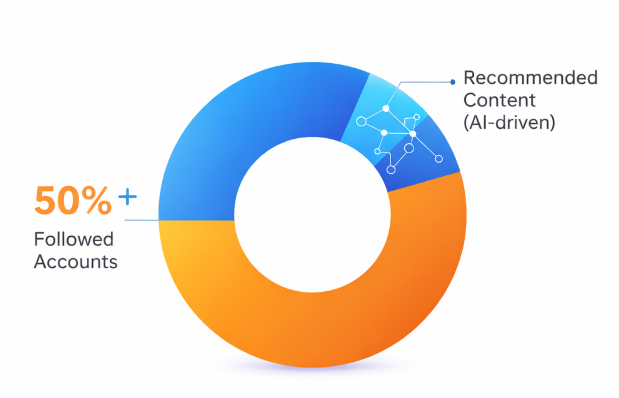
Meta’s algorithm increasingly prioritizes discovery—more than half of feed content now comes from accounts users don’t follow
The algorithm analyzes thousands of signals, including:
-
Past interactions with similar content
-
Time spent on related posts
-
Device and connection type
-
Content freshness
Meta has confirmed that it uses thousands of ranking signals, though only a subset has a significant impact on distribution.
3. Predictions and Scoring
The system predicts the likelihood that a user will:
-
Engage with the post
-
Spend time viewing it
-
Share or comment on it
Each post receives a relevance score. Higher scores increase the probability of appearing at the top of the feed.
The Weight of Different Signals
Not all signals are equal. Meta assigns varying importance depending on how strongly a signal indicates user interest.
-
Comments and shares carry significantly more weight than likes
-
Watch time is a dominant factor for video content
-
Saves indicate long-term value and are increasingly prioritized
-
Direct interactions (messages, replies) strengthen relationship signals
Research suggests that video content with high completion rates can achieve up to 40% more distribution compared to videos with low retention.
The Role of AI and Machine Learning
Meta relies heavily on machine learning models to continuously refine its understanding of user behavior. These models adapt in real time, meaning the algorithm evolves based on ongoing interactions.
This has several implications:
-
Performance is dynamic—what works today may not work tomorrow
-
Niche targeting is more effective than broad messaging
-
Consistency matters more than occasional viral success
Meta’s AI systems process billions of interactions daily, enabling hyper-personalized content delivery at scale.
Common Misconceptions
There are several myths about how Meta’s algorithm works:
-
Posting frequency alone does not guarantee reach
-
Hashtags have limited influence compared to engagement signals
-
Algorithm changes are continuous, not occasional major updates
-
Engagement pods and artificial interactions can reduce reach over time
Understanding these misconceptions helps avoid strategies that may harm long-term performance.
How to Optimize for Audience Signals
To align with Meta’s algorithm, businesses should focus on creating content that generates strong, meaningful signals.
Focus on Meaningful Engagement
Encourage conversations rather than passive reactions. Ask questions, create discussion points, and respond actively to comments.
Improve Content Retention
Structure content to capture attention early and maintain interest throughout. Strong hooks and clear narratives are essential.
Leverage Video Strategically
Short-form video continues to dominate engagement metrics. Prioritize formats that maximize watch time and completion rates.
Build Consistent Interaction Patterns
Regular posting combined with consistent engagement helps reinforce relationship signals with your audience.
Personalize Content
Segment your audience and tailor messaging to specific interests. Generic content performs significantly worse in algorithmic ranking.
The Future of Audience Signal Interpretation
Meta’s algorithm is moving toward deeper contextual understanding. This includes:
-
Increased emphasis on content relevance over popularity
-
Greater use of AI to interpret sentiment and intent
-
Expansion of predictive engagement modeling
As privacy regulations evolve, first-party engagement data will become even more valuable.
Conclusion
Meta’s algorithm is fundamentally driven by audience signals. Businesses that understand and optimize for these signals can significantly improve their visibility and engagement.
Success is no longer about gaming the system—it is about aligning with how the system interprets human behavior.
Further Reading