Ad relevance score is a critical metric in modern digital advertising ecosystems. It directly impacts cost-per-click (CPC), ad delivery, and overall campaign efficiency. Platforms reward highly relevant ads with better placements and lower costs. Research indicates that ads with higher relevance scores can achieve up to 50% lower CPC and up to 3 times higher click-through rates (CTR) compared to poorly matched ads.
Improving ad relevance is not a one-time optimization but a continuous process involving audience understanding, creative alignment, and performance feedback loops.
-
Build Deep Audience Intelligence
High relevance begins with precise audience understanding. According to industry data, 72% of marketers report that audience targeting is the most impactful factor in improving campaign performance.
Develop detailed audience segments using behavioral data, interests, purchase intent signals, and historical engagement patterns. Move beyond basic demographics and focus on intent-driven segmentation.
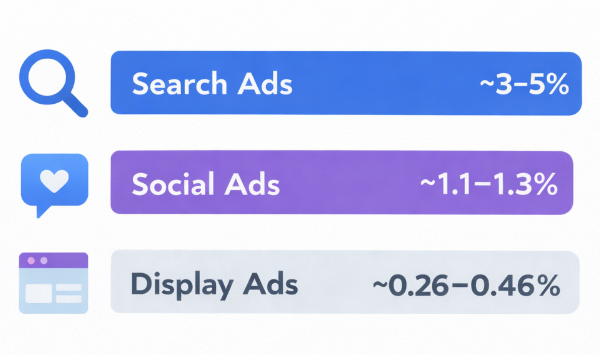
Click-through rates vary significantly across ad channels, highlighting the importance of targeting and relevance optimization
Leverage first-party data wherever possible. Users who have previously interacted with your brand are significantly more likely to engage with relevant messaging, often resulting in conversion rates that are 2–3 times higher than cold audiences.
-
Align Messaging with User Intent
Ad platforms prioritize content that matches what users are actively interested in. Misalignment between ad messaging and user expectations is one of the most common causes of low relevance scores.
Craft messaging that directly addresses the audience’s current needs, pain points, or goals. Use language that mirrors how your audience searches and communicates.
Segment campaigns by intent level:
-
Awareness stage: educational and problem-focused messaging
-
Consideration stage: solution-oriented positioning
-
Conversion stage: strong value propositions and calls to action
Ads aligned with user intent can increase engagement rates by over 2.5 times compared to generic messaging.
-
Continuously Test Creative Variations
Creative fatigue quickly reduces ad relevance. Regular A/B testing is essential to maintain performance.
Test variations in:
-
Headlines and hooks
-
Visual formats (static, video, carousel)
-
Copy length and tone
-
Calls to action
Data shows that advertisers who run continuous creative testing improve CTR by 20–40% over time. Small incremental improvements compound into significantly higher relevance scores.
-
Optimize Landing Page Experience
Ad relevance does not stop at the click. Platforms evaluate post-click experience, including landing page consistency and user behavior.
Ensure that:
-
The landing page matches the ad’s promise and messaging
-
Load speed is optimized (pages loading within 2 seconds see significantly higher engagement)
-
Content is structured clearly with a strong, visible call to action
Studies suggest that 70% of users are more likely to convert when landing page content closely aligns with the ad they clicked.
-
Use Feedback Signals to Refine Campaigns
Engagement metrics such as CTR, bounce rate, time on page, and conversion rate act as feedback loops for relevance.
Negative signals—such as low engagement or high bounce rates—indicate misalignment. Positive signals reinforce delivery and improve ad ranking within the auction.
Monitor performance frequently and make iterative adjustments. Even small optimizations based on real-time data can significantly improve relevance over time.
-
Refresh Audiences and Avoid Saturation
Repeated exposure to the same audience reduces engagement and lowers relevance scores. Frequency management is essential.
Rotate audiences, expand lookalike segments, and exclude users who have already converted. Maintaining freshness in both targeting and creative prevents performance decline.
Campaigns that actively manage frequency and audience expansion often sustain higher engagement rates and avoid the drop-offs associated with ad fatigue.
Conclusion
Improving ad relevance scores consistently requires a structured approach: deep audience understanding, precise messaging alignment, continuous creative testing, and strong post-click experiences. When these elements work together, advertisers benefit from lower costs, improved delivery, and stronger overall campaign performance.
Relevance is not static—it evolves with audience behavior, platform algorithms, and market conditions. Continuous optimization is the only way to maintain and improve results over time.