Product feed quality is one of the most influential yet underestimated factors in Facebook Ads performance. While many advertisers focus on creatives, targeting, and bidding strategies, the underlying product data often determines whether campaigns scale efficiently or stagnate.
A product feed acts as the backbone of dynamic ads. It supplies Facebook’s algorithm with structured information about your products—titles, descriptions, images, availability, pricing, and more. When this data is incomplete, inconsistent, or poorly optimized, it restricts the platform’s ability to match products with relevant audiences.
Why Product Feed Quality Matters
Facebook’s ad delivery system relies heavily on machine learning. High-quality feeds provide richer signals, enabling the algorithm to better understand products and serve them to users with higher purchase intent.
According to industry benchmarks, advertisers who optimize product titles and descriptions can see up to a 20–30% increase in click-through rates (CTR). Additionally, clean and accurate feeds reduce disapprovals and improve delivery consistency, which can increase return on ad spend (ROAS) by 15–25%.
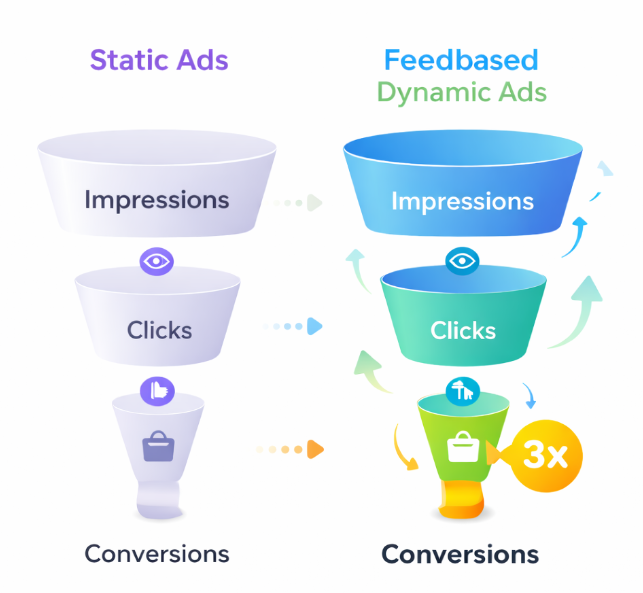
Personalized product feed data enables significantly higher conversion rates compared to static advertising
Poor feed quality, on the other hand, leads to:
-
Limited product visibility
-
Lower relevance scores
-
Increased cost per acquisition (CPA)
-
Higher likelihood of ad disapprovals
Key Elements of a High-Quality Product Feed
1. Accurate and Descriptive Product Titles
Product titles should include essential attributes such as brand, product type, key features, and variations (size, color, model). Clear titles help Facebook match products with user queries and interests.
For example, a title like “Running Shoes” is far less effective than “Men’s Nike Air Zoom Pegasus 40 Running Shoes – Black, Size 10.”
2. High-Resolution Images
Visual quality plays a critical role in engagement. Facebook recommends using images with at least 1024 x 1024 resolution. High-quality visuals can improve CTR by up to 40% compared to low-quality images.
Avoid:
-
Watermarks
-
Text overlays
-
Poor lighting or cluttered backgrounds
3. Consistent and Up-to-Date Pricing
Price mismatches between ads and landing pages are a common cause of disapprovals. Keeping pricing accurate and synchronized ensures smoother campaign delivery and maintains user trust.
4. Detailed Product Descriptions
Descriptions should include relevant keywords and product specifications. This helps the algorithm better categorize products and improves matching accuracy.
Well-optimized descriptions can contribute to a 10–15% improvement in conversion rates.
5. Availability and Inventory Accuracy
Out-of-stock products in feeds lead to wasted ad spend and poor user experience. Regular updates ensure that only available products are promoted.
The Impact on Facebook Ads Performance
Improved Targeting Precision
High-quality feeds enable Facebook to build stronger connections between products and user behavior. This leads to better audience matching and higher engagement rates.
Enhanced Dynamic Ad Performance
Dynamic Product Ads (DPAs) rely entirely on feed data. When feeds are optimized, DPAs can deliver highly personalized experiences, increasing conversion rates by up to 20%.
Lower Costs and Higher Efficiency
Better relevance leads to lower CPM and CPC. Advertisers with optimized feeds often experience a 10–20% reduction in cost per click (CPC).
Faster Learning Phase Stabilization
Clean data accelerates Facebook’s learning phase, allowing campaigns to stabilize more quickly and scale efficiently.
Common Product Feed Mistakes
-
Missing or incomplete attributes
-
Duplicate product entries
-
Generic or keyword-poor titles
-
Low-quality or inconsistent images
-
Outdated availability or pricing
These issues limit algorithmic performance and reduce campaign effectiveness.
How to Improve Your Product Feed
Standardize Your Data Structure
Ensure all products follow a consistent format. This includes naming conventions, attribute order, and categorization.
Enrich Product Information
Add as much relevant detail as possible, including specifications, materials, and use cases.
Regularly Audit and Update
Conduct frequent feed audits to identify errors, missing fields, and inconsistencies.
Use Automation Tools
Automated solutions can help maintain feed accuracy, sync inventory, and optimize data at scale.
Conclusion
Product feed quality is a foundational element of Facebook Ads success. It directly influences targeting, delivery, and overall campaign performance. Advertisers who invest in feed optimization gain a significant competitive advantage through improved efficiency, higher engagement, and stronger returns.
By prioritizing accurate, detailed, and well-structured product data, businesses can unlock the full potential of their advertising efforts.
Recommended Articles