Facebook advertising has matured into a highly competitive ecosystem. As costs rise and audiences become more saturated, advertisers are increasingly turning to competitor audience strategies to find high-intent users. These are people who already understand the market, recognize the problem, and are actively engaging with similar brands.
Advertising to a competitor’s audience does not mean stealing data or violating platform rules. Instead, it involves leveraging Facebook’s targeting, behavioral signals, and creative positioning to place your brand in front of users who are statistically more likely to convert.
Why Targeting Competitor Audiences Works
Competitor audiences are valuable because they sit further down the funnel than broad or interest-based segments.
Key reasons this approach is effective:
-
Higher intent: Users who follow or interact with competing brands have already demonstrated buying interest.
-
Lower education cost: You don’t need to explain the category or problem from scratch.
-
Stronger benchmarking: Performance can be directly compared against known market players.
According to Meta’s internal advertising benchmarks, ads shown to high-intent audiences can generate up to 2× higher click-through rates compared to broad targeting. Additionally, industry reports show that retargeting and lookalike strategies often deliver 30–50% lower cost per acquisition than cold audiences.
Facebook-Compliant Ways to Reach Competitor Audiences
Facebook does not allow direct targeting of a competitor’s customer list. However, there are several compliant and effective alternatives.
1. Interest Targeting Based on Competitor Brands
Facebook allows advertisers to target users based on interests related to specific brands, pages, or behaviors.
How to use this effectively:
-
Target users interested in competitor brand names, products, or public figures.
-
Combine competitor interests with demographic or behavioral filters to avoid overly broad reach.
-
Exclude your own existing customers to keep the audience focused on acquisition.
This method works best in industries where brands have strong awareness and active Facebook presence.
2. Lookalike Audiences From High-Value Data
Lookalike audiences remain one of the most powerful tools on Facebook.
Instead of creating lookalikes from all customers, use:
-
High-LTV customers
-
Recent converters
-
Trial-to-paid users
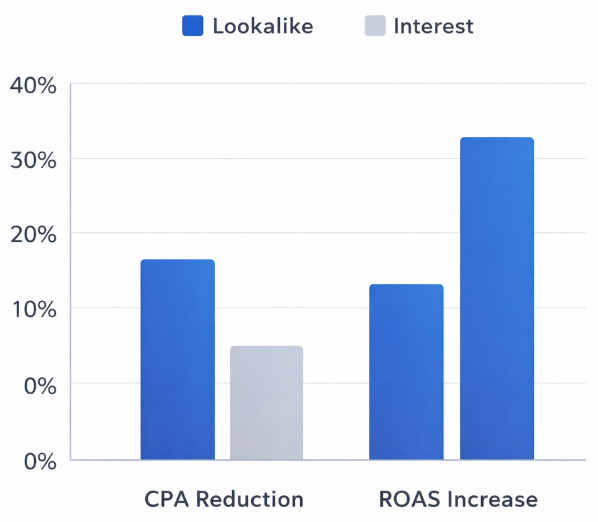
Lookalike audiences typically deliver significantly lower acquisition costs and higher return on ad spend compared with broad interest targeting
Meta data indicates that well-segmented lookalike audiences can improve conversion rates by up to 70% compared to interest-only targeting. When competitors serve similar markets, lookalikes often overlap significantly with their customer base.
3. Engagement-Based Audiences
You can build custom audiences from users who have interacted with your content, including:
-
Video views
-
Instagram profile visits
-
Facebook page engagement
-
Lead forms
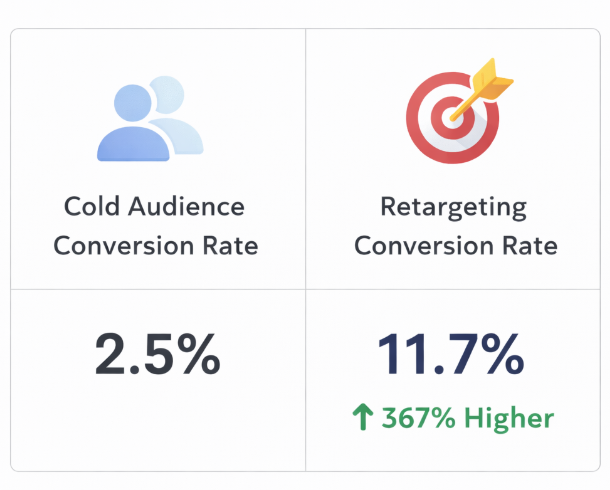
Retargeting campaigns convert at dramatically higher rates compared with cold audience campaigns, highlighting the value of warm traffic
By running awareness or comparison-style ads first, you can warm up users who are also engaging with competitor messaging, then retarget them with stronger conversion-focused campaigns.
4. Contextual Creative Positioning
Targeting alone is not enough. Your ad creative must clearly differentiate you from competitors.
Effective positioning tactics include:
-
Highlighting a unique feature or pricing model
-
Emphasizing ease of use or faster results
-
Addressing common frustrations users experience with existing solutions
Studies show that ads with clear value differentiation can increase conversion rates by up to 40% when competing brands are already familiar to the audience.
Common Mistakes to Avoid
Targeting competitor audiences requires precision. The most frequent mistakes include:
-
Relying on a single competitor interest without layering additional filters
-
Copying competitor messaging instead of differentiating
-
Ignoring creative testing and frequency control
-
Sending cold competitor audiences directly to high-commitment offers
A structured funnel approach consistently outperforms direct-response-only campaigns.
Measuring Success and Optimization
When advertising to competitor audiences, track metrics beyond basic clicks.
Key indicators include:
-
Cost per qualified lead
-
Conversion rate by audience segment
-
Frequency and ad fatigue
-
Assisted conversions across campaigns
Incremental lift testing and audience overlap analysis can help determine whether competitor-focused campaigns are driving net-new results or simply reallocating conversions.
Conclusion
Advertising to your competitor’s audience on Facebook is not about shortcuts or rule-bending. It is a strategic approach built on understanding intent, leveraging platform tools, and presenting a clear alternative value proposition.
When executed correctly, this strategy can significantly reduce acquisition costs, improve lead quality, and accelerate growth in highly competitive markets.
Recommended Reading
To deepen your understanding of advanced Facebook advertising strategies, consider exploring these related articles: