Lead quality is one of the most debated—and misunderstood—topics in revenue operations. Marketing teams often prioritize volume and engagement, while sales teams focus on conversion likelihood and deal size. Without alignment, this disconnect leads to wasted resources, slower pipelines, and missed revenue opportunities.
According to industry research, companies with strong sales and marketing alignment achieve up to 38% higher sales win rates and 36% higher customer retention. Yet, only about 27% of organizations report having fully aligned lead qualification criteria across teams.
The solution lies in building a shared system of lead quality metrics that reflects both marketing intent and sales reality.
Why Lead Quality Alignment Matters
When teams define lead quality differently, several problems emerge:
-
Marketing generates leads that sales rejects
-
Sales ignores marketing-qualified leads (MQLs)
-
Pipeline forecasts become unreliable
-
Customer acquisition costs increase
Aligned metrics eliminate ambiguity. Everyone understands what constitutes a "good" lead, and decisions become data-driven rather than subjective.
Core Lead Quality Metrics to Standardize
To align effectively, organizations need to agree on a core set of metrics used across all teams.
1. Fit Score
Fit measures how closely a lead matches your ideal customer profile (ICP). This includes:
-
Company size
-
Industry
-
Geography
-
Technology stack
A shared fit scoring model ensures marketing targets the right audience while sales prioritizes the most relevant prospects.
2. Engagement Score
Engagement reflects how actively a lead interacts with your brand. Common indicators include:
-
Website visits
-
Content downloads
-
Email engagement
-
Event participation
Research shows that highly engaged leads are up to 3x more likely to convert compared to low-engagement prospects.
3. Intent Signals
Intent data captures buying readiness based on behavior outside your owned channels, such as:
-
Third-party content consumption
-
Keyword searches
-
Competitive research activity
Organizations using intent data report up to 20% shorter sales cycles and 15% higher conversion rates.
4. Lead Stage Definitions
Standardizing lifecycle stages is critical. Common stages include:
-
Marketing Qualified Lead (MQL)
-
Sales Qualified Lead (SQL)
-
Opportunity
Each stage must have clearly defined entry and exit criteria agreed upon by all teams.
Steps to Align Lead Quality Metrics
Step 1: Establish a Shared Definition of a Qualified Lead
Bring marketing, sales, and operations stakeholders together to define what qualifies as an MQL and SQL. Use historical data to identify attributes of leads that converted successfully.
Step 2: Build a Unified Scoring Model
Combine fit, engagement, and intent into a single scoring framework. Assign weights based on their impact on conversion rates.
For example:
-
Fit: 40%
-
Engagement: 35%
-
Intent: 25%
This creates a balanced view of lead quality that reflects both interest and suitability.
Step 3: Align KPIs Across Teams
Ensure that marketing and sales are measured against shared outcomes, such as:
-
Pipeline contribution
-
Conversion rates
-
Revenue generated
Organizations with shared KPIs see up to 19% faster revenue growth compared to those with siloed metrics.
Step 4: Implement Feedback Loops
Create structured feedback mechanisms where sales can evaluate lead quality and provide insights back to marketing.
Examples include:
-
Weekly pipeline reviews
-
Lead rejection analysis
-
Win/loss reporting
Continuous feedback ensures the scoring model evolves over time.
Step 5: Use Data to Refine Continuously
Monitor performance and adjust scoring thresholds regularly. Analyze which leads convert and which do not, and refine your criteria accordingly.
Companies that actively optimize lead scoring models improve conversion rates by up to 30% over time.
Common Challenges and How to Overcome Them
Misaligned Incentives
If marketing is rewarded for lead volume while sales is rewarded for revenue, alignment will fail. The solution is to tie both teams to shared revenue goals.
Data Silos
Disconnected systems prevent a unified view of lead quality. Integrating CRM, marketing automation, and data enrichment tools is essential.
Lack of Governance
Without clear ownership, lead quality definitions drift over time. Assign responsibility to a revenue operations function to maintain consistency.
Best Practices for Sustained Alignment
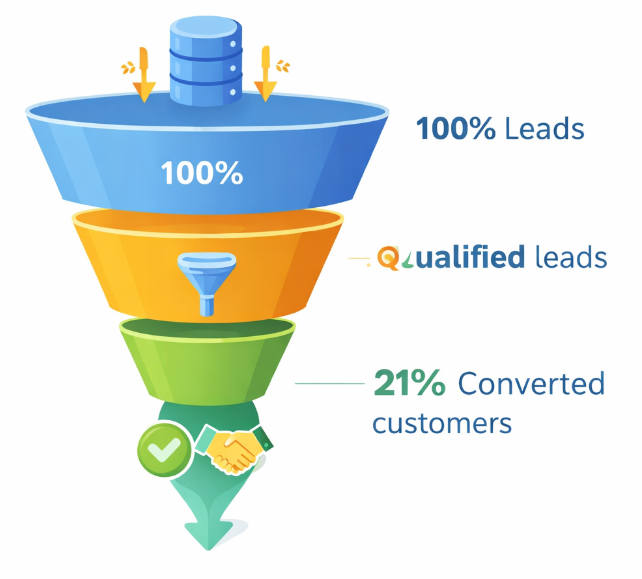
Organizations with aligned lead quality metrics significantly outperform those with disconnected sales and marketing processes
-
Document all definitions and scoring criteria
-
Review metrics quarterly
-
Train teams on how lead quality is measured
-
Use dashboards to ensure transparency
Organizations that follow these practices are significantly more likely to maintain long-term alignment and consistent pipeline performance.
Suggested Articles for Further Reading
Conclusion
Aligning lead quality metrics across teams is not a one-time project—it is an ongoing process that requires collaboration, data discipline, and continuous optimization. When done correctly, it transforms how organizations generate, qualify, and convert leads, resulting in stronger pipelines and more predictable revenue growth.
By standardizing metrics, aligning incentives, and leveraging data effectively, teams can move from disagreement to alignment—and from inefficiency to performance.