
When sales and marketing rely on different data sources, definitions, or reporting timelines, decision-making becomes fragmented. Marketing may optimize for lead volume, while sales focuses on deal quality and close rates. According to industry research, organizations with strong sales and marketing alignment achieve up to 19% faster revenue growth and 15% higher profitability compared to poorly aligned teams. Conversely, data silos are responsible for up to 30% of lost productivity in go-to-market teams.
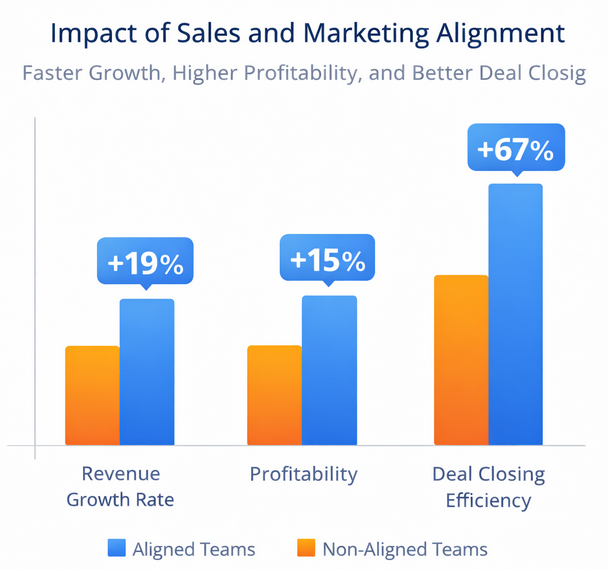
Impact of Sales and Marketing Alignment: Faster Growth, Higher Profitability, and Better Deal Closing
Alignment is not only a strategic goal; it is an operational requirement for scaling predictable revenue.
Common Data Misalignment Challenges
Inconsistent Definitions
Terms such as “lead,” “marketing-qualified lead,” and “sales-qualified lead” often mean different things to different teams. Without shared definitions, reports become misleading and performance reviews turn into debates rather than decisions.
Disconnected Systems
Marketing automation platforms, CRM systems, analytics tools, and ad platforms often store overlapping but inconsistent data. Studies show that over 50% of companies use more than five tools to manage customer data, increasing the risk of duplication and attribution errors.
Conflicting KPIs
Marketing teams typically measure success by impressions, clicks, and leads, while sales teams focus on pipeline value, win rates, and revenue. When KPIs are not connected through shared data, optimization efforts pull teams in opposite directions.
Step 1: Establish a Unified Data Model
The foundation of alignment is a shared data model that clearly defines:
-
Lead and opportunity stages
-
Ownership rules
-
Data sources of truth
-
Required and optional data fields
A unified model ensures that a lead viewed in marketing reports is the same entity evaluated by sales. Companies that standardize their data models report up to 25% higher data accuracy across revenue operations.
Step 2: Connect Marketing and Sales Platforms
Integrating marketing platforms with the CRM is essential for maintaining data continuity across the funnel. Key integration principles include:
-
Bi-directional data syncing
-
Real-time or near real-time updates
-
Field-level mapping and validation rules
Research indicates that businesses with fully integrated CRM and marketing platforms improve lead-to-opportunity conversion rates by approximately 20%.
Step 3: Align KPIs Across the Funnel
True alignment happens when marketing and sales share responsibility for revenue outcomes. This requires connecting top-of-funnel metrics to bottom-of-funnel results.
Examples of aligned KPIs include:
-
Cost per qualified opportunity
-
Opportunity-to-close conversion rate by source
-
Revenue influenced by marketing campaigns
Organizations that track revenue-based marketing metrics are 1.5 times more likely to exceed their growth targets.
Step 4: Implement Closed-Loop Reporting
Closed-loop reporting links marketing activities directly to sales outcomes. This approach enables teams to:
-
Identify which campaigns drive high-value deals
-
Eliminate low-performing channels
-
Improve forecasting accuracy
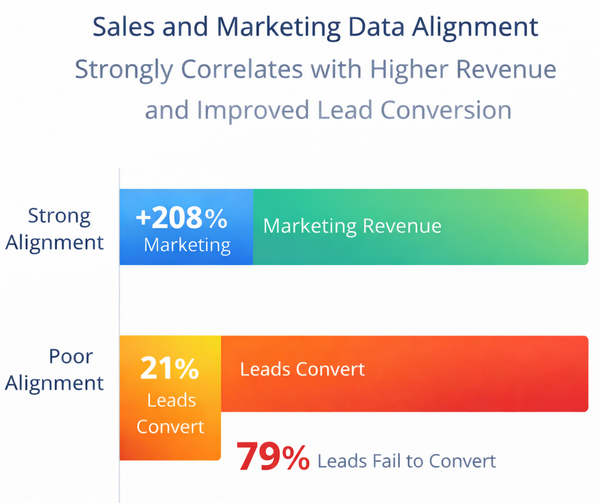
Sales and Marketing Data Alignment Strongly Correlates with Higher Revenue and Improved Lead Conversion
According to benchmark studies, companies using closed-loop reporting see up to 30% improvement in campaign ROI due to better budget allocation and faster feedback cycles.
Step 5: Create Shared Dashboards and Review Cadence
Data alignment is reinforced through visibility and routine collaboration. Shared dashboards should present:
-
Funnel performance from lead to revenue
-
Conversion rates between stages
-
Revenue attribution by channel and campaign
Weekly or bi-weekly joint reviews help teams interpret the data together, identify issues early, and agree on corrective actions. Teams that hold regular cross-functional revenue reviews report significantly higher forecast accuracy.
Step 6: Maintain Data Quality and Governance
Even the best systems degrade without ongoing governance. Effective data alignment requires:
-
Automated data validation rules
-
Regular data audits
-
Clear ownership of data quality
Poor data quality costs organizations an average of 12% of annual revenue, making governance a critical component of long-term alignment.
Conclusion
Aligning sales and marketing data is not a one-time integration project. It is an ongoing process that combines shared definitions, connected systems, aligned metrics, and collaborative workflows. When both teams rely on the same data to make decisions, performance discussions shift from assumptions to insights, enabling faster growth and more efficient revenue operations.