Ad targeting has evolved far beyond demographic checklists and broad interest categories. Today, performance depends on how accurately campaigns align with user intent—the underlying motivation that drives a person to search, click, or convert. When targeting reflects intent, ads feel timely and useful rather than intrusive, leading to stronger engagement and higher returns.
Yet many campaigns still rely on static audience definitions that ignore where users are in their decision journey. This disconnect often results in wasted spend, declining click-through rates, and poor conversion quality.
What Is User Intent?
User intent refers to the goal a user is trying to accomplish at a specific moment. In advertising, intent is typically grouped into three categories:
-
Informational intent: Users are researching a problem or learning about options.
-
Consideration intent: Users are comparing solutions or evaluating providers.
-
Transactional intent: Users are ready to act, purchase, or sign up.
Targeting that ignores these differences risks showing bottom-funnel ads to top-funnel users—or vice versa—creating friction and reducing effectiveness.
Why Intent Alignment Impacts Performance
Intent-aligned targeting consistently outperforms broad or assumption-based approaches. Industry data shows:
-
Ads matched to high-intent audiences can deliver conversion rates up to 2–3× higher than interest-only targeting.
-
Campaigns that segment audiences by intent stage see 20–30% lower cost per acquisition on average.
-
Users exposed to ads aligned with their current intent are significantly more likely to convert within fewer impressions, reducing frequency waste.
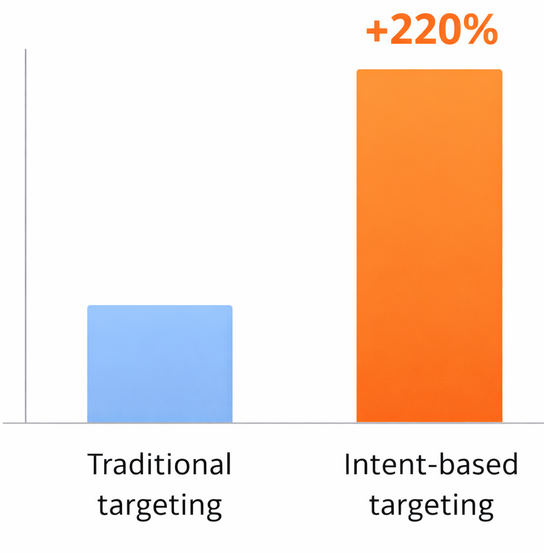
Comparison of average click-through rates: intent-based targeting significantly outperforms traditional targeting by up to 220%
These gains occur because relevance increases at every touchpoint—from messaging and offer selection to landing page experience.
Signals That Reveal User Intent
Modern targeting strategies rely on behavioral and contextual signals rather than static traits. Key intent indicators include:
-
Recent actions: Page visits, content engagement, form starts, or search behavior.
-
Recency and frequency: How recently and how often users interact with related topics.
-
Contextual alignment: The environment where the ad appears, such as content category or keyword theme.
The closer these signals are to a conversion-related action, the stronger the intent signal becomes.
Aligning Targeting with Each Intent Stage
Informational Stage
At this stage, targeting should prioritize reach within relevant contexts. Broader filters are appropriate, but messaging should focus on education and problem awareness rather than sales pressure.
Best practices:
-
Use content-based or contextual targeting.
-
Optimize for engagement metrics rather than immediate conversions.
Consideration Stage
Here, audiences should be refined using behavioral signals that indicate comparison or evaluation.
Best practices:
-
Target users who have interacted with related content or previous campaigns.
-
Introduce proof points, benefits, and differentiation.
Transactional Stage
For high-intent users, precision matters more than scale. Narrow targeting improves efficiency and reduces wasted impressions.
Best practices:
-
Focus on recent, high-signal behaviors.
-
Limit frequency to avoid fatigue while maintaining visibility.
Common Targeting Mistakes to Avoid
-
Over-segmentation too early: Narrowing audiences before intent signals are strong can limit learning and scale.
-
Static assumptions: Assuming intent based solely on demographics or job titles.
-
Misaligned optimization goals: Optimizing for clicks when the audience is already purchase-ready.
Each of these mistakes creates a gap between what the user wants and what the campaign delivers.
Measuring Intent Alignment
Intent alignment should be evaluated beyond surface-level metrics. Strong indicators include:
-
Conversion rate lift by audience segment
-
Decrease in time-to-conversion
-
Lower frequency required to drive action
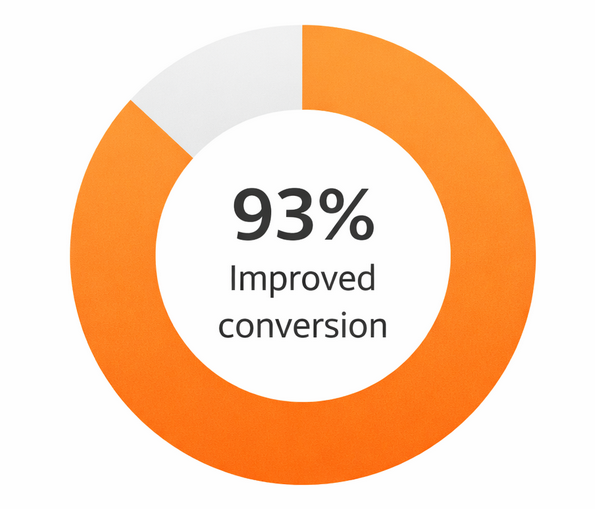
Percentage of marketers who report higher conversion rates when using intent data to guide targeting and engagement
When targeting truly reflects intent, campaigns often reach performance stability faster and maintain results longer.
Conclusion
Aligning targeting with user intent is no longer optional—it is foundational to sustainable ad performance. By focusing on real behavioral signals, respecting intent stages, and adjusting targeting depth accordingly, advertisers can reduce waste, improve relevance, and drive stronger outcomes across the funnel.