Meta’s advertising system relies heavily on machine learning models that analyze conversion signals to predict which users are most likely to complete a desired action. The commonly referenced benchmark of 50 conversions per week is tied to the platform’s learning phase.
During the learning phase, the system tests different audience segments, placements, and bid combinations. Once an ad set receives around 50 optimization events within a seven‑day window, the algorithm gains enough statistical signal to stabilize performance and move toward more efficient delivery.
Internal Meta guidance has historically suggested that campaigns exiting the learning phase can experience up to 20–30% improvement in cost efficiency compared with campaigns still in early testing.
The Learning Phase: What Happens Before 50 Conversions
Before the system reaches sufficient data volume, the optimization engine performs broad experimentation across multiple dimensions:
-
Audience clusters
-
Ad placement combinations
-
Device types
-
Time‑of‑day delivery patterns
-
Bid and pacing adjustments
Meta’s predictive models rely on billions of behavioral data points. However, conversion events specific to a campaign provide the strongest signal for identifying high‑value users.
Until enough events accumulate, the system prioritizes exploration over efficiency.
What Changes After 50 Conversions
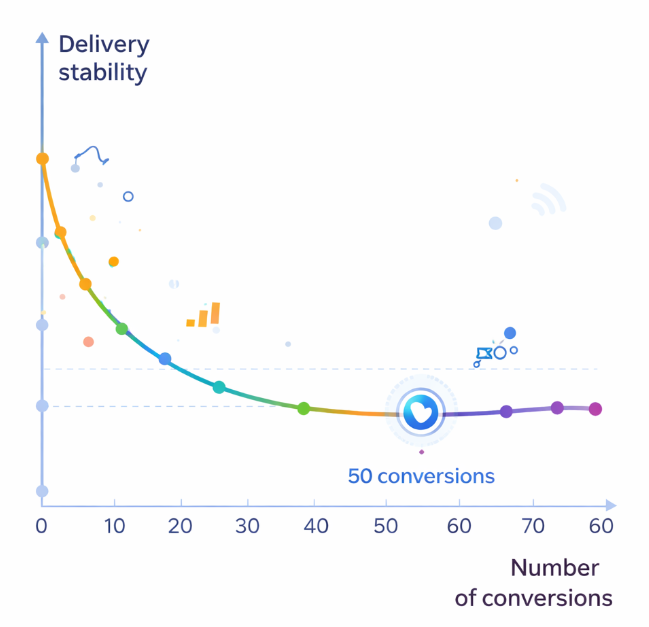
Meta’s delivery system typically requires around 50 conversion events per ad set within seven days to collect enough data for stable machine-learning optimization
Once an ad set accumulates roughly 50 optimization events, the engine transitions from exploration to exploitation. Several key changes occur internally.
Stronger Predictive Modeling
With more conversion data available, Meta’s machine learning models refine probability scores for individual users. Instead of broad testing, the system prioritizes users whose profiles closely resemble those who already converted.
According to Meta’s advertising documentation, campaigns with stable conversion signals can see up to 50% more consistent delivery performance compared with campaigns that remain in the learning phase.
Delivery Stabilization
Budget pacing and bid adjustments become more stable after sufficient signals accumulate. Large fluctuations in CPM, CPC, and CPA often decrease because the system has identified clearer performance patterns.
Research from multiple media buying studies suggests that campaigns exiting the learning phase often experience 10–25% lower CPA volatility during subsequent weeks.
More Efficient Audience Targeting
Rather than targeting large experimental groups, the algorithm begins to concentrate delivery on micro‑segments of users with high predicted conversion probability.
This shift is driven by Meta’s ranking system, which evaluates three core factors:
-
Estimated action rate
-
Ad quality signals
-
Auction competitiveness
When enough conversions are collected, estimated action rate predictions become significantly more accurate.
Improved Budget Allocation
The optimization engine also improves budget allocation across placements such as Feed, Stories, Reels, and Audience Network. After learning stabilizes, budget tends to concentrate on placements historically associated with higher conversion rates.
Industry benchmarks show that placement optimization alone can improve campaign efficiency by 15–20% once enough data is available.
Why Some Campaigns Never Reach 50 Conversions
Many advertisers struggle to exit the learning phase. The most common reasons include:
-
Budgets that are too small
-
Highly restrictive audiences
-
Optimization for low‑volume events
-
Frequent campaign edits
Meta reports that over 30% of new ad sets reset their learning phase due to frequent changes in targeting, creatives, or budget adjustments.
Each reset forces the algorithm to start exploration again, delaying optimization.
Strategies to Reach 50 Conversions Faster
To help the optimization engine gather sufficient data, advertisers should focus on a few practical tactics.
Use Higher‑Volume Optimization Events
If purchase volume is low, optimizing for earlier funnel actions such as Add to Cart or View Content can help generate enough signals for the algorithm.
Consolidate Ad Sets
Running too many small ad sets spreads conversion data across multiple learning systems. Consolidating them allows the algorithm to gather stronger signals more quickly.
Avoid Frequent Edits
Major changes to budget, targeting, or creative often reset the learning phase. Stabilizing campaigns for at least several days allows the engine to complete its modeling process.
Increase Budget Strategically
A common guideline suggests setting a weekly budget capable of generating at least 50 optimization events. If the average CPA is $20, the ad set budget may need to reach roughly $1,000 per week to exit the learning phase.
The Long‑Term Impact of Exiting the Learning Phase
Once sufficient conversion data accumulates, campaigns typically become easier to scale.
Key long‑term benefits include:
-
More predictable cost per acquisition
-
Stronger audience matching
-
Reduced delivery volatility
-
Higher return on ad spend
Some performance marketing studies indicate that campaigns operating with stable conversion signals can generate up to 40% higher ROAS compared with campaigns stuck in constant learning resets.
Recommended Articles
For additional insights on improving advertising performance, consider reading:
Conclusion
The 50‑conversion milestone is not an arbitrary number. It represents the point where Meta’s optimization engine finally has enough statistical evidence to shift from experimentation to precision targeting.
Understanding how this transition works allows advertisers to structure campaigns that feed the algorithm high‑quality signals, shorten the learning phase, and ultimately achieve more efficient and scalable advertising performance.