Many marketing teams fall into the trap of auditing performance based on formats — video vs. image, carousel vs. static, long-form vs. short-form. While formats matter, they rarely explain why a campaign succeeds or fails.
The real driver of performance is the creative angle — the core idea, message, or perspective that shapes how your audience perceives your offer.
Auditing creative angles instead of formats allows you to identify repeatable patterns of success, eliminate guesswork, and build a scalable creative strategy.
What Is a Creative Angle?
A creative angle is the underlying concept or narrative behind your content. It answers the question: Why should the audience care?
Examples of creative angles include:
-
Problem-solution framing
-
Social proof and testimonials
-
Fear of missing out (FOMO)
-
Contrarian or myth-busting statements
-
Educational or value-driven insights
Different formats can deliver the same angle, but the angle itself determines how compelling the message is.
Why Auditing Formats Falls Short
Focusing only on formats creates misleading conclusions. For example, if video ads outperform static images, it does not necessarily mean video is inherently better. It may simply reflect that stronger angles were used in video creatives.
According to recent marketing data, up to 70% of campaign performance variance is driven by creative quality rather than targeting or format choices. Additionally, campaigns that systematically test messaging angles see up to 2–3x higher return on ad spend compared to those that only iterate on formats.
Benefits of Auditing Creative Angles
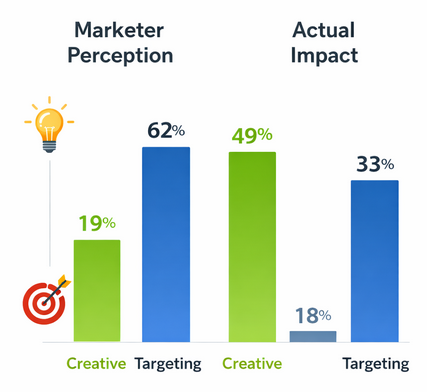
There is a significant gap between what marketers believe drives results and what actually does
Shifting to angle-based auditing provides several advantages:
1. Clear Performance Drivers
You identify why something works, not just what works.
2. Faster Optimization Cycles
Instead of redesigning entire creatives, you can refine messaging while keeping production efficient.
3. Scalable Testing Framework
Angles can be reused across formats, platforms, and audiences.
4. Improved Cross-Channel Consistency
Strong angles translate across email, paid ads, landing pages, and social content.
Step-by-Step Guide to Auditing Creative Angles
Step 1: Group Creatives by Angle
Start by categorizing your existing creatives based on their core message rather than their format.
For example:
-
All creatives highlighting urgency → FOMO angle
-
All creatives showing results → Social proof angle
-
All creatives explaining value → Educational angle
Step 2: Normalize Performance Metrics
Compare creatives using consistent KPIs such as:
-
Click-through rate (CTR)
-
Conversion rate (CVR)
-
Cost per acquisition (CPA)
-
Return on ad spend (ROAS)
This ensures you evaluate angles fairly across formats.
Step 3: Identify Winning Angles
Look for patterns:
-
Which angles consistently outperform others?
-
Which angles drive high engagement but low conversion?
-
Which angles scale effectively with budget increases?
Step 4: Diagnose Underperformance
Instead of discarding entire formats, analyze whether the angle is weak, unclear, or mismatched with the audience.
Step 5: Iterate Systematically
Test variations within the same angle before moving to new ones. For example:
-
Different hooks for the same angle
-
Different levels of detail
-
Different emotional triggers
Common Mistakes to Avoid
Mistake 1: Mixing Angles Within One Creative
Blending multiple angles dilutes the message and reduces clarity.
Mistake 2: Overvaluing Aesthetic Quality
Visually appealing creatives do not guarantee performance if the angle is weak.
Mistake 3: Ignoring Audience Segmentation
An angle that works for one audience may fail for another.
Mistake 4: Stopping Tests Too Early
Angles require sufficient data to validate. Premature conclusions lead to incorrect optimization decisions.
Practical Example
Imagine two campaigns:
-
Campaign A: High-quality video with a vague value proposition
-
Campaign B: Simple static image with strong social proof
If Campaign B outperforms Campaign A, the correct takeaway is not that images outperform videos. The real insight is that social proof is a stronger angle than a generic message.
This insight can then be applied across all formats.
Building an Angle Testing Framework
To operationalize this approach, create a structured system:
-
Define 5–10 core angles relevant to your offer
-
Produce multiple creatives per angle
-
Distribute angles evenly across formats
-
Track performance at the angle level
-
Continuously expand winning angles
Teams that adopt structured creative testing frameworks report up to 40% faster creative iteration cycles and significantly reduced acquisition costs over time.
Conclusion
Auditing creative angles instead of formats shifts your focus from surface-level execution to core messaging effectiveness. This approach enables deeper insights, more efficient testing, and stronger long-term performance.
By understanding which ideas resonate with your audience, you can build campaigns that scale — regardless of format.