Marketing teams often rely on instinct when evaluating creative. If an ad feels powerful—visually striking, emotionally engaging, or cleverly written—it is assumed to perform well. However, real-world performance data frequently contradicts this assumption.
In practice, ads that generate internal excitement can underdeliver on key metrics such as click-through rate (CTR), conversion rate, and cost per acquisition (CPA). Understanding why this happens is essential for improving campaign effectiveness.
The “Creative Bias” Problem
One of the most common reasons for underperformance is internal bias. Teams tend to favor ads that align with their personal taste or brand perception rather than audience response.
According to Nielsen, creative quality accounts for nearly 47% of sales lift, making it the single most influential factor in campaign success. Yet, “quality” from a data perspective often differs from what teams perceive as compelling.
An ad that looks polished and sophisticated may fail if it doesn’t clearly communicate value or resonate with the target audience.
Emotional Impact vs. Actionability
Emotion is important—but it’s not enough.
Research from the Ehrenberg-Bass Institute shows that while emotionally engaging ads can improve brand recall, they do not consistently drive immediate action. Ads that balance emotional appeal with clear, actionable messaging tend to perform better in performance-driven campaigns.
For example:
-
A visually stunning brand video may generate high engagement but low conversions.
-
A simple, benefit-driven ad with a direct call-to-action often produces higher ROI.
This mismatch explains why ads that feel strong may still fail to deliver results.
Misalignment with Audience Intent
Even the most compelling creative will underperform if it doesn’t match the audience’s intent at the moment of exposure.
Google research indicates that over 70% of consumers expect personalized experiences, yet many ads remain generic. When messaging does not reflect the user’s needs, stage in the funnel, or context, performance drops significantly.
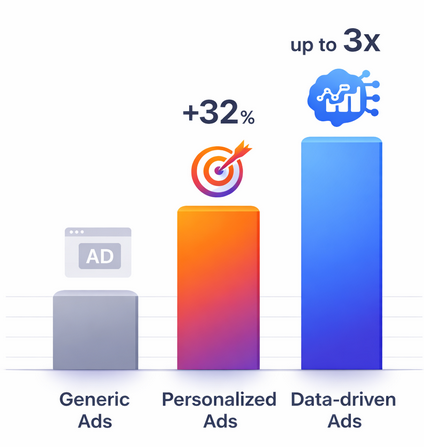
Personalization and data-driven targeting significantly increase conversion rates compared to generic advertising approaches
Common misalignments include:
-
Showing awareness-stage messaging to decision-ready audiences
-
Using broad value propositions instead of specific pain points
-
Ignoring industry-specific nuances
Overestimating Visual Complexity
Design-heavy ads often receive positive internal feedback—but complexity can reduce clarity.
A study by Microsoft found that users form impressions in less than 0.05 seconds, meaning clarity must be immediate. Overly detailed visuals, excessive text, or abstract concepts can delay understanding and reduce engagement.
High-performing ads tend to prioritize:
-
Clear hierarchy
-
Simple messaging
-
Immediate value recognition
Weak or Hidden Value Proposition
A strong “feeling” ad may still fail if the core value proposition is unclear or buried.
According to HubSpot, 55% of visitors spend fewer than 15 seconds on a page, which applies similarly to ad consumption. If the benefit is not instantly visible, users move on.
Effective ads answer three questions instantly:
-
What is this?
-
Why does it matter to me?
-
What should I do next?
If any of these are unclear, performance suffers regardless of creative quality.
Lack of Data-Driven Iteration
Another major issue is insufficient testing.
Meta’s internal data shows that campaigns using structured A/B testing can improve performance by up to 30%. Yet many teams rely on a single “strong” concept rather than iterating based on results.
Without testing:
-
Assumptions go unchallenged
-
Underperforming creatives persist
-
Opportunities for optimization are missed
What High-Performing Ads Do Differently
To avoid the trap of “feels strong but performs weak,” successful campaigns follow a different approach:
1. Prioritize Clarity Over Creativity
Clear messaging consistently outperforms clever but ambiguous ideas.
2. Align with Audience Intent
Segment audiences and tailor messaging to their stage in the buying journey.
3. Emphasize Value Immediately
Make the benefit obvious within the first second of interaction.
4. Test Relentlessly
Run multiple variations and let performance data guide decisions.
5. Balance Emotion with Action
Combine emotional appeal with a direct and compelling call-to-action.
Recommended Reading
To deepen your understanding of ad performance optimization, explore these related articles:
Conclusion
Ads that feel strong are not inherently effective. Performance depends on clarity, relevance, and alignment with user intent—not just creativity.
By shifting from intuition-driven decisions to data-driven strategies, marketers can consistently produce campaigns that not only look good—but deliver measurable results.