Creative assets are often judged subjectively. Personal preferences, internal politics, and confirmation bias frequently influence how teams evaluate ads, landing pages, and campaign visuals. However, biased evaluation leads to poor decisions, wasted budget, and missed growth opportunities.
A structured creative performance audit helps teams analyze marketing assets using objective data instead of opinions. This article explains how to audit creative performance without bias and how to build a repeatable evaluation framework.
Why Bias Appears in Creative Evaluation
Bias enters the evaluation process in several ways:
-
Confirmation bias — teams favor creatives that support their initial idea.
-
Authority bias — senior stakeholders' preferences override data.
-
Recency bias — the latest creative performance influences perception of long-term results.
-
Aesthetic bias — designs that "look better" are assumed to perform better.
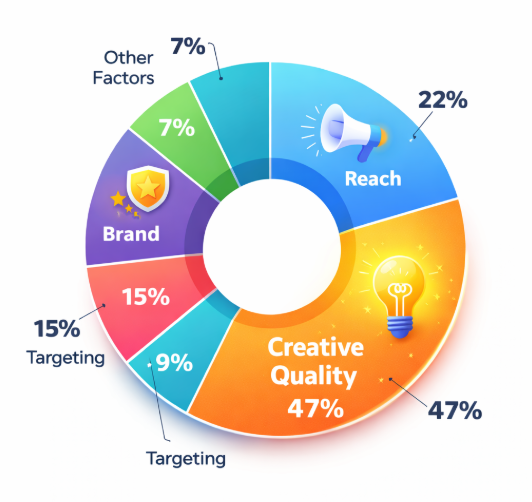
Creative quality is the largest driver of advertising effectiveness
Research from Nielsen shows that creative quality accounts for 49% of sales lift in advertising campaigns, making objective evaluation critical for marketing ROI.
Step 1: Define Clear Performance Metrics
Before auditing creatives, define the metrics that actually measure success. Without agreed metrics, teams tend to rely on subjective impressions.
Common creative performance metrics include:
-
Click-through rate (CTR)
-
Conversion rate
-
Cost per acquisition (CPA)
-
Engagement rate
-
Scroll depth on landing pages
-
Time on page
According to WordStream benchmark data, the average Google Ads CTR across industries is 3.17% for search and 0.46% for display, providing a useful baseline for evaluating creative performance.
Use historical campaign data to establish internal benchmarks. This helps compare creatives fairly across campaigns.
Step 2: Separate Creative Variables from Campaign Variables
Many audits fail because they evaluate creatives without accounting for other campaign factors.
Performance is influenced by:
-
Audience targeting
-
Budget allocation
-
Placement
-
Seasonality
-
Frequency
When auditing creatives, compare assets that ran under similar conditions. Otherwise, results may incorrectly attribute performance differences to creative quality.
Step 3: Use Structured A/B Testing
A/B testing is the most reliable way to evaluate creative performance objectively.
Best practices include:
-
Test one creative variable at a time (headline, image, CTA).
-
Ensure statistically significant sample sizes.
-
Run tests long enough to avoid early false winners.
HubSpot reports that companies that run structured A/B testing see up to 30% higher conversion rates compared with teams that rely on intuition alone.
Step 4: Build a Standardized Creative Scorecard
A creative scorecard introduces consistency into the audit process.
Example evaluation framework:
| Category | Evaluation Criteria |
|---|---|
| Message clarity | Is the value proposition immediately understandable? |
| Visual hierarchy | Are key elements visible within 3 seconds? |
| Brand alignment | Does the creative follow brand guidelines? |
| CTA strength | Is the action clear and compelling? |
| Performance metrics | CTR, conversion rate, CPA |
Combining qualitative review with quantitative data prevents aesthetic bias from dominating the decision process.
Step 5: Use Blind Reviews When Possible
Blind review is a powerful way to reduce bias in creative evaluation.
Instead of showing reviewers the creator, campaign owner, or department responsible for the asset, present only the creative and the performance data.
This approach helps eliminate:
-
reputation bias
-
internal politics
-
assumptions about teams or designers
Many design organizations report more balanced feedback when blind review systems are used.
Step 6: Analyze Patterns Across Multiple Campaigns
A single campaign rarely provides enough data to judge creative effectiveness.
Look for patterns across multiple campaigns such as:
-
which headline structures drive higher CTR
-
which visual formats improve engagement
-
which CTAs convert best
Marketing research from Meta indicates that creative-driven optimization can improve campaign performance by up to 30–40% when insights are applied across campaigns.
Step 7: Document Insights and Create Creative Guidelines
A creative audit should produce long-term learning.
Document insights such as:
-
best-performing headline formulas
-
visual elements that improve engagement
-
messaging patterns that drive conversions
These insights become internal creative guidelines that help future campaigns start from proven concepts instead of guesswork.
Common Mistakes in Creative Audits
Teams often introduce bias unintentionally. The most common mistakes include:
-
judging creatives too early before sufficient data is collected
-
mixing brand preference with performance metrics
-
ignoring campaign context
-
evaluating creatives without historical benchmarks
Avoiding these pitfalls improves the accuracy of performance analysis.
Conclusion
Auditing creative performance without bias requires structure, consistent metrics, and reliable testing methods. By separating subjective opinions from measurable outcomes, marketing teams can identify which creative elements actually drive results.
Over time, a disciplined creative audit process turns marketing data into a powerful engine for continuous campaign improvement.
Suggested Articles