Companies that regularly audit their lead generation funnels outperform competitors in revenue growth and marketing efficiency. According to industry research, organizations that align marketing and sales processes can achieve up to 36% higher customer retention and 38% higher sales win rates. Meanwhile, businesses that actively optimize conversion rates see average improvements of 20–30% in qualified lead volume.
A funnel audit allows you to:
-
Identify conversion leaks
-
Improve lead quality
-
Reduce cost per acquisition (CPA)
-
Shorten the sales cycle
-
Increase marketing ROI
This step-by-step framework will help you evaluate each funnel stage, from traffic acquisition to closed deals.
Step 1: Map Your Entire Funnel
Before analyzing performance, document your funnel stages clearly. A standard B2B funnel typically includes:
-
Traffic acquisition
-
Visitor-to-lead conversion
-
Lead qualification (MQL)
-
Sales qualification (SQL)
-
Opportunity creation
-
Closed-won deals
Ensure each stage has:
-
A precise definition
-
Entry and exit criteria
-
Assigned ownership (marketing or sales)
-
Measurable KPIs
If definitions are inconsistent between teams, conversion metrics become unreliable. Misalignment alone can reduce marketing effectiveness by over 25%.
Step 2: Audit Traffic Quality, Not Just Volume
More traffic does not equal more revenue. Evaluate traffic using:
-
Channel breakdown (organic, paid, outbound, referral)
-
Bounce rate
-
Average session duration
-
Pages per session
-
Conversion rate by source
For B2B companies, average landing page conversion rates range between 2% and 5%, but high-performing campaigns can exceed 10%. If your conversion rate is below 2%, investigate:
-
Audience targeting accuracy
-
Messaging alignment
-
Offer relevance
-
Page load speed (a 1-second delay can reduce conversions by 7%)
Focus on attracting ICP-aligned visitors rather than maximizing raw traffic.
Step 3: Evaluate Lead Capture Efficiency
Analyze visitor-to-lead conversion mechanisms:
-
Form length and friction
-
CTA clarity
-
Content relevance
-
Trust signals
Audit form performance by measuring:
-
Form completion rate
-
Abandonment rate
-
Field-level drop-offs
Research shows reducing form fields from 11 to 4 can increase conversions by up to 120%. However, fewer fields may reduce lead qualification precision. Strike a balance between volume and data quality.
Step 4: Measure Lead Quality and Qualification Criteria
Not all leads have revenue potential. Review:
-
MQL definition criteria
-
Scoring thresholds
-
Demographic filters
-
Behavioral triggers
Key diagnostic metrics:
-
MQL-to-SQL conversion rate
-
SQL-to-opportunity rate
-
Lead rejection rate by sales
If more than 30% of MQLs are rejected by sales, your qualification criteria need refinement. Strong alignment between marketing and sales typically results in 50% higher conversion from qualified leads to revenue.
Step 5: Analyze Sales Response Time
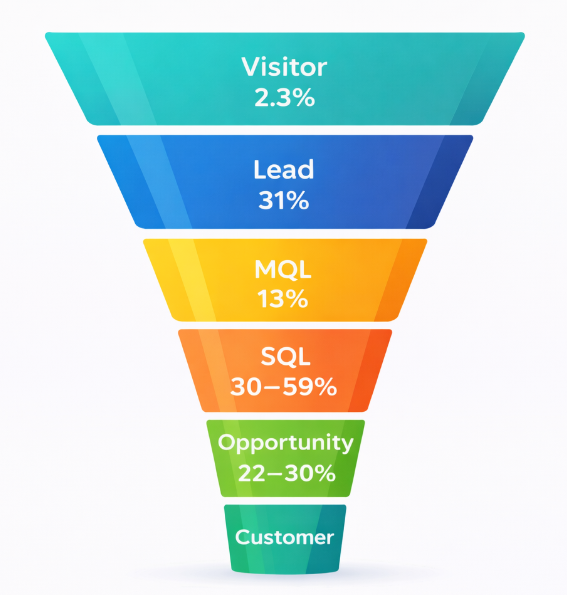
Lead conversion likelihood comparison by initial response time
Speed is a major performance driver. Studies show:
-
Responding within 5 minutes increases contact probability by up to 9x
-
Waiting more than 24 hours drastically reduces qualification likelihood
Audit:
-
Average first response time
-
Follow-up frequency
-
Touchpoint cadence
Even high-quality leads deteriorate without timely follow-up.
Step 6: Review Funnel Conversion Rates Stage by Stage
Calculate conversion between each stage:
-
Visitor → Lead
-
Lead → MQL
-
MQL → SQL
-
SQL → Opportunity
-
Opportunity → Closed-Won
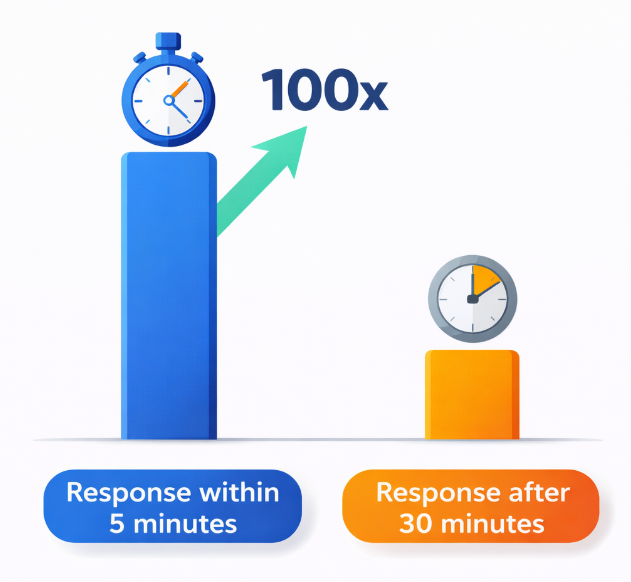
Typical conversion rates through each stage of a B2B lead generation funnel
Example diagnostic pattern:
-
Strong top-of-funnel conversion
-
Weak MQL-to-SQL conversion
This often indicates poor targeting or unclear qualification standards.
Benchmark references (B2B averages vary by industry):
-
Visitor-to-lead: 2–5%
-
Lead-to-MQL: 30–50%
-
MQL-to-Sales opportunity: 20–40%
-
Opportunity-to-close: 20–30%
Large deviations signal bottlenecks requiring deeper analysis.
Step 7: Evaluate Cost Efficiency Metrics
Audit financial efficiency:
-
Cost per lead (CPL)
-
Cost per MQL
-
Customer acquisition cost (CAC)
-
Marketing contribution to revenue
If CAC exceeds customer lifetime value (LTV) sustainability thresholds, scaling traffic will amplify losses rather than revenue.
An optimized funnel reduces acquisition cost while increasing close rates, improving overall margin.
Step 8: Inspect Attribution Accuracy
Incorrect attribution distorts decision-making.
Audit:
-
First-touch attribution
-
Last-touch attribution
-
Multi-touch attribution
-
CRM tracking integrity
If attribution models are misconfigured, high-performing channels may appear underperforming and vice versa.
Step 9: Identify Drop-Off Patterns and Friction Points
Use cohort analysis and funnel visualization tools to detect:
-
Stage stagnation
-
Long deal cycles
-
High abandonment segments
Ask:
-
Where does momentum slow?
-
Which industries convert best?
-
Which campaigns generate lowest CAC?
Segmented analysis often reveals hidden opportunities that aggregate metrics conceal.
Step 10: Create a Structured Optimization Plan
After identifying bottlenecks:
-
Prioritize highest-impact leaks
-
Define measurable hypotheses
-
Implement A/B tests
-
Track statistically significant results
-
Document findings
Companies that test continuously generate 30–50% higher conversion improvements compared to those relying on assumptions.
Optimization should follow a monthly review cadence with quarterly strategic reassessment.
Common Funnel Audit Mistakes
-
Focusing only on top-of-funnel metrics
-
Ignoring sales feedback
-
Optimizing for lead volume instead of revenue
-
Failing to align ICP definitions
-
Not tracking lifecycle stages consistently
A funnel is only as strong as its weakest stage.
Conclusion
A systematic lead generation funnel audit transforms marketing from a cost center into a predictable revenue engine. By evaluating traffic quality, lead capture efficiency, qualification criteria, response speed, conversion rates, and cost structure, you create a data-driven foundation for scalable growth.
Consistent auditing eliminates guesswork, reduces inefficiencies, and strengthens collaboration between marketing and sales teams. When executed quarterly, funnel audits compound performance improvements and create sustainable competitive advantage.
Recommended Reading