
In data-driven marketing and sales operations, match rate is a core performance indicator. Whether you are onboarding first-party CRM data to advertising platforms, enriching prospect lists, or conducting account-based marketing, higher match rates translate directly into improved reach, reduced wasted spend, and stronger attribution accuracy.
However, match rates are not solely dependent on platform algorithms. They are largely influenced by the quality, structure, and governance of the underlying data. Clean data practices are the most controllable and scalable lever organizations have to improve identity resolution and maximize ROI.
This article examines the operational, technical, and strategic practices that materially improve match rates, supported by relevant industry statistics.
Why Match Rates Matter
A match rate represents the percentage of records successfully matched between two datasets, such as a CRM file and a digital advertising platform. Low match rates reduce effective audience size, distort performance measurement, and inflate acquisition costs.
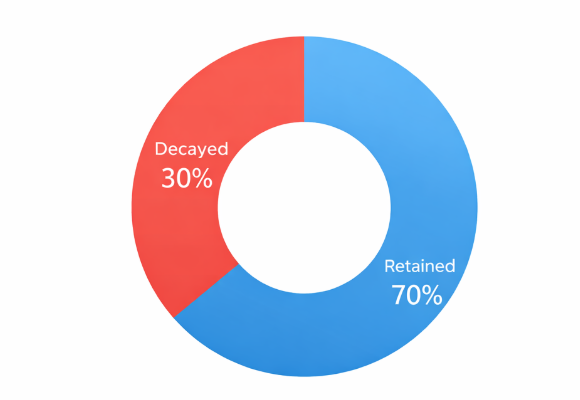
Annual decay of B2B database records significantly reduces matchable audiences
Industry benchmarks highlight the financial implications:
-
Poor data quality costs organizations an average of $12.9 million annually (Gartner).
-
Up to 30% of B2B database records decay each year due to job changes, company updates, and contact turnover (Forrester).
-
Campaign performance can improve by 15–25% when identity resolution accuracy increases through structured data enrichment (various industry analyses).
These statistics demonstrate that match rates are not merely technical metrics — they are revenue multipliers.
The Core Drivers of Low Match Rates
Before improving match performance, it is essential to diagnose root causes. The most common drivers include:
-
Inconsistent formatting (names, phone numbers, addresses)
-
Missing key identifiers (corporate emails, company domains)
-
Duplicate records
-
Outdated contact information
-
Free email addresses instead of business emails
-
Lack of standardized country and region codes
Each of these factors reduces deterministic matching probability and weakens probabilistic models.
Clean Data Practices That Increase Match Rates
1. Standardization and Normalization
Data normalization ensures consistent formatting across datasets. This includes:
-
Converting all text to consistent casing
-
Standardizing phone numbers to E.164 format
-
Parsing first and last names correctly
-
Normalizing country and state values using ISO standards
-
Removing leading/trailing whitespace and hidden characters
Even minor inconsistencies can prevent deterministic matching. Standardization alone can improve match rates by 5–15% depending on initial data condition.
2. Email Validation and Domain Correction
Corporate email addresses are among the strongest identifiers in B2B matching. Validation processes should:
-
Remove invalid or syntactically incorrect emails
-
Correct common domain typos
-
Flag disposable or generic inboxes
-
Identify role-based emails separately
Replacing personal email addresses with verified business emails significantly improves cross-platform match rates.
3. Deduplication and Record Consolidation
Duplicate records distort segmentation and reduce effective match efficiency. Implement:
-
Fuzzy matching for near-duplicate detection
-
Unique identifier assignment
-
Record survivorship rules
-
Merge logic based on recency and completeness
Organizations that deploy structured deduplication workflows often see match rate improvements of 10% or more.
4. Data Enrichment for Identity Resolution
Appending missing attributes increases match probability. Key enrichment fields include:
-
Company domain
-
Linked business email
-
Direct phone number
-
Job title normalization
-
Company size and industry classification
The addition of company domain data alone can significantly increase deterministic matches in B2B environments.
5. Continuous Data Refresh Cycles
Because 20–30% of B2B data becomes outdated annually, one-time cleaning is insufficient. Establish:
-
Quarterly validation processes
-
Automated bounce monitoring
-
Employment change tracking
-
CRM hygiene workflows
Proactive refresh cycles maintain match performance stability over time.
6. Governance and Data Entry Controls
Preventing future data degradation is as important as cleaning existing records. Best practices include:
-
Mandatory field enforcement in CRM systems
-
Dropdown-based standardized inputs
-
Automated formatting validation at entry
-
Clear data ownership policies
High-performing revenue teams treat data governance as an operational discipline rather than an IT afterthought.
Quantifying the Business Impact
Improving match rates produces measurable downstream effects:
-
Larger addressable audiences in paid media
-
More accurate lookalike modeling
-
Reduced cost per acquisition
-
Improved attribution confidence
-
Stronger account-based marketing precision
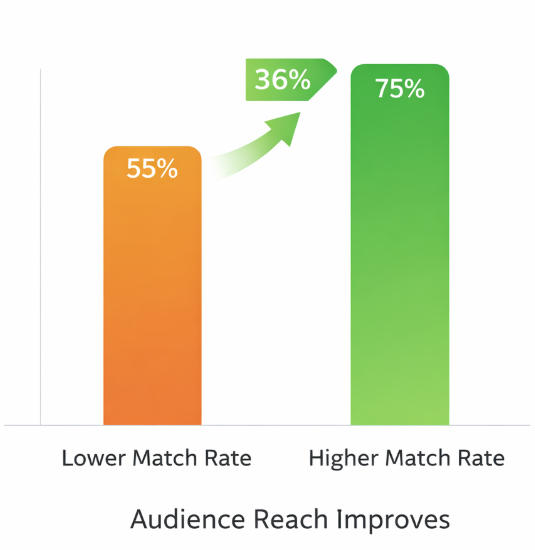
Boosting match rates from 55% to 75% increases audience reach by 36%
For example, increasing match rates from 55% to 75% effectively expands reachable audience size by 36% without increasing acquisition costs.
Over time, these gains compound across campaigns, channels, and revenue cycles.
Building a Data Quality Framework
To systematically improve match performance, organizations should implement a repeatable framework:
-
Audit current match rates by channel
-
Identify highest-impact data gaps
-
Apply structured normalization rules
-
Enrich missing high-value identifiers
-
Deduplicate and consolidate records
-
Implement governance controls
-
Monitor match rates continuously
Match rate optimization is not a one-time project. It is an ongoing operational capability.
Conclusion
Match rates reflect the operational maturity of your data infrastructure. While algorithmic matching continues to evolve, the most reliable lever for improvement remains disciplined data hygiene.
Organizations that invest in normalization, enrichment, deduplication, and governance consistently achieve stronger campaign performance, improved targeting precision, and higher revenue efficiency.
Clean data is not a technical luxury — it is a strategic growth asset.
Recommended Reading
To deepen your understanding of data-driven marketing performance, consider exploring these related articles: