
Digital advertising once promised precise attribution: track every click, assign every conversion, optimize in real time. Today, privacy regulations, browser restrictions, signal loss, and cross-device behavior make deterministic attribution increasingly unreliable.
Recent industry research indicates:
-
Over 40% of marketers report decreased visibility into customer journeys due to privacy changes.
-
Safari and Firefox block third-party cookies by default, and Chrome is progressively limiting cross-site tracking capabilities.
-
B2B buying committees now involve 6–10 stakeholders on average, dramatically complicating attribution paths.
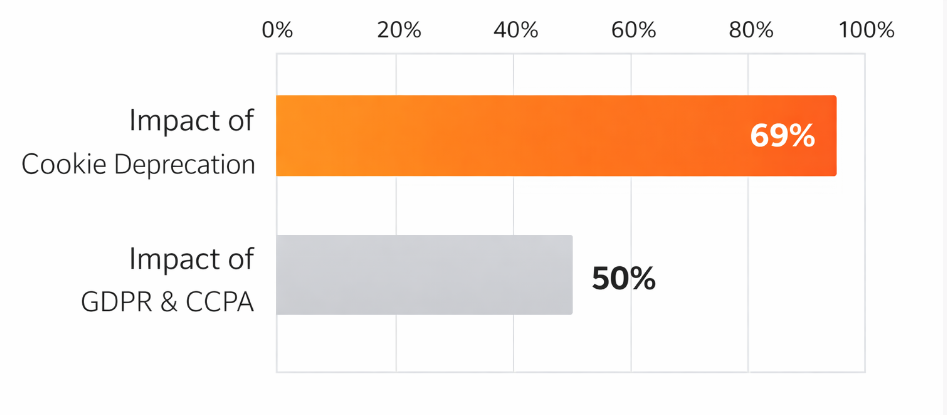
Horizontal bar chart showing 69% of advertisers say cookie deprecation impacts business more than GDPR and CCPA
In this environment, waiting for "perfect" attribution is not a strategy. Instead, high-performing teams adopt probabilistic measurement, blended analytics, and structured experimentation.
This article outlines a practical framework to build an effective digital advertising strategy without relying on flawless attribution models.
1. Redefine Success Metrics
When attribution weakens, over-reliance on last-click or user-level conversion tracking becomes dangerous. The solution is to shift from tactical metrics to strategic outcomes.
Move From:
-
Last-click ROAS
-
Channel-level CPL
-
Single-touch conversion paths
Move Toward:
-
Pipeline contribution
-
Customer acquisition cost (blended)
-
Revenue growth rate
-
Marketing efficiency ratio (MER)
-
Conversion lift over baseline
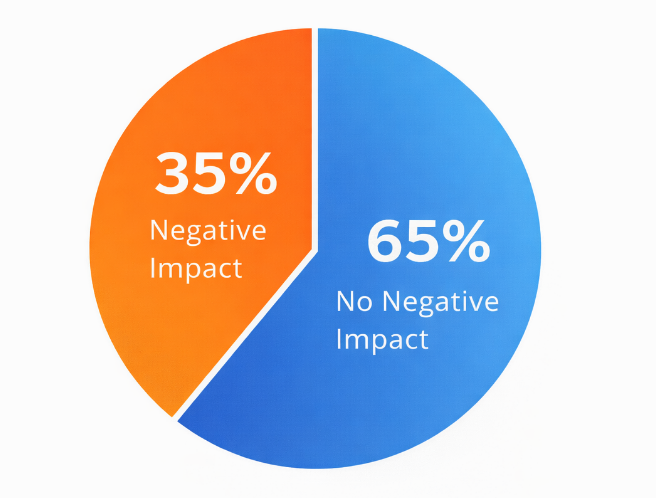
Share of marketers reporting diminished ability to track, target, and measure results after cookie deprecation
Blended metrics reduce volatility and reflect overall business impact rather than isolated tracking signals.
2. Adopt a Portfolio-Based Channel Strategy
Without perfect attribution, each channel cannot be judged in isolation. Instead, treat your advertising mix as an investment portfolio.
Core Channel Categories
-
Demand Capture (e.g., high-intent search)
-
Demand Generation (paid social, display, video)
-
Retargeting and remarketing
-
Account-based or company-level targeting
Rather than asking, "Did this channel directly convert?" ask:
-
Does it increase overall conversion rate across channels?
-
Does branded search volume rise after campaign launches?
-
Does pipeline velocity improve?
Correlation analysis and trend comparisons become more important than individual user tracking.
3. Use Incrementality Testing
Incrementality testing is one of the most reliable methods in low-attribution environments.
Methods to Apply
-
Geo-based holdout tests
-
Time-based experiments (on/off cycles)
-
Audience suppression tests
-
Budget step-change experiments
For example, if you increase spend by 30% in a defined region and total conversions rise by 18% relative to control regions, you can model contribution even without deterministic attribution.
Incrementality answers the real question: "Would these results have happened without this spend?"
4. Leverage First-Party and Company-Level Data
As third-party signals decline, first-party data becomes the foundation of strategy.
This includes:
-
CRM lifecycle data
-
Offline conversion imports
-
Sales-qualified lead tracking
-
Company-level engagement signals
Company-level tracking and IP-based intelligence help bridge visibility gaps in B2B environments where individual users may not convert immediately.
Instead of asking, "Which person clicked?" focus on:
-
Which accounts engaged?
-
Which companies returned?
-
Which segments accelerated through the funnel?
This shift aligns advertising with revenue operations.
5. Embrace Modeled and Blended Attribution
Perfect attribution is deterministic. Modern attribution is probabilistic.
Use:
-
Data-driven attribution models
-
Media mix modeling (MMM)
-
Multi-touch modeling with confidence intervals
-
Blended ROAS analysis
Even if precision drops, directional accuracy is often sufficient for optimization.
Studies show that marketers using modeled attribution combined with incrementality testing see up to 20–30% improvement in budget allocation efficiency compared to last-click-only optimization.
6. Optimize for Signal Density, Not Just Volume
Signal density refers to how much meaningful data your campaigns generate.
Ways to improve it:
-
Broaden conversion definitions (include micro-conversions)
-
Track engagement depth
-
Monitor assisted conversions
-
Measure pipeline stage progression
When macro conversions are scarce, micro-signals provide optimization leverage.
For example:
-
Demo request
-
Pricing page revisit
-
Multiple session engagement
-
Return visits within 14 days
These signals enhance modeling reliability.
7. Strengthen Creative and Messaging Feedback Loops
In limited attribution environments, creative testing becomes even more important.
Instead of relying solely on conversion metrics:
-
Measure engagement rate differentials
-
Compare click-through lift
-
Track time-on-site changes
-
Analyze assisted conversion influence
Creative that increases engagement quality often improves downstream performance — even if attribution tools cannot fully reflect it.
8. Align Marketing and Sales Measurement
Attribution breaks down when marketing optimizes for leads while sales optimizes for revenue.
Unify around:
-
Revenue-qualified pipeline
-
Opportunity creation rate
-
Win rate by source cluster
-
Average deal velocity
When measurement aligns across departments, imperfect attribution becomes less damaging because overall performance indicators remain stable.
9. Build a Decision Framework for Uncertainty
Without perfect data, decision-making must be structured.
Implement:
-
Predefined test duration
-
Minimum data thresholds
-
Confidence interval requirements
-
Budget reallocation rules
For example:
-
Maintain campaigns for at least 2–3 sales cycles before evaluation.
-
Reallocate only when performance delta exceeds 15–20% sustained over multiple weeks.
Consistency prevents reactive optimization based on noise.
10. Accept That Attribution Is a Model — Not Reality
All attribution systems are simplified representations of complex buyer behavior.
In B2B especially:
-
Buying journeys can span 3–12 months.
-
Multiple channels interact.
-
Offline conversations influence decisions.
The goal is not perfection.
The goal is confident resource allocation.
If total pipeline and revenue grow sustainably while blended acquisition costs remain stable or decrease, the strategy is working — even if attribution reports appear incomplete.
Recommended Reading
For deeper strategic insight, consider exploring:
-
From Cold Traffic to Qualified Leads: A Full-Funnel Blueprint
-
How Influencers and Creators Can Monetize Instagram Follower Audiences
Conclusion
Digital advertising no longer operates in a world of full visibility. Privacy regulations, multi-device journeys, and complex B2B buying committees have permanently changed measurement dynamics.
Winning teams adapt by:
-
Using blended and modeled analytics
-
Prioritizing incrementality
-
Leveraging first-party and company-level data
-
Optimizing at the portfolio level
-
Making structured decisions under uncertainty
Perfect attribution is not required for profitable growth.
Strategic clarity, disciplined experimentation, and aligned revenue measurement are far more powerful.