Most Meta accounts struggle with scale because prospecting is unstable. Performance looks strong for a week, then collapses. The problem is rarely the creative alone. It is the structure behind how new users enter your funnel.
A scalable prospecting engine attracts cold audiences consistently and feeds retargeting with qualified traffic. It runs on clear architecture, disciplined testing, and clean signal prioritization. When these pieces align, scaling becomes predictable instead of reactive.
What a Prospecting Engine Actually Is
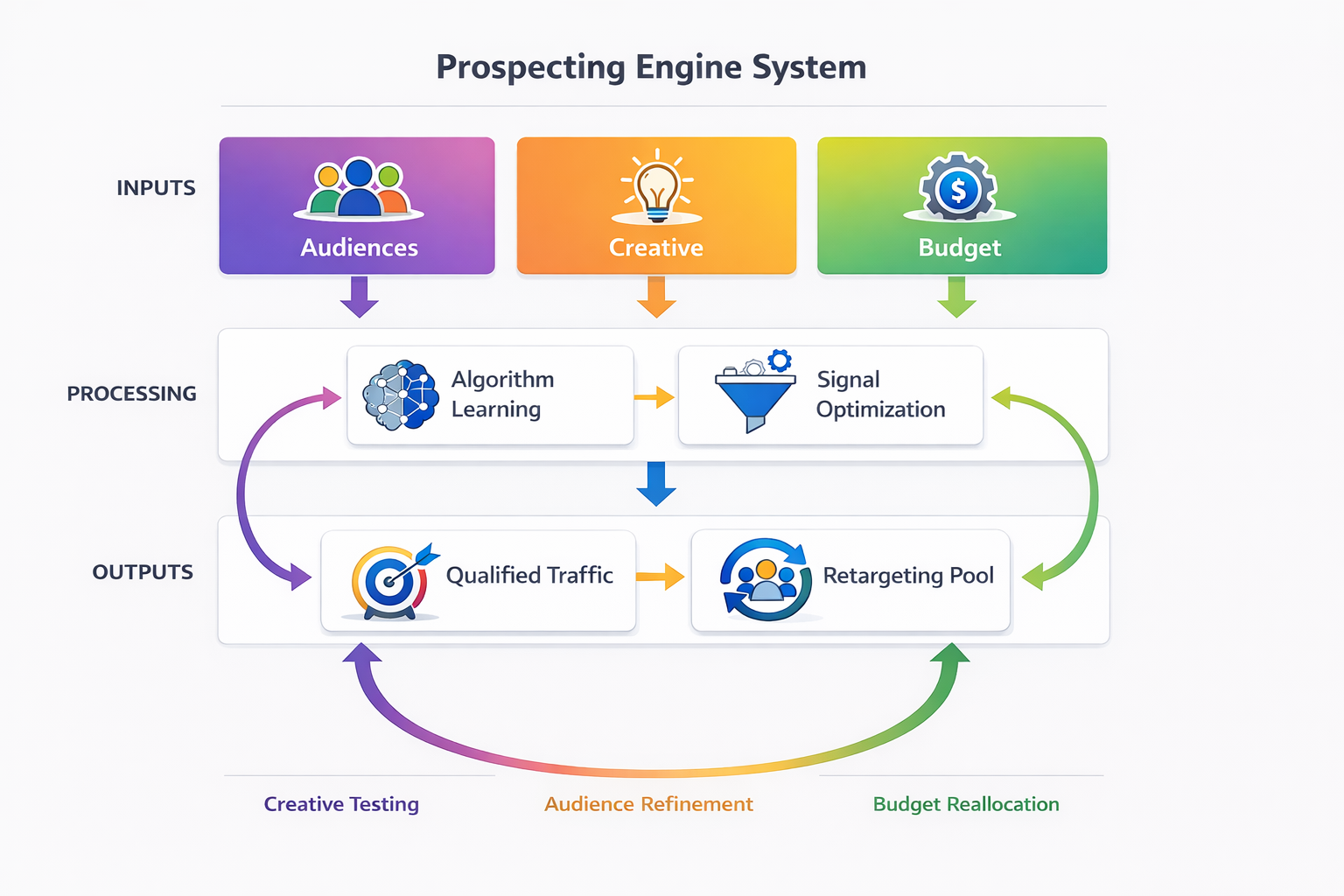
A prospecting engine is a structured system for acquiring new users at controlled costs. It is not a single campaign or a temporary test. It is a repeatable acquisition framework.
It includes audience strategy, creative rotation logic, budget allocation rules, and optimization signals. Each component has a defined role. When one fails, the entire system weakens.
The Core Objective of Prospecting
Prospecting is not about immediate purchases. It is about identifying high-intent users at scale. That requires accepting that some traffic will not convert instantly.
Your main objective is stable cost per qualified action. Depending on your funnel, that action may be:
-
Landing page views; this suits accounts with low daily budgets and limited data.
-
Add to cart; this works when traffic volume is strong but purchases are inconsistent.
-
Purchase; this is optimal when you generate enough conversions weekly for learning stability.
Choosing the wrong event destabilizes delivery. Meta optimizes toward the signal you provide, even if it hurts downstream efficiency.
Build the Right Campaign Architecture
Most scaling issues start with messy structure. Overlapping audiences and duplicated ad sets create internal competition. Costs rise, and performance becomes volatile.
Your prospecting layer should remain clean and isolated from retargeting. Clear exclusions are not optional. If you need a deeper structural breakdown, read The Anatomy of a Scalable Campaign.
Separate Prospecting From Retargeting
Prospecting should target only new users. Exclude all website visitors, customer lists, and recent engagers.
Retargeting should handle:
-
Website visitors segmented by behavior; for example, product viewers versus cart abandoners.
-
Social engagers; users who watched video or interacted with ads.
-
Existing customers; segmented by recency and purchase frequency.
Blending these audiences inside prospecting corrupts performance data. You lose clarity on what truly drives new demand.
Control Budget Allocation Intentionally
Scaling fails when budgets shift randomly between ad sets. Consolidation usually outperforms fragmentation.
Use fewer ad sets with broader targeting. Let the algorithm allocate spend inside a controlled framework. Set budget rules such as:
-
Allocate 60 to 80 percent of total spend to prospecting; this maintains consistent pipeline volume.
-
Limit audience testing budgets; new segments should not absorb core scaling capital.
-
Increase budgets gradually; large jumps reset learning and inflate CPMs.
For detailed allocation logic by funnel stage, see Budget Allocation by Funnel Stage 2025.
Budget discipline protects signal stability.
Design Creative for Cold Traffic
Cold audiences require context. They do not know your brand, and they do not trust your claims.
Creative for prospecting should educate before it persuades. It should match awareness level.
Match Creative to Awareness Stage
Segment creative by user sophistication, not by random concepts. For example:
-
Problem-aware users; show relatable pain points and demonstrate consequences clearly.
-
Solution-aware users; explain your approach and differentiate from alternatives.
-
Product-aware users; focus on proof, case studies, and specific outcomes.
Running product-heavy ads to unaware audiences suppresses click-through rate. That lowers relevance signals and increases costs.
Implement Structured Creative Rotation
Creative fatigue often masquerades as audience saturation. The fix is not always new targeting.
Build a rotation plan based on measurable thresholds:
-
Monitor frequency; when it exceeds 2.5 to 3 on cold traffic, performance often declines.
-
Track CTR trend over seven days; a steady drop signals message exhaustion.
-
Review first impression rate; declining values indicate audience recycling.
For a deeper analysis of fatigue patterns, review Creative Fatigue: Early Signals and Fixes.
Replace angles, not just visuals. New hooks produce stronger resets than minor design changes.
Use Data to Expand Intelligently
Scaling requires systematic expansion. Random interest stacking or daily audience tweaks create noise.
Expansion should follow performance data.
Expand Through Proven Signals
Start with broad targeting. Let Meta identify patterns inside conversion data.
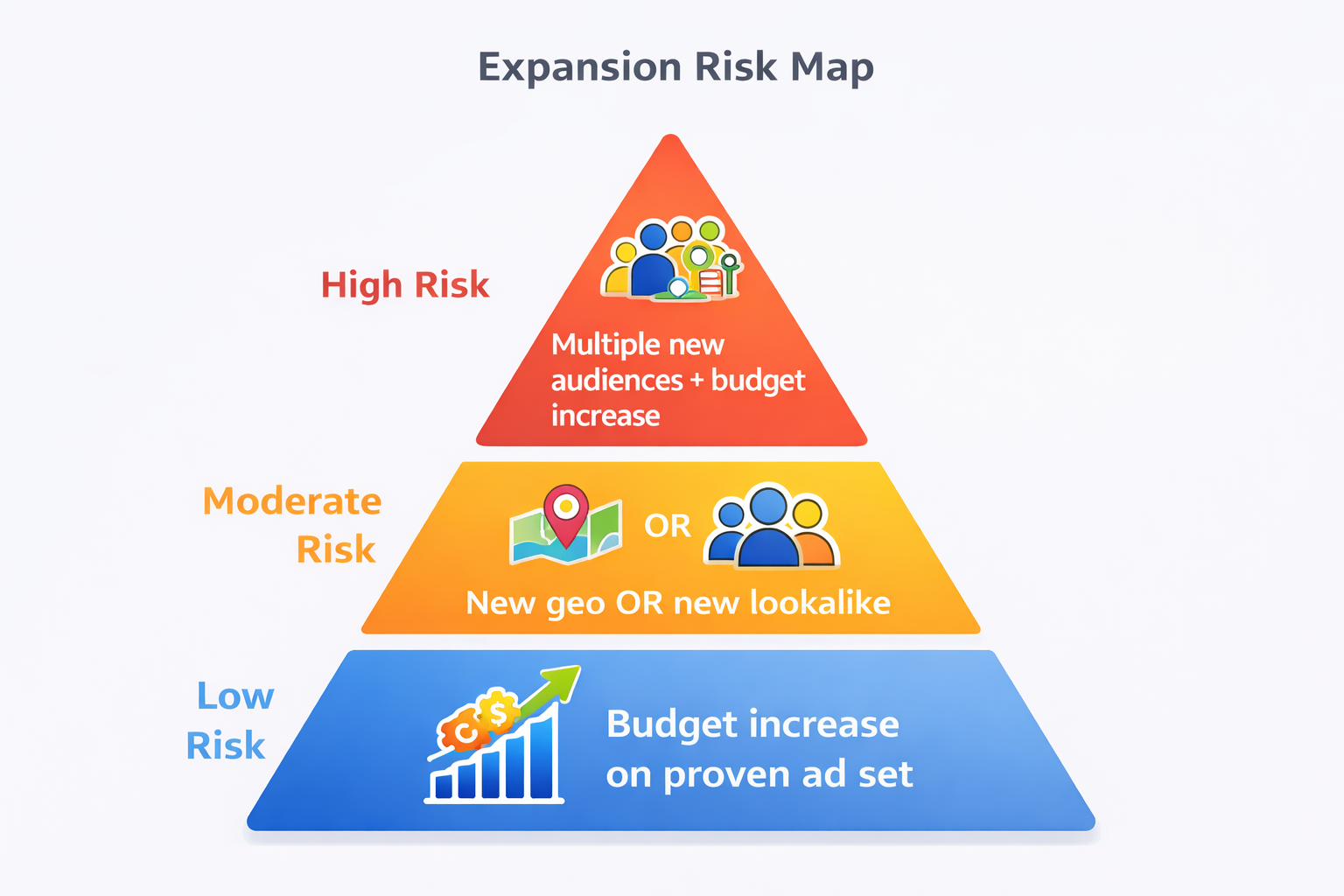
When scaling, consider:
-
Lookalike audiences based on high-value customers; use value-based sources when available.
-
Broad audiences with strong exclusions; this gives the algorithm freedom.
-
Geographic expansion; test new regions only after core markets stabilize.
If lookalikes are central to your growth model, consult The Ultimate Guide to Facebook Lookalike Audiences.
Avoid launching too many expansions simultaneously. You will not know what drives performance shifts.
Monitor Leading Indicators
Purchase data arrives late in the cycle. Relying only on final conversions slows decisions.
Track earlier metrics such as:
-
Cost per landing page view; rising costs may signal creative mismatch.
-
Add to cart rate; declining ratios suggest targeting drift.
-
Engagement rate on video; low retention indicates weak hooks.
These signals allow proactive adjustments before revenue drops.
Strengthen Your Conversion Signal
A scalable engine depends on strong optimization signals. Weak tracking corrupts algorithmic learning.
Audit your pixel and events regularly. Confirm event firing accuracy across devices.
Prioritize High-Quality Events
Event hierarchy should reflect business value. Do not optimize for vanity metrics.
If purchase volume is low, strengthen the funnel first. Improve conversion rate before forcing purchase optimization.
Practical steps include:
-
Improve landing page load speed; slow pages destroy early intent.
-
Reduce form friction; fewer fields increase completion rates.
-
Align ad promise with page content; disconnect lowers conversion probability.
Better post-click experience improves signal quality. The algorithm learns from real conversions, not theoretical demand.
Protect Stability While Scaling
Scaling often breaks performance because structural stability disappears. Sudden changes confuse the learning phase.
Adopt a controlled scaling process.
Scale Vertically Before Horizontally
Increase budget on winning ad sets gradually. Monitor CPA after each adjustment.
Only expand to new audiences after core sets stabilize. Horizontal expansion without vertical strength spreads data thin.
Limit Structural Changes
Frequent edits reset learning. Avoid changing targeting, creative, and budget simultaneously.
Instead:
-
Change one variable at a time; this isolates cause and effect.
-
Allow at least three to five days before evaluating impact; early volatility is normal.
-
Document changes; performance analysis requires clear records.
Consistency allows patterns to emerge.
Diagnose Prospecting Breakdowns
When prospecting stops scaling, identify the failing layer. Do not assume audience fatigue immediately.
Check these layers sequentially:
-
Creative layer; declining CTR and rising CPM suggest message issues.
-
Signal layer; tracking gaps or low event volume reduce optimization accuracy.
-
Funnel layer; stable traffic with falling conversion rate indicates landing page problems.
-
Structural layer; overlapping audiences inflate costs and fragment delivery.
Diagnosis should rely on data trends, not intuition.
Create a Repeatable Growth Framework
A scalable prospecting engine is systematic. It relies on structure, signal integrity, and disciplined testing.
Document your targeting logic, budget rules, and creative rotation schedule. Treat prospecting as an operational system, not a campaign experiment.
When structure is stable, scaling becomes incremental. You add controlled budget, validate performance, and expand with confidence. That is how consistent growth compounds over time.