Predictive analytics is transforming the way marketers plan, execute, and optimize paid social campaigns. By leveraging historical data, machine learning models, and behavioral insights, advertisers can move from reactive decision-making to proactive, performance-driven strategy.
Introduction
Paid social advertising has evolved into a data-intensive discipline. With increasing competition, rising CPMs, and fragmented audience journeys, marketers can no longer rely solely on manual optimization and retrospective reporting. Predictive analytics introduces statistical modeling and machine learning techniques to forecast outcomes before budget is deployed.
Rather than asking what happened, predictive analytics answers what is likely to happen next — and what should be done about it.
What Is Predictive Analytics in Paid Social?
Predictive analytics uses historical campaign data, audience behavior signals, and algorithmic modeling to forecast future outcomes such as:
-
Conversion probability
-
Customer lifetime value (LTV)
-
Click-through rate (CTR)
-
Cost per acquisition (CPA)
-
Churn likelihood
-
Audience engagement depth
Models typically rely on regression analysis, classification algorithms, clustering techniques, and increasingly, neural networks. These systems detect patterns that are not visible through traditional dashboard reporting.
Why Predictive Analytics Matters Now
The average social media user interacts with multiple platforms daily, creating enormous behavioral datasets. At the same time, advertising costs have steadily increased. For example:
-
Global social media ad spend surpassed $200 billion in 2023.
-
Average CPMs on major social platforms have increased by more than 60% over the past five years.
-
High-performing campaigns that leverage data-driven optimization report up to 20–30% lower acquisition costs compared to manual-only optimization.
With tighter margins, forecasting accuracy becomes a competitive advantage.
Core Applications in Paid Social Campaigns
1. Predictive Audience Targeting
Instead of targeting broad interest groups, predictive models identify users with the highest probability of conversion. Lookalike modeling, behavioral clustering, and intent scoring allow advertisers to allocate budget to high-propensity segments.
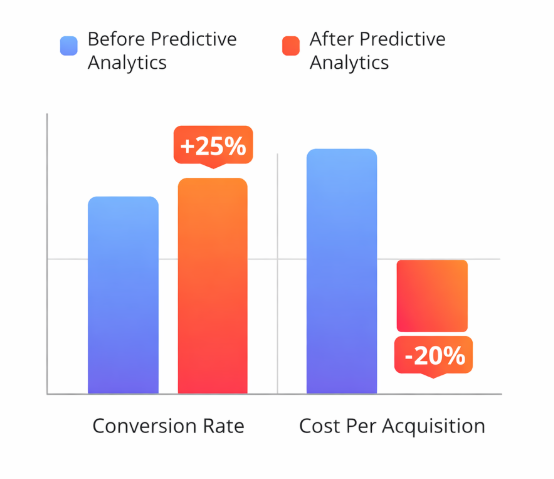
Changes in conversion rate and cost per acquisition driven by predictive analytics implementation
This improves:
-
Conversion rate stability
-
Budget efficiency
-
Reduced audience fatigue
2. Budget Allocation Forecasting
Predictive models estimate expected returns across campaigns, ad sets, and creatives. Rather than distributing budget evenly, marketers can shift spend toward segments projected to deliver the highest marginal return.
Organizations implementing predictive budget allocation often see measurable improvements in ROAS consistency.
3. Creative Performance Prediction
By analyzing historical engagement metrics — such as hook retention, engagement velocity, and click intent — predictive systems can estimate which creative concepts are likely to outperform before scaling.
This reduces creative testing waste and accelerates optimization cycles.
4. Customer Lifetime Value Modeling
Short-term CPA can be misleading. Predictive analytics enables long-term value forecasting, allowing campaigns to optimize for expected revenue rather than immediate cost per lead.
LTV-based bidding models frequently outperform short-term conversion optimization in subscription and high-ticket industries.
Data Inputs That Power Predictive Models
Accurate forecasting depends on data quality and volume. Common inputs include:
-
Historical campaign performance metrics
-
CRM data and closed-won revenue
-
Behavioral event tracking (page views, scroll depth, time on site)
-
Audience segmentation attributes
-
Attribution modeling data
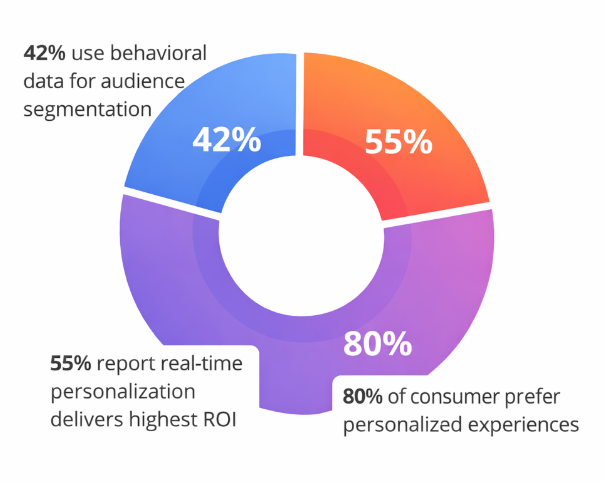
Adoption of behavioral data and personalization techniques among marketers for improved targeting and ROI
The integration of first-party data has become especially critical as privacy regulations reduce third-party tracking reliability.
Statistical Impact on Campaign Performance
Research across performance marketing studies indicates that organizations using predictive modeling experience:
-
15–25% improvement in conversion rate consistency
-
10–20% reduction in wasted ad spend
-
20% faster optimization cycles
-
30% more accurate revenue forecasting
These gains compound over time, particularly in multi-channel acquisition ecosystems.
Implementation Challenges
Despite its advantages, predictive analytics requires:
-
Sufficient historical data volume
-
Clean attribution frameworks
-
Technical infrastructure for modeling
-
Cross-team collaboration between marketing and analytics
Without these components, predictive outputs may be unreliable or misinterpreted.
Strategic Best Practices
-
Start with a clearly defined objective (CPA reduction, LTV growth, churn minimization).
-
Centralize data collection before modeling.
-
Validate models using holdout testing.
-
Avoid overfitting by retraining models regularly.
-
Combine machine predictions with human strategic oversight.
Predictive analytics is a decision-support system — not a replacement for marketing strategy.
The Future of Paid Social Optimization
As automation becomes standard across ad platforms, competitive differentiation will increasingly depend on proprietary data modeling. Predictive frameworks will evolve toward real-time adaptive bidding, dynamic audience reshaping, and cross-platform forecasting integration.
Organizations that treat predictive analytics as infrastructure rather than an experiment will gain structural performance advantages.
Conclusion
Predictive analytics transforms paid social from reactive reporting to proactive strategy. By forecasting user behavior, optimizing budget allocation, and aligning campaigns with long-term value metrics, advertisers can reduce inefficiencies and increase profitability.
In an environment of rising acquisition costs and algorithmic complexity, prediction is no longer optional — it is foundational to scalable growth.