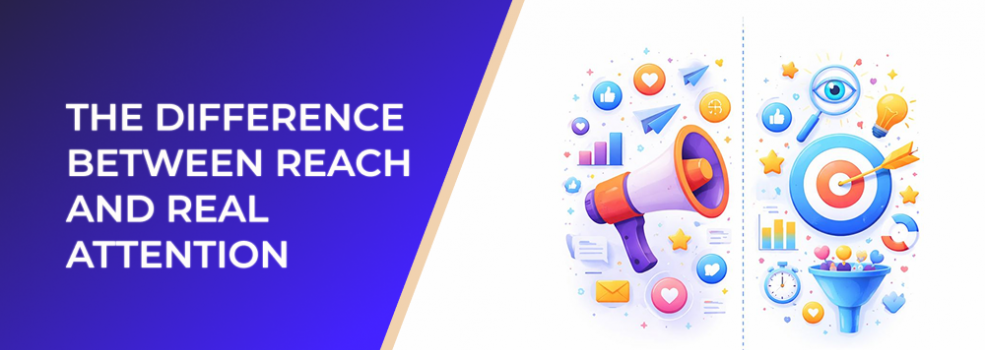
For years, reach has been one of the most visible and easy-to-understand metrics in digital marketing. It answers a simple question: How many people could have seen your message? Platforms highlight it prominently because it scales well and looks impressive in reports.
However, reach is a potential, not a guarantee. A campaign that reaches 500,000 people does not mean 500,000 people noticed, processed, or remembered the message. In fact, most of them likely scrolled past it in less than a second.
According to multiple eye-tracking studies in digital environments, users spend less than 2 seconds on average viewing a single piece of content in fast-scrolling feeds. High reach in this context often represents fleeting exposure rather than meaningful interaction.
What “Real Attention” Actually Means
Real attention goes beyond exposure. It measures whether people:
-
Stop scrolling and visually engage with the content
-
Spend time consuming the message
-
Interact (click, comment, save, or share)
-
Recall the brand or offer later
Attention is tied to cognitive effort. If a message does not demand enough relevance or emotional resonance, the brain filters it out almost instantly.
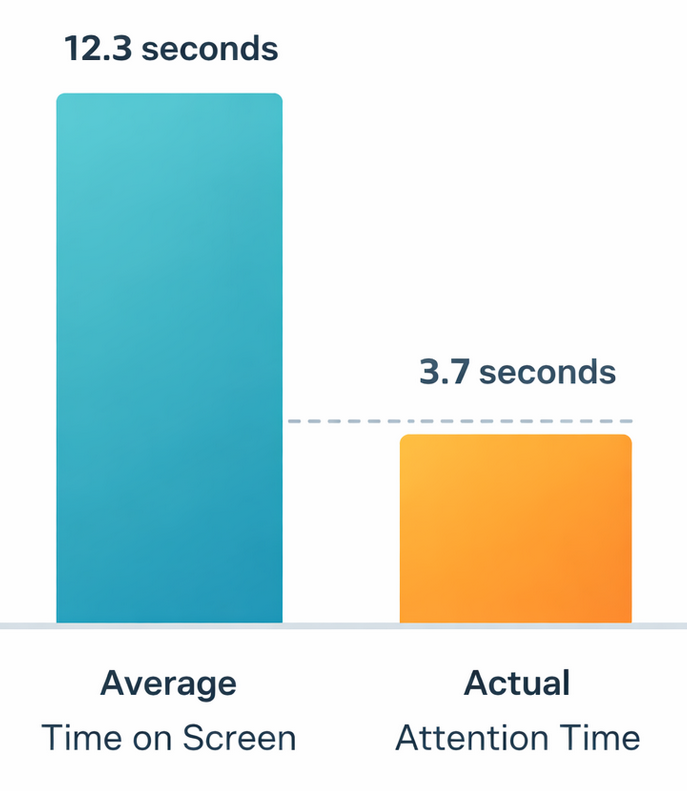
Average ad visibility vs. actual viewer attention — showing that audiences only focus for a fraction of the time ads are displayed
Research in advertising effectiveness shows that ads receiving at least 3 seconds of active attention are significantly more likely to be remembered and to influence purchase intent. Anything below that threshold has a sharply diminishing impact.
The Hidden Cost of Chasing Reach
When campaigns are optimized primarily for reach, three problems tend to appear:
-
Low message retention – People may technically see an ad but forget it moments later.
-
Weak downstream performance – Click-through rates, conversions, and post-click engagement remain low.
-
False confidence – Large numbers create the illusion of success, masking poor efficiency.
A common pattern in campaign audits is seeing millions of impressions paired with click-through rates below 0.7%, a strong indicator that the message failed to earn attention.
Attention Is Scarce — And That Changes Everything
Human attention is limited. Studies estimate that the average person is exposed to 4,000–10,000 marketing messages per day across digital and offline channels. The brain’s defense mechanism is to ignore most of them automatically.
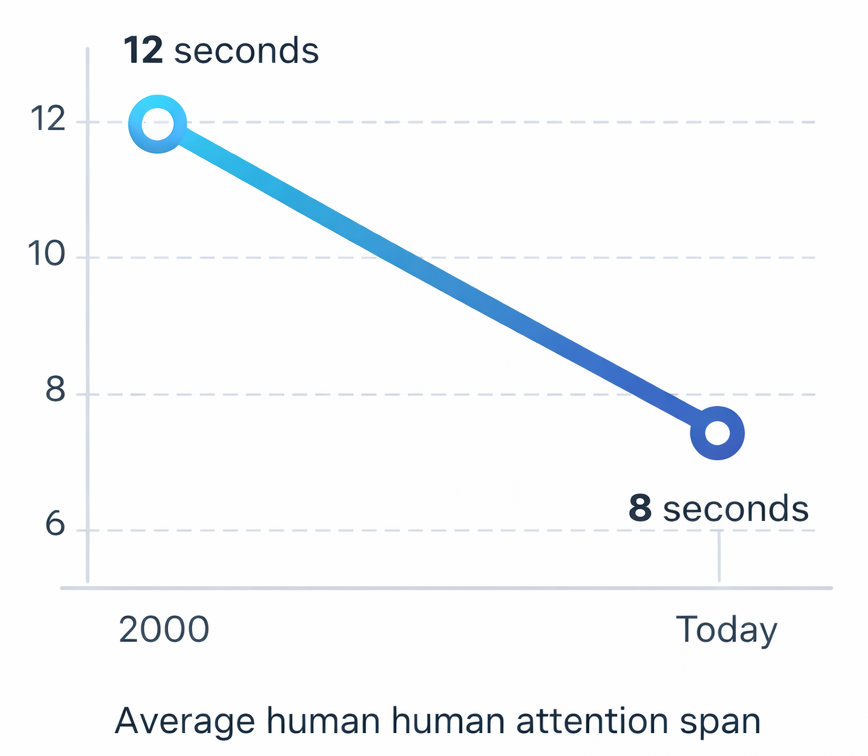
Trend of decreasing average attention span over the past two decades
This means that attention is no longer just a byproduct of exposure; it is a scarce resource that must be deliberately earned. Relevance, timing, and context play a far bigger role than sheer volume.
Metrics That Signal Real Attention
Instead of focusing on reach alone, attention-driven campaigns track signals such as:
-
Average view duration (especially past the 3-second mark)
-
Engagement rate (comments, saves, meaningful reactions)
-
Click quality, not just click quantity
-
Conversion rate per engaged user, not per impression
In performance-focused accounts, campaigns optimized around these metrics often show 20–40% lower cost per conversion compared to reach-optimized campaigns, even with smaller audience sizes.
From Visibility to Impact
Shifting from reach to real attention requires a mindset change. Success is no longer about how many people could see your message, but how many actually process it.
This shift typically involves:
-
Narrower but more relevant audience segments
-
Clear, specific messaging instead of generic awareness slogans
-
Creative formats designed to stop scrolling, not just fill space
The result is fewer wasted impressions and a stronger connection with the people who matter most.
Final Thought
Reach answers the question, “How far did this message travel?”
Attention answers the more important one: “Did it land?”
In a saturated digital landscape, the campaigns that win are not the loudest, but the ones that earn a moment of genuine focus.