Predictable lead generation is not about finding a single high-performing campaign or platform. It is about building a system that produces consistent results over time, regardless of short-term fluctuations in traffic, costs, or algorithms. Companies that succeed with predictable lead generation rely on structure, measurement, and continuous optimization rather than isolated tactics.
Why Predictability Matters
Unpredictable lead flow makes planning difficult. Sales teams struggle with pipeline gaps, budgets become harder to justify, and growth decisions are based on assumptions rather than data. In contrast, predictable lead generation allows businesses to forecast revenue, scale with confidence, and react faster to market changes.
Industry research shows that organizations using data-driven marketing strategies are significantly more likely to achieve consistent performance. According to multiple marketing benchmarks, companies that actively track and optimize their funnels report conversion rate improvements of 20–30% on average compared to those that rely on static campaigns.
Build a Structured Acquisition Funnel
Predictability starts with a clearly defined funnel. Every stage—from first touch to qualified lead—should have a specific goal, metric, and expected conversion rate.
A structured funnel typically includes:
-
Traffic sources with stable volume and historical performance data
-
Dedicated landing pages tailored to a single offer
-
Clear qualification criteria for leads
-
Automated follow-up and nurturing flows
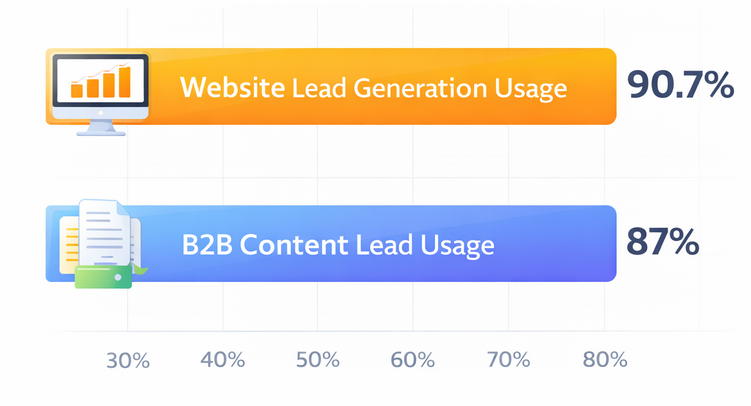
Inbound Channels in Lead Acquisition: A significant majority of marketers rely on websites and content for lead generation
When each stage is measured independently, it becomes easier to identify bottlenecks and forecast how changes in traffic or budget will affect total lead volume.
Focus on Conversion Rate Optimization
Increasing traffic alone rarely leads to predictable growth. Conversion rate optimization (CRO) plays a critical role in stabilizing lead output.
Data from CRO studies indicates that nearly 80% of businesses see improved lead quality or volume after running structured experiments. Moreover, statistically significant tests can deliver conversion lifts of up to 40–50% in high-impact funnel stages such as landing pages or lead forms.
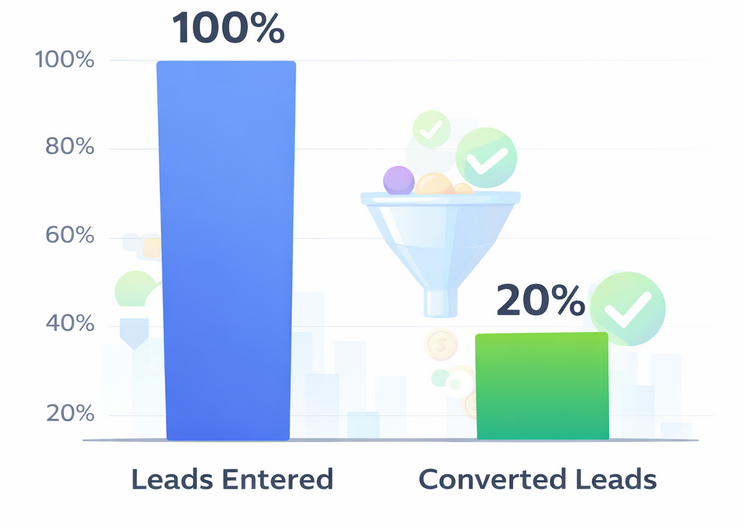
Lead Conversion Gap: Most captured leads don’t convert without structured nurturing and optimization
To make CRO predictable:
-
Test one variable at a time
-
Set minimum data thresholds before drawing conclusions
-
Document results and reuse winning patterns across campaigns
Standardize Lead Qualification
Not all leads have equal value. Predictable lead generation requires consistent qualification rules that align marketing and sales.
Organizations that implement standardized lead scoring models report up to 30% higher sales acceptance rates. By defining what qualifies as a marketing-qualified lead (MQL) or sales-qualified lead (SQL), teams reduce friction and improve downstream conversion predictability.
Key qualification signals may include:
-
Intent-based behaviors
-
Firmographic or demographic fit
-
Engagement depth and frequency
Use Historical Data to Forecast Results
Predictability comes from understanding past performance. Historical data allows teams to calculate expected outcomes and set realistic targets.
For example, if a funnel consistently converts 3% of visitors into leads and 20% of leads into opportunities, traffic increases can be directly translated into expected pipeline growth. This approach transforms lead generation from experimentation into forecasting.
According to industry benchmarks, companies that regularly use historical performance data in planning are more likely to hit their lead targets than those that rely on short-term trends or assumptions.
Reduce Dependency on Single Channels
Relying on one traffic source introduces volatility. Algorithm updates, cost increases, or policy changes can disrupt lead flow overnight.
Predictable systems distribute risk across multiple channels while maintaining consistent messaging and offers. Even if one channel underperforms temporarily, the overall system remains stable.
Marketing surveys show that businesses using three or more acquisition channels experience less lead volatility compared to those focused on a single platform.
Align Marketing and Sales Around Feedback Loops
Predictability improves when feedback is continuous. Sales insights help refine targeting, messaging, and qualification criteria.
High-performing teams review lead quality and conversion data on a regular basis. This feedback loop allows marketing efforts to adjust quickly, reducing wasted spend and improving consistency over time.
Recommended Reading
For deeper insights into building scalable and consistent acquisition systems, consider exploring these related articles:
Final Thoughts
Predictable lead generation is the result of systems, not shortcuts. By structuring funnels, optimizing conversions, standardizing qualification, and relying on data rather than intuition, businesses can create a repeatable engine for growth. The goal is not to eliminate experimentation, but to turn experimentation into a controlled, measurable process that supports long-term stability and scale.