Successful campaigns confirm what you already know. Failed campaigns challenge assumptions and reveal what your audience truly responds to—or rejects. Data from multiple marketing studies shows that nearly 70% of digital campaigns fail to meet their primary performance goals, yet the same campaigns often contain signals that later drive higher-performing iterations.
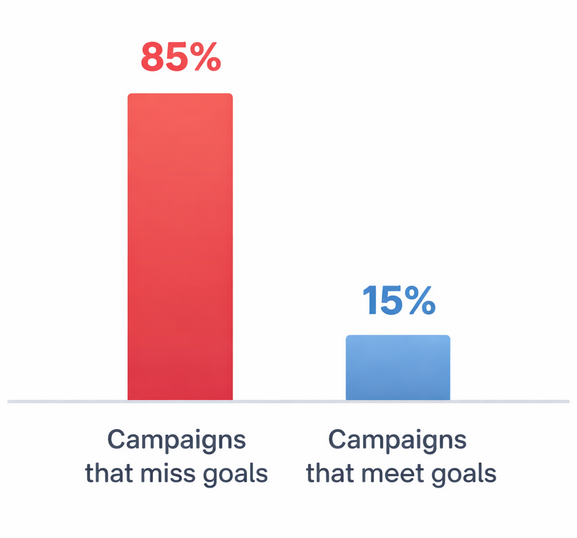
Most marketing campaigns fail to reach their intended goals, with approximately 85% missing performance targets
Instead of treating failure as wasted spend, high-performing teams treat it as structured feedback. The difference lies not in budget size, but in how insights are extracted and applied.
Step 1: Redefine What “Failure” Means
A campaign that misses its target CPA or CTR is not useless. It is a diagnostic tool. Ask specific questions:
-
Which audience segments engaged but did not convert?
-
Which creatives generated attention but failed to drive action?
-
At what stage did users drop off?
Industry benchmarks show that up to 40% of campaigns with below-average ROI still outperform benchmarks in at least one micro-metric, such as click quality, engagement depth, or time to conversion. These partial wins are often overlooked.
Step 2: Segment Before You Analyze
Looking at aggregated performance hides the real story. Break results down by:
-
Audience source and size
-
Creative format and message angle
-
Placement and device
-
Time of day and frequency
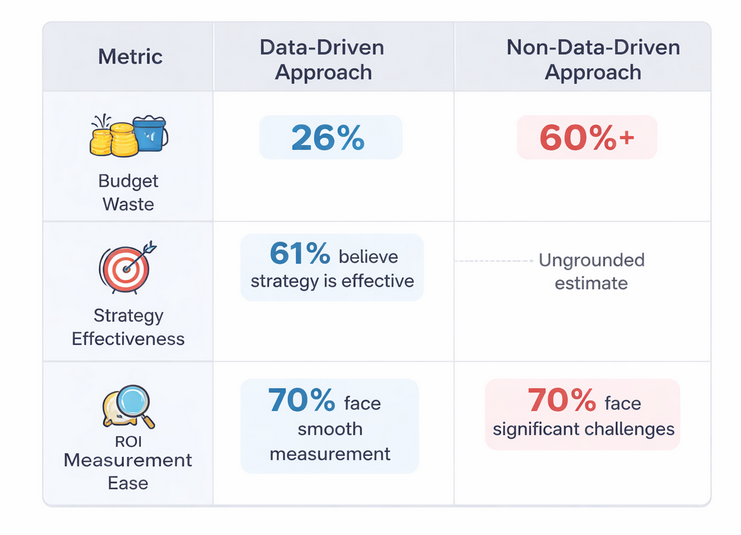
Comparison of campaign performance trends between teams using structured data practices and those without strong data approaches
According to large-scale ad account analyses, segment-level reviews uncover actionable insights in over 60% of campaigns initially labeled as failures. Without segmentation, these insights remain invisible.
Step 3: Compare Against Controlled Baselines
A failed campaign only makes sense in context. Compare results against:
-
Previous campaigns with similar objectives
-
Control audiences or creatives
-
Historical account averages
For example, if a campaign shows a 15% lower conversion rate than average but a 25% higher click-through rate, the issue may lie in post-click experience rather than targeting or messaging. Studies indicate that nearly 50% of performance drops are caused by mismatches between ad promise and landing experience, not the ad itself.
Step 4: Turn Patterns into Hypotheses
Insights become valuable only when they lead to structured testing. Translate observations into clear hypotheses:
-
“If we narrow the audience based on high-engagement segments, conversion rates will improve.”
-
“If we align creative messaging more closely with the landing page, bounce rates will decrease.”
Teams that formalize insights into testable hypotheses are 2× more likely to improve performance in the next campaign cycle, compared to teams that make reactive changes without documentation.
Step 5: Build an Insight Repository
One of the most overlooked practices is documenting failures. Create a shared repository that records:
-
What was tested
-
What failed and why
-
What signals were discovered
-
What should be tested next
Organizations that maintain structured insight libraries report up to 30% faster campaign optimization cycles and reduced repetition of the same mistakes.
Common Mistakes to Avoid
-
Pausing campaigns too early without enough data
-
Judging performance solely on one KPI
-
Making multiple changes at once, obscuring causality
-
Ignoring qualitative signals such as comments or feedback
Avoiding these pitfalls ensures that even underperforming campaigns contribute to long-term growth.
From Failure to Competitive Advantage
The most resilient marketers are not those who avoid failure, but those who systematize learning. Each unsuccessful campaign sharpens targeting logic, improves creative relevance, and refines strategic judgment.
When failures are treated as structured experiments rather than setbacks, they become one of the most reliable sources of sustainable performance improvement.
Recommended Reading
To deepen your understanding of performance optimization and learning-driven growth, explore these related articles: