
Modern marketing campaigns operate in highly dynamic environments where audience behavior, platform algorithms, and competitive landscapes shift constantly. According to recent industry benchmarks, over 60% of marketers report that campaign performance declines significantly within the first two weeks if no adjustments are made. Additionally, campaigns that incorporate automated optimization mechanisms can improve conversion rates by up to 30% compared to static campaigns.
Designing campaigns that self-correct over time is no longer an advanced tactic—it is a necessity. These campaigns use structured feedback loops, performance signals, and adaptive logic to refine targeting, messaging, and timing automatically.
What Is a Self-Correcting Campaign?
A self-correcting campaign is a system-driven marketing initiative that continuously analyzes its own performance and makes incremental adjustments to improve outcomes. Instead of relying solely on periodic human intervention, it leverages predefined rules, data triggers, and learning mechanisms.
Key characteristics include:
-
Continuous performance monitoring
-
Automated decision-making based on thresholds
-
Iterative audience refinement
-
Message and channel optimization over time
Why Traditional Campaigns Fail
Traditional campaigns are built on static assumptions: predefined audiences, fixed messaging, and rigid timelines. This approach introduces several critical limitations:
-
Audience fatigue: Repeated exposure leads to declining engagement rates
-
Signal decay: Initial targeting assumptions become less accurate over time
-
Delayed optimization: Manual adjustments are often reactive rather than proactive
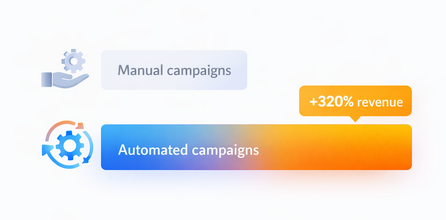
Automation-driven campaigns dramatically outperform manual execution, highlighting the value of adaptive optimization systems
Research shows that audience engagement can drop by 25–40% after repeated exposure to unchanged messaging. Without adaptive mechanisms, campaigns gradually lose efficiency.
Core Components of Self-Correcting Campaigns
1. Feedback Loops
At the core of any self-correcting system is a feedback loop. Campaigns must continuously collect and process signals such as:
-
Open and click-through rates
-
Conversion events
-
Response timing
-
Drop-off points
These signals form the basis for decision-making. High-performing segments are expanded, while underperforming ones are deprioritized or removed.
2. Dynamic Audience Segmentation
Static lists quickly become outdated. Instead, campaigns should dynamically segment audiences based on behavior and engagement.
Examples include:
-
Re-engaging users who interacted within the last 7 days
-
Suppressing contacts who have not responded after multiple attempts
-
Prioritizing accounts showing high-intent signals
Companies using dynamic segmentation report up to 20% higher engagement rates compared to static segmentation strategies.
3. Rule-Based Optimization
Rule-based systems allow campaigns to respond automatically to performance changes.
Examples of rules:
-
Pause sequences if open rates fall below a defined threshold
-
Increase outreach frequency for high-engagement segments
-
Switch messaging angles after repeated non-response
These rules act as guardrails, ensuring campaigns remain efficient without constant manual oversight.
4. Message Iteration Framework
Messaging should evolve based on real performance data. Instead of relying on a single version, campaigns should:
-
Rotate multiple message variants
-
Promote top-performing copy
-
Retire underperforming variations
A/B testing alone is not sufficient; continuous iteration is required. Studies show that campaigns using ongoing message optimization can increase response rates by up to 25%.
5. Timing and Cadence Adjustment
Timing plays a critical role in campaign success. Self-correcting campaigns adjust cadence based on engagement patterns.
For example:
-
Shortening intervals for highly responsive leads
-
Extending intervals for colder segments
-
Pausing outreach during inactivity periods
Adaptive timing strategies can reduce unsubscribe rates by up to 15%.
Building a Self-Correcting Campaign: Step-by-Step
Step 1: Define Success Signals
Identify the metrics that indicate progress toward your goal. These may include:
-
Reply rates
n- Conversion rates -
Pipeline generation
Clear signals ensure that optimization decisions are aligned with business outcomes.
Step 2: Establish Thresholds
Define performance benchmarks that trigger actions. For example:
-
Open rate below 20% triggers subject line changes
-
No response after three touches triggers audience suppression
Thresholds transform raw data into actionable decisions.
Step 3: Implement Automation Logic
Translate thresholds into rules that the campaign can execute automatically. This creates a system that reacts in real time rather than waiting for manual review.
Step 4: Enable Continuous Testing
Introduce controlled variation in messaging, targeting, and timing. Ensure that the system continuously learns from results.
Step 5: Monitor and Refine
Even self-correcting systems require oversight. Regularly review performance trends to refine rules and improve long-term outcomes.
Common Mistakes to Avoid
-
Over-automation: Excessive rules can create conflicting actions
-
Insufficient data volume: Small sample sizes lead to unreliable decisions
-
Ignoring qualitative signals: Not all insights are captured in metrics
-
Delayed feedback loops: Slow data processing reduces responsiveness
Balancing automation with strategic oversight is essential for sustainable performance.
Future Outlook
As marketing systems become more data-driven, self-correcting campaigns will evolve toward predictive optimization. Instead of reacting to performance changes, future systems will anticipate them.
Organizations that adopt adaptive campaign design today will be better positioned to compete in increasingly complex digital environments.
Recommended Reading
Conclusion
Self-correcting campaigns represent a shift from static execution to adaptive systems. By embedding feedback loops, dynamic segmentation, and automated optimization, marketers can create campaigns that continuously improve over time.
In a landscape where change is constant, the ability to adapt is not just an advantage—it is a requirement.