Marketing teams often assume that weak campaign performance is caused by poor creative. As a result, they invest time redesigning banners, rewriting copy, or producing new videos. However, in many cases the real issue lies in how the budget is distributed.
Reallocating budget across channels, audiences, or campaign stages can produce faster and more measurable improvements than creative changes. Understanding when to prioritize budget optimization can significantly increase marketing efficiency.
Why Creative Changes Are Not Always the First Fix
Creative optimization is important, but it can be slow and expensive. Producing new assets may take weeks and requires designers, copywriters, and approval cycles.
Meanwhile, budget allocation decisions can often be tested within hours. By shifting spend toward high-performing segments, marketers can immediately improve cost efficiency.
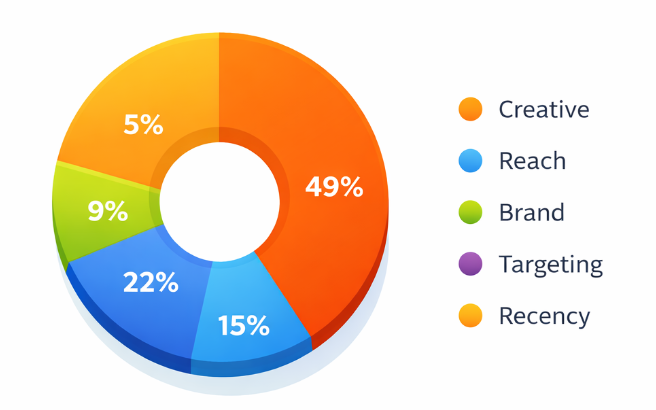
Key drivers of advertising sales lift across campaigns
According to a Nielsen study, marketing budget allocation accounts for up to 50–60% of campaign performance, while creative quality accounts for around 20–30%. This suggests that how money is distributed can have a larger impact than the message itself.
Signals That Budget Reallocation Is the Right Move
Several indicators suggest that budget distribution, rather than creative quality, is limiting performance.
1. Large performance gaps between channels
If some channels consistently deliver lower cost per acquisition while others struggle, reallocating budget toward the stronger channels can increase total conversions.
2. Audience segments performing unevenly
Different audience groups respond differently to the same creative. When certain segments convert significantly better, directing more spend toward them can yield immediate gains.
3. Campaign stages with clear bottlenecks
In multi‑stage funnels, some stages may receive too little budget. For example, a campaign may generate strong engagement but insufficient retargeting investment to convert that interest into sales.
The Data Behind Budget Optimization
Several industry studies demonstrate the impact of smarter budget allocation.
-
Research by Gartner found that marketers who regularly adjust budget allocation based on performance data improve campaign ROI by up to 30%.
-
HubSpot reports that companies that prioritize data‑driven budget decisions generate 20% more leads than those relying primarily on creative experimentation.
-
A McKinsey analysis shows that reallocating marketing budgets across channels can improve overall marketing efficiency by 10–20%.
These findings reinforce a simple idea: performance improvements often come from where money is spent rather than how ads look.
Practical Strategies for Budget Reallocation
1. Shift budget toward proven acquisition channels
Analyze cost per acquisition and conversion rates across all active channels. Increasing spend on channels with strong performance can scale results quickly without creative changes.
2. Prioritize high‑intent audiences
Audiences with higher purchase intent typically convert at significantly higher rates. Allocating more budget toward these segments improves efficiency and shortens the sales cycle.
3. Reinforce the retargeting layer
Many campaigns spend heavily on top‑of‑funnel awareness but underinvest in retargeting. Strengthening the retargeting budget ensures that interested prospects are repeatedly exposed to the offer.
When Creative Changes Still Matter
Budget optimization should not replace creative testing entirely. If all channels and audiences show weak engagement, the message itself may indeed be the issue.
Creative changes become necessary when:
-
Click‑through rates are consistently low across all segments
-
Engagement metrics decline even with adequate reach
-
Competitor campaigns clearly outperform similar offers
In these cases, updating the creative strategy becomes the priority.
Conclusion
Marketing performance rarely depends on a single factor. However, before investing significant time in new creatives, marketers should first examine how budgets are allocated.
Shifting resources toward high‑performing channels, audiences, and funnel stages can deliver faster improvements and better return on investment. In many cases, optimizing where the money goes is more impactful than changing what the ads say.
Recommended Reading