
cA well-structured funnel depends on clear audience segmentation across awareness, consideration, and decision stages. When these audiences overlap excessively, campaigns compete against themselves, frequency rises, and budget efficiency declines. Diagnosing overlap is therefore a critical step in optimizing campaign performance and ensuring accurate measurement.
Recent studies show that up to 30–50% of paid media inefficiency can be attributed to poor audience segmentation and overlap. Additionally, campaigns with unmanaged overlap can experience cost-per-acquisition increases of 20% or more due to internal competition in ad auctions.
What Is Audience Overlap?
Audience overlap occurs when the same users are included in multiple targeting groups across different campaigns or funnel stages. While some overlap is intentional (e.g., retargeting), excessive or uncontrolled overlap leads to:
-
Cannibalization between campaigns
-
Inflated frequency and ad fatigue
-
Misleading attribution data
-
Higher acquisition costs
Why Overlap Happens
Several structural and operational issues contribute to overlapping audiences:
1. Broad Targeting Definitions
When top-of-funnel audiences are defined too broadly, they inevitably include users already engaged in mid- or bottom-funnel campaigns.
2. Lack of Exclusion Rules
Failure to exclude users already in lower funnel stages leads to repeated targeting across campaigns.
3. Poor Data Synchronization
Disconnected data sources (CRM, website events, ad platforms) create inconsistent audience definitions.
4. Retargeting Expansion
Aggressive retargeting windows can reintroduce users into earlier funnel stages.
How to Diagnose Audience Overlap
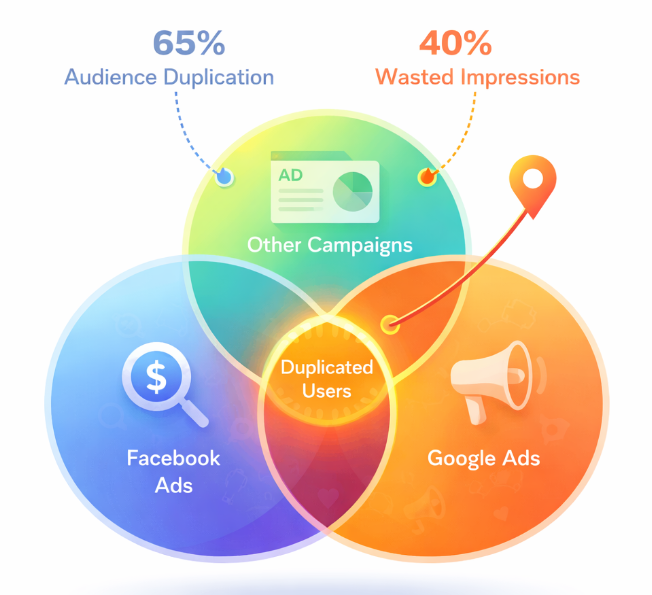
A significant portion of campaign reach is duplicated across audiences, leading to wasted impressions and reduced efficiency
1. Use Platform Overlap Tools
Most ad platforms provide audience overlap analysis features. These tools allow you to compare audience segments and quantify shared users.
Key metric to watch:
-
Percentage overlap between segments
A healthy funnel typically keeps overlap between adjacent stages below 20–30%, depending on campaign structure.
2. Analyze Frequency Distribution
High frequency in early-stage campaigns can indicate that users are being targeted repeatedly across multiple campaigns.
Benchmark indicators:
-
Awareness stage: frequency 1.5–3
-
Consideration stage: frequency 3–6
-
Decision stage: frequency 6–10
Significant deviations often signal overlap.
3. Compare Conversion Paths
Analyze user journeys in analytics tools to identify whether the same users are interacting with multiple funnel stages simultaneously rather than sequentially.
Look for patterns such as:
-
Direct conversions from awareness campaigns
-
Repeated exposure across multiple campaign types
4. Audit Audience Logic
Review how each audience is constructed:
-
Inclusion criteria
-
Exclusion rules
-
Time windows
-
Data sources
Map these across all campaigns to identify logical conflicts.
5. Monitor Auction Competition
If campaigns targeting similar audiences show rising CPMs or CPCs without external factors, internal competition may be the cause.
Studies indicate that internal bidding competition can increase CPMs by 10–25% in overlapping segments.
Methods to Fix Audience Overlap
1. Implement Strict Exclusion Hierarchies
Define a clear funnel hierarchy where each stage excludes users from lower stages:
-
Awareness excludes consideration and decision audiences
-
Consideration excludes decision audiences
This ensures clean progression through the funnel.
2. Refine Audience Definitions
Narrow broad audiences using:
-
Behavioral signals
-
Intent data
-
Firmographic filters
More precise targeting reduces unintended overlap.
3. Adjust Retargeting Windows
Shorten or stagger retargeting durations to prevent users from re-entering earlier funnel stages.
4. Centralize Audience Management
Use unified audience management systems to synchronize data across platforms and maintain consistent segmentation.
5. Segment by Engagement Level
Create distinct audience tiers based on interaction depth:
-
Low engagement (awareness)
-
Medium engagement (consideration)
-
High engagement (decision)
This reduces ambiguity in audience assignment.
Measuring Improvement
After implementing changes, track the following metrics:
-
Reduction in audience overlap percentage
-
Lower frequency in upper funnel stages
-
Improved cost-per-acquisition
-
More consistent attribution paths
Organizations that actively manage overlap often report efficiency gains of 15–35% in media spend.
Common Mistakes to Avoid
-
Over-segmentation leading to fragmented data
-
Ignoring cross-channel overlap
-
Failing to update exclusion lists dynamically
-
Relying solely on platform automation without manual validation
Conclusion
Diagnosing overlapping funnel audiences is essential for maintaining a clean, efficient marketing structure. By systematically analyzing overlap, refining segmentation, and enforcing exclusion rules, marketers can significantly improve performance, reduce wasted spend, and achieve more accurate attribution.
Recommended Articles