Modern digital marketing generates vast volumes of audience data, but not all of it is valuable. The critical challenge is not acquiring more data—it is isolating the segments that actually drive revenue.
Signal audiences are those with clear intent, engagement, and conversion potential. Noise audiences inflate metrics but contribute little to business outcomes. Failing to separate the two leads to inefficient spend, misleading analytics, and poor strategic decisions.
According to industry benchmarks, up to 60% of marketing-qualified leads never convert, often due to poor targeting or misclassification. Additionally, studies show that companies using advanced audience segmentation achieve up to 760% increase in revenue from targeted campaigns.
Defining Signal vs. Noise Audiences
Signal audiences exhibit measurable indicators of relevance and intent:
-
Consistent engagement across multiple touchpoints
-
Alignment with ideal customer profiles (ICP)
-
Demonstrated buying behavior or clear progression through the funnel
-
High lifetime value (LTV) potential
Noise audiences, in contrast, typically show:
-
Sporadic or shallow engagement
-
Mismatch with ICP criteria
-
Low conversion rates despite high impressions or clicks
-
High bounce rates or short session durations
Understanding these distinctions is foundational before applying any segmentation strategy.
Key Metrics That Reveal Audience Quality
To separate signal from noise, focus on metrics tied to outcomes rather than vanity indicators:
1. Conversion Rate by Segment
Segment-level conversion rates reveal which audiences actually produce results. A segment with a 2% conversion rate is significantly more valuable than one with 0.2%, even if the latter is larger.
2. Customer Acquisition Cost (CAC)
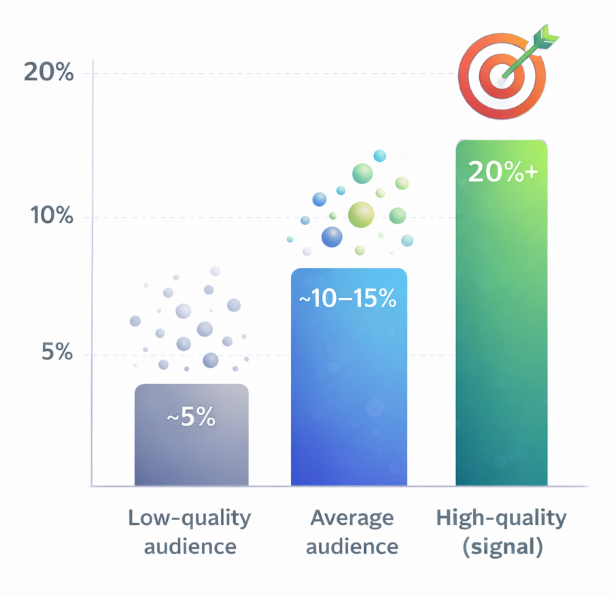
Higher-quality (signal) audiences consistently deliver stronger conversion performance
Noise audiences typically inflate CAC. Monitoring CAC at the segment level highlights inefficient targeting.
3. Engagement Depth
Track time on site, pages per session, and repeat visits. Signal audiences demonstrate sustained interaction rather than one-off visits.
4. Lead-to-Customer Ratio
A high volume of leads with low conversion indicates noise contamination in your pipeline.
Research shows that improving lead quality by just 10% can increase sales productivity by over 20%, emphasizing the importance of accurate audience classification.
Behavioral Indicators of Signal Audiences
Behavioral data often provides clearer signals than demographic attributes alone.
Key behaviors to prioritize:
-
Multiple visits within a short timeframe
-
Interaction with high-intent content (pricing pages, product demos)
-
Returning via direct or branded search
-
Engagement with emails beyond initial open rates (click-throughs, replies)
In contrast, noise audiences often:
-
Arrive via broad or irrelevant keywords
-
Exhibit high bounce rates
-
Do not progress beyond top-of-funnel content
Companies that leverage behavioral segmentation report up to 3x higher conversion rates compared to those relying solely on static attributes.
Segmentation Techniques That Work
1. Intent-Based Segmentation
Classify audiences based on actions that indicate readiness to buy. Examples include product page visits, demo requests, or repeated engagement.
2. Firmographic and Demographic Filtering
Refine audiences by company size, industry, role, or geography to align with your ICP.
3. Engagement Scoring Models
Assign weighted scores to user actions. For example:
-
Pricing page visit: +10
-
Demo request: +20
-
Blog visit: +2
This approach quantifies signal strength and helps prioritize outreach.
4. Cohort Analysis
Analyze groups of users over time to identify patterns in retention and conversion. High-performing cohorts indicate strong signal segments.
Eliminating Noise Systematically
Removing noise requires continuous refinement rather than one-time filtering.
Effective approaches include:
-
Excluding low-performing segments from campaigns
-
Applying negative audience filters (irrelevant industries, roles, or behaviors)
-
Using lookalike modeling based on high-value customers only
-
Regularly auditing data sources to remove outdated or inaccurate records
Organizations that actively prune low-quality audiences reduce wasted ad spend by up to 30%.
Validation and Continuous Optimization
Separating signal from noise is not a static process. Continuous validation ensures accuracy over time.
Best practices:
-
A/B test audience segments to compare performance
-
Monitor changes in conversion rates after segmentation updates
-
Re-evaluate scoring models quarterly
-
Align marketing and sales feedback loops to confirm lead quality
Data-driven teams that iterate on segmentation strategies outperform competitors by maintaining consistently high-quality pipelines.
Common Mistakes to Avoid
-
Over-reliance on top-of-funnel metrics such as impressions or clicks
-
Treating all leads as equal without segmentation
-
Ignoring behavioral signals in favor of static attributes
-
Failing to update ICP definitions as the business evolves
Avoiding these pitfalls is essential for maintaining a clean distinction between signal and noise.
Recommended Articles
Conclusion
Separating signal audiences from noise audiences is a foundational capability for any data-driven marketing strategy. By focusing on intent, behavior, and outcome-based metrics, organizations can significantly improve efficiency, reduce costs, and drive higher conversion rates.
The difference between growth and stagnation often lies not in how many leads are generated, but in how accurately they are qualified.