In B2B marketing, the average buying journey is no longer linear. According to Gartner, B2B buyers engage in 6–10 interactions before making a purchase decision, involving multiple stakeholders across departments. Research from Forrester indicates that more than 60% of B2B purchase decisions involve four or more decision-makers. In such an environment, single-touch attribution models fail to capture the true impact of marketing and sales efforts.
Multi-touch attribution (MTA) provides a structured methodology to assign value across every meaningful interaction that contributes to conversion. When implemented correctly, it allows revenue teams to allocate budget more efficiently, optimize campaigns, and align marketing and sales around measurable contribution to pipeline and revenue.
Why Single-Touch Attribution Fails
Traditional attribution models such as First-Touch or Last-Touch assign 100% of the credit to one interaction. While simple, these models distort performance insights:
-
First-Touch overvalues initial awareness channels while ignoring nurturing efforts.
-
Last-Touch overemphasizes bottom-of-funnel activities.
-
Neither reflects the collaborative nature of modern B2B buying cycles.
HubSpot reports that companies using multi-touch attribution are 33% more likely to improve marketing ROI measurement accuracy compared to those relying on single-touch models.
Core Multi-Touch Attribution Models
1. Linear Attribution
Linear attribution distributes equal credit across all touchpoints.
Best for: Organizations seeking simplicity while acknowledging multiple interactions.
Limitations: Does not distinguish between high-impact and low-impact touchpoints.
2. Time-Decay Attribution
Time-decay assigns increasing credit to touchpoints closer to conversion.
Best for: Long sales cycles where recency indicates stronger buying intent.
Limitations: May undervalue early-stage awareness campaigns.
3. Position-Based (U-Shaped) Attribution
This model typically allocates 40% credit to the first touch, 40% to the lead conversion touch, and 20% distributed across the remaining interactions.
Best for: Organizations prioritizing acquisition and lead creation events.
Limitations: Arbitrary weighting may not reflect actual influence.
4. W-Shaped Attribution
Extends the U-shaped model by assigning significant credit to three milestones: first touch, lead creation, and opportunity creation.
Best for: B2B organizations with clearly defined funnel stages.
Limitations: Still rule-based rather than data-driven.
5. Full-Path Attribution
Allocates credit across all major lifecycle milestones, including closed-won stage.
Best for: Revenue operations teams seeking complete funnel visibility.
Limitations: Requires sophisticated tracking infrastructure.
6. Data-Driven Attribution
Uses algorithmic modeling and historical performance data to calculate contribution weights dynamically.
Best for: Mature organizations with high data volume and clean CRM architecture.
Limitations: Demands strong data governance and integration discipline.
Google reports that data-driven attribution can improve conversion rates by up to 6% compared to rule-based models in high-volume environments.
Building a Reliable Multi-Touch Attribution Framework
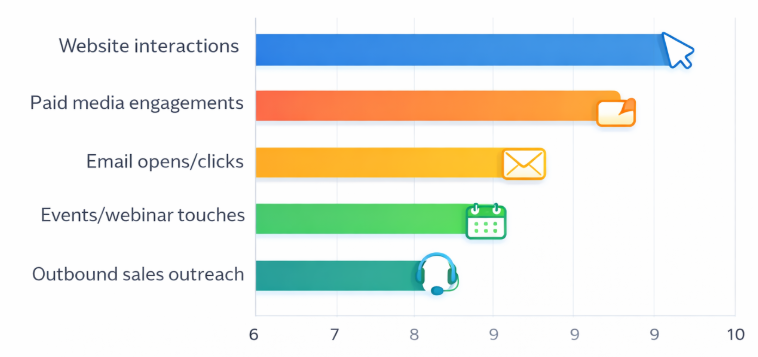
Average number of touchpoints B2B buyers engage with before making a purchase decision
Successful implementation requires more than selecting a model. It demands a structured data foundation.
1. Unified Data Architecture
Every touchpoint must be captured and mapped to contact and account records. This includes:
-
Website interactions
-
Paid media engagements
-
Email marketing activity
-
Outbound sales outreach
-
Events and webinars
-
CRM stage transitions
Without consistent identifiers and deduplicated records, attribution outputs become unreliable.
2. Contact-to-Account Mapping
In B2B, buying decisions are account-based. Attribution must aggregate interactions across all stakeholders within a target company. Studies show that enterprise deals often involve 6–8 stakeholders, each engaging with different content assets.
3. Funnel Stage Definition
Clear definitions for MQL, SQL, Opportunity, and Closed-Won stages are critical. Attribution depends on consistent lifecycle transitions.
4. Revenue Alignment
Marketing and sales leadership must agree on attribution logic. Misalignment results in distrust of reporting outputs.
Common Pitfalls in Multi-Touch Attribution
-
Incomplete tracking implementation
-
CRM data inconsistencies
-
Overlapping campaign tagging
-
Manual data entry errors
-
Ignoring offline touchpoints
According to SiriusDecisions, poor data quality reduces attribution accuracy by up to 20–30% in B2B environments.
Measuring Attribution Effectiveness
To validate your attribution model, monitor:
-
Pipeline contribution by channel
-
Cost per influenced opportunity
-
Revenue per marketing channel
-
Sales cycle acceleration by touchpoint type
-
Multi-channel interaction density before conversion
A well-implemented multi-touch model often reveals that mid-funnel nurturing activities influence 30–50% more revenue than previously reported under last-touch reporting.
Operationalizing Attribution for Growth
Attribution insights should drive decisions, not remain static dashboards.
-
Reallocate budget toward high-influence channels
-
Optimize campaign sequencing
-
Refine target account strategies
-
Improve sales and marketing coordination
-
Identify high-performing content clusters
Organizations that align budget allocation with multi-touch attribution insights report up to 15–20% improvement in marketing efficiency within 12 months.
Recommended Reading
Conclusion
Multi-touch attribution is not a reporting feature—it is a strategic revenue framework. In complex B2B buying journeys, accurate performance measurement requires recognizing the cumulative impact of every interaction. Organizations that invest in clean data architecture, cross-functional alignment, and scalable attribution modeling gain a measurable competitive advantage.
As buying committees expand and sales cycles lengthen, the ability to quantify influence across the entire customer journey becomes essential for sustainable growth.