
Audience health reflects how relevant, engaged, and conversion-ready your targeting base is. Poor audience health leads to rising costs, declining engagement, and unstable results. Strong audience health, on the other hand, supports predictable performance and smoother scaling.
According to multiple paid media benchmarks, campaigns optimized for high-quality audiences can achieve 20–40% lower cost per acquisition and up to 2× higher conversion rates compared to poorly segmented traffic. This makes audience evaluation a core operational task, not a one-time setup.
Key Metrics That Define Audience Health
1. Audience Size vs. Saturation
An audience must be large enough to scale but not so small that it becomes saturated quickly.
Healthy indicators:
-
Stable delivery without sharp frequency spikes
-
Frequency below 2.5–3.0 for prospecting campaigns
Risk signals:
-
Frequency rising above 3.5 within a short time window
-
Impressions growing while reach remains flat
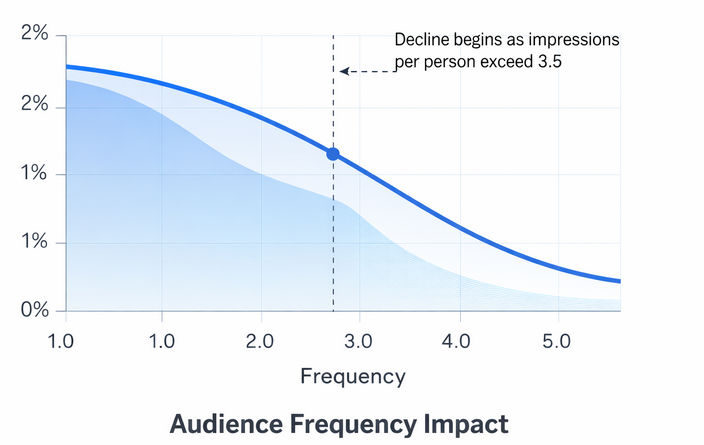
As average impressions per person exceed 3.5, engagement (CTR) begins to decline noticeably, indicating audience fatigue
Industry data shows that when ad frequency exceeds 3.5, click-through rates drop by an average of 15–25%, signaling audience fatigue.
2. Engagement Quality
Raw reach is meaningless without interaction. Engagement metrics reveal whether your audience actually cares about the message.
Track:
-
Click-through rate (CTR)
-
Video watch time
-
Post engagement rate
As a benchmark, healthy prospecting audiences typically maintain a CTR of 0.9–1.5% on social platforms, while low-quality audiences often fall below 0.6% after initial testing.
3. Conversion Consistency
Audience health is confirmed by stability, not isolated spikes.
Evaluate:
-
Cost per conversion volatility
-
Conversion rate trends over time
-
Performance consistency across creatives
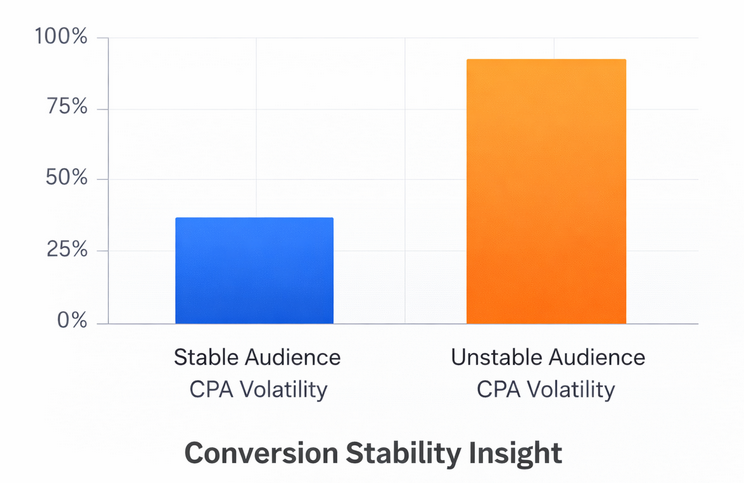
Audiences with strong engagement and quality metrics deliver significantly more consistent cost-per-acquisition performance
Data from performance marketing studies shows that high-quality audiences produce 30–50% less CPA fluctuation week over week compared to unstable or overextended segments.
4. Overlap and Redundancy
Overlapping audiences compete against each other, inflate costs, and distort performance data.
Warning signs include:
-
Multiple campaigns targeting nearly identical users
-
Rising CPMs without changes in creative or bidding
Maintaining clean audience separation can reduce CPMs by 10–18%, based on cross-account audits of scaled ad accounts.
Diagnostic Questions to Ask Regularly
-
Is performance declining even when creative remains strong?
-
Is frequency increasing faster than conversions?
-
Are new segments performing worse than historical baselines?
-
Is scaling limited by audience exhaustion rather than budget?
Consistently negative answers point to audience health issues rather than creative or bidding problems.
How to Improve Audience Health
Refresh Data Sources
Introduce new behavioral or interest-based signals regularly. Fresh data improves relevance and reduces fatigue.
Segment by Intent Level
Separate high-intent users from broader discovery segments. High-intent audiences typically convert 2–3× higher than cold traffic when isolated correctly.
Monitor Health Weekly
Audience health should be reviewed at least once per week. Early detection prevents wasted spend and preserves learning phases.
Common Mistakes in Audience Evaluation
-
Judging audiences after only a few days of data
-
Scaling spend before validating engagement quality
-
Ignoring overlap until performance collapses
-
Treating all conversions as equal without intent analysis
Avoiding these mistakes can improve long-term efficiency more than frequent creative changes.
Recommended Related Articles
Final Thoughts
Audience health is not static. It evolves as platforms, user behavior, and competition change. Marketers who actively monitor and refine audience quality gain a compounding advantage—lower costs, stronger signals, and the confidence to scale without destabilizing results.