Audience saturation occurs when the same users are exposed to an advertisement too many times within a limited period. As exposure increases, engagement typically declines while costs rise. Identifying saturation early allows marketers to refresh targeting, update creatives, and maintain efficient campaign performance.
According to marketing performance studies, campaigns that exceed optimal frequency levels can experience click-through rate declines of up to 40 percent while cost per acquisition may increase by more than 30 percent.
Key Signals of Audience Saturation
Rising Frequency with Declining Engagement
Frequency measures how often the same user sees your advertisement. When frequency continues to rise but engagement metrics such as CTR decrease, saturation is likely approaching.
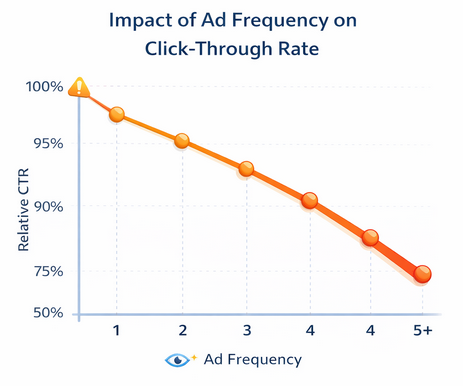
As ad exposure increases beyond optimal frequency levels, click-through rates tend to decline sharply due to audience fatigue
Many performance benchmarks indicate that once ad frequency exceeds 3–5 impressions per user within a short cycle, engagement often begins to fall significantly.
Increasing Cost per Acquisition
One of the most reliable indicators of saturation is rising acquisition cost. As the same audience repeatedly sees the same messaging, conversions decline while advertising platforms continue to deliver impressions.
Research from digital marketing benchmarks shows that CPA can increase by 25–35 percent once an audience segment becomes overexposed to identical creatives.
Declining Conversion Rates
When audiences grow tired of repeated messaging, conversion rates fall even if impressions remain stable. This usually signals that the reachable segment has already engaged with the campaign or lost interest.
Campaign performance analysis suggests that conversion rates may drop by more than 20 percent after the same audience has been exposed to identical creative messaging for several weeks.
Metrics That Help Detect Saturation Early
Audience Reach vs. Frequency
Tracking the relationship between reach and frequency helps identify whether campaigns are expanding into new audiences or repeatedly targeting the same users.
If frequency grows quickly while reach stagnates, it indicates that the platform is struggling to find new users within the selected targeting parameters.
Impression Share Stability
A stable or increasing impression share combined with declining results can signal saturation. The campaign continues delivering impressions, but the audience response weakens.
Engagement Trends Over Time
Monitoring CTR and engagement trends across several weeks helps reveal gradual declines before performance drops sharply.
Performance trend analysis across large-scale advertising accounts shows that campaigns experiencing steady CTR decline over three consecutive reporting periods often face imminent saturation.
Methods to Evaluate Audience Capacity
Estimate Total Audience Size
Before launching or scaling a campaign, analyze the estimated audience size provided by advertising platforms. Compare that number with expected impression volume and campaign duration.
If projected impressions significantly exceed the available audience size, saturation will occur quickly.
Analyze Historical Campaign Data
Review previous campaigns targeting similar audiences. Historical frequency levels and performance patterns often reveal when saturation occurred.
Historical analysis helps establish realistic frequency thresholds for future campaigns.
Segment Audience Layers
Breaking audiences into smaller segments allows marketers to distribute impressions across multiple groups rather than repeatedly targeting a single group.
Segmented campaigns typically maintain higher engagement rates because exposure is distributed more evenly.
Strategies to Prevent Performance Decline
Refresh Creative Assets Regularly
New visuals and messaging can renew audience attention even when targeting remains the same. Many advertisers rotate creative variations every two to four weeks to maintain engagement.
Expand Lookalike or Similar Audiences
Introducing additional audience segments based on high-performing users can increase reach and reduce pressure on existing audiences.
Adjust Campaign Budget Scaling
Rapid budget increases can accelerate saturation by forcing platforms to deliver impressions more frequently to the same users. Gradual scaling helps maintain healthier exposure levels.
Conclusion
Audience saturation is one of the most common causes of declining advertising performance. By monitoring frequency trends, engagement metrics, and conversion patterns, marketers can detect saturation before it significantly impacts results.
Early detection allows campaigns to maintain efficiency through creative updates, audience expansion, and more balanced impression distribution.