
Modern Meta advertising campaigns are driven heavily by algorithmic optimization. Instead of evenly distributing impressions across ads, Meta dynamically allocates budget toward the creatives that demonstrate stronger performance signals.
For marketers, this allocation pattern provides valuable insight. By observing where the budget flows inside an ad set, you can often diagnose creative performance long before traditional metrics stabilize.
Understanding these patterns allows advertisers to improve testing frameworks, scale high‑performing assets faster, and avoid wasting budget on creatives that the algorithm has already deprioritized.
How Meta’s Algorithm Allocates Budget
Meta’s delivery system continuously evaluates multiple performance signals including click‑through rate, engagement, conversion probability, and post‑click behavior.
When the system detects stronger signals from a specific creative, it shifts impressions toward that asset to maximize the likelihood of achieving the campaign objective.
This process typically produces a recognizable pattern within ad sets:
-
A small number of creatives receive the majority of spend
-
Several creatives receive moderate testing budget
-
The rest receive minimal delivery
Industry data indicates that in many campaigns, the top 20–30% of creatives capture more than 80% of total spend once optimization stabilizes.
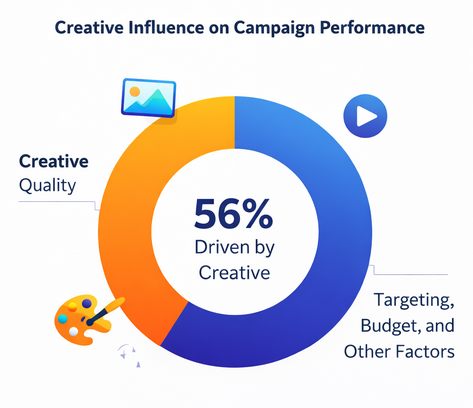
Creative quality drives more than half of advertising outcomes, making it the most influential factor in campaign performance
This distribution reflects the algorithm’s attempt to concentrate budget where it expects the highest return.
Budget Concentration as a Performance Signal
Budget allocation itself becomes a diagnostic signal.
If one creative rapidly absorbs the majority of spend, it usually means the algorithm has detected stronger early signals compared with other variations.
Research across large Meta advertising datasets shows that creatives receiving early budget concentration often deliver 30–50% higher conversion efficiency than those that remain in low‑delivery states.
Advertisers can use this information to make faster decisions:
-
Scale creatives that receive consistent delivery
-
Pause creatives that fail to gain traction
-
Replace weak variations with new tests
Rather than waiting for statistically significant conversion data, budget flow offers an early directional indicator.
Identifying Weak Creatives Through Low Delivery
Low delivery is often misunderstood as a technical issue. In reality, it frequently reflects weak performance signals.
Meta may restrict impressions for creatives that demonstrate:
-
Low click‑through rate
-
Poor engagement signals
-
Weak predicted conversion probability
When a creative consistently receives less than 5–10% of ad set spend after the learning phase, it usually indicates the algorithm has deprioritized it.
In these cases, keeping the creative active rarely improves performance. Instead, replacing it with new variations typically produces better results.
Creative Testing and Budget Allocation Patterns
Budget allocation patterns become particularly valuable during structured creative testing.
Effective testing frameworks typically follow several principles:
Maintain Multiple Creative Variations
Running several creative concepts allows the algorithm to identify strong signals quickly. Campaigns that test at least 5–8 creative variations simultaneously can improve conversion rates by up to 30% compared with limited testing environments.
Monitor Budget Share Instead of Only CPA
Cost metrics often stabilize slowly. Budget share, however, changes rapidly as the algorithm learns.
Tracking which creatives receive increasing delivery can reveal winners earlier than waiting for complete CPA data.
Replace Low‑Delivery Creatives Regularly
Creative fatigue and weak early signals can stall campaign performance. Regularly introducing new creative concepts keeps the testing pool healthy and prevents the algorithm from over‑relying on a small number of assets.
Signals That a Creative Is Ready to Scale
Certain budget allocation patterns indicate that a creative may be ready for scaling:
-
The creative consistently receives the highest share of ad set spend
-
Delivery continues increasing over several days
-
Engagement and click metrics outperform other variations
When these signals appear together, advertisers can often scale the creative into new ad sets, broader audiences, or additional campaign structures.
This approach reduces risk because the algorithm has already demonstrated a clear preference for the asset.
Structuring Campaigns to Learn From Budget Flow
To interpret Meta’s budget allocation patterns effectively, campaigns must be structured in a way that allows the algorithm to compare creatives fairly.
Recommended practices include:
-
Keep creatives within the same ad set during testing
-
Avoid excessive audience fragmentation
-
Allow sufficient learning time before making decisions
When campaigns are structured properly, budget flow becomes one of the clearest indicators of creative effectiveness.
Conclusion
Meta’s ad delivery system constantly evaluates creative performance and reallocates budget toward assets that generate stronger signals. For advertisers, these allocation patterns provide a powerful diagnostic tool.
By analyzing how budget flows across creatives, marketers can identify winners earlier, eliminate weak variations faster, and build more efficient testing frameworks.
Understanding these patterns transforms budget allocation from a passive outcome into an active source of performance insight.