Cold audiences do not give Facebook ads much time.
They are not searching for your product. They do not know your brand. They may not even know they have the problem your offer solves.
That is why confusing creative hurts cold campaigns fast. If the user cannot understand the message in a few seconds, they usually scroll past. Meta may still spend the budget, but the campaign starts collecting weak signals from people who do not clearly understand the offer.
A confusing ad does not always look bad. It can have clean design, strong visuals, and polished copy. The real issue is that the message asks too much from someone with no context.
Problem: Cold audiences cannot act on a message they do not understand
Most confusing Facebook ads fail for one core reason: they ask cold users to care before they understand the offer.
The ad may lead with a product name, a feature, a brand update, or a clever hook. That can work for warm audiences because they already have context. Cold audiences usually need the problem first.
This is where many ads created from Facebook Page content struggle. A Page post often assumes the reader already knows the brand. When that post becomes a cold ad, the message may feel incomplete.
For example, “Our new reporting dashboard is live” might make sense to existing users. Cold traffic needs a clearer reason to care, such as “See where your ad budget is being wasted before CPA climbs.”
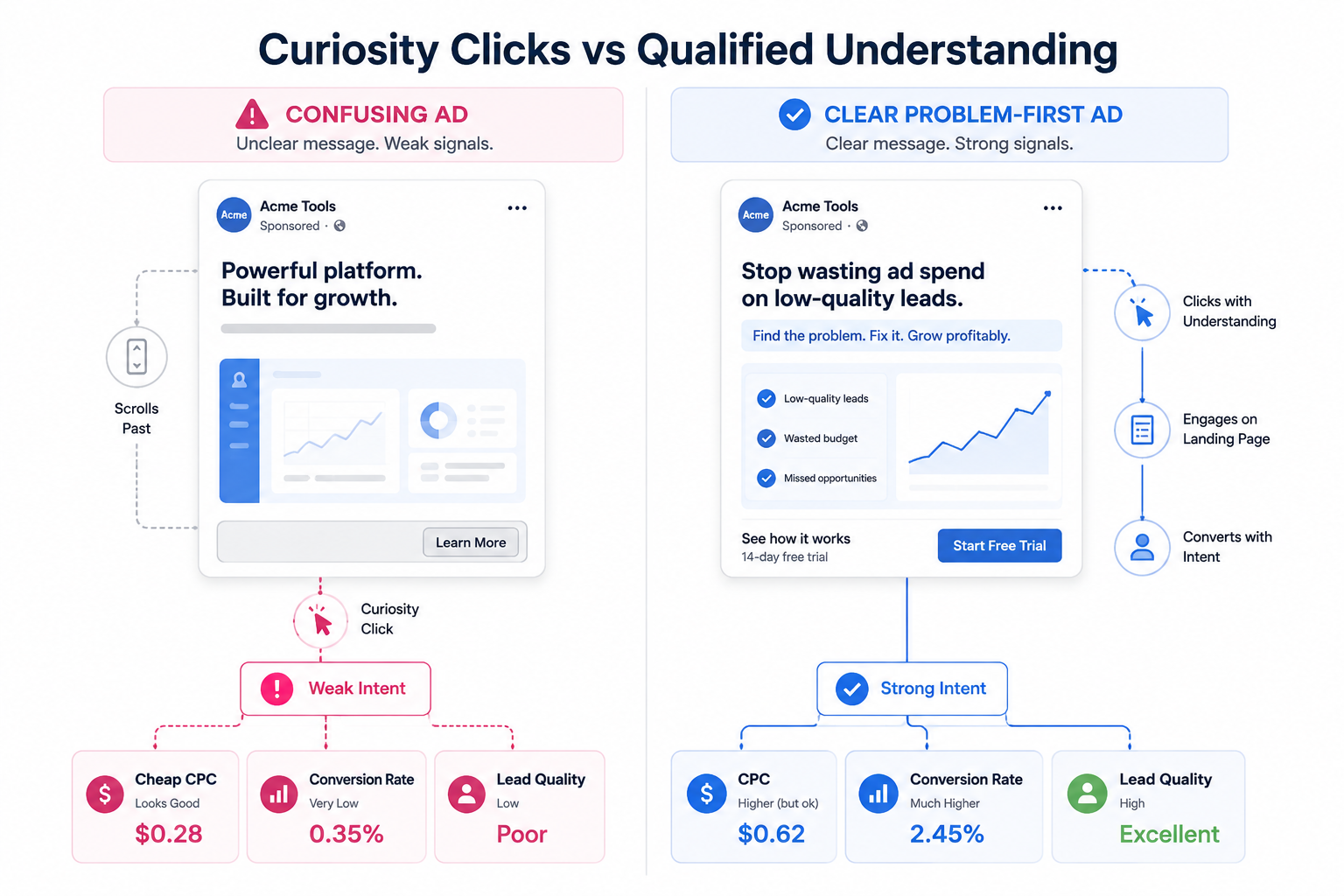
When the message is unclear, the campaign can still get clicks. But those clicks often come from curiosity, not qualified intent. In Ads Manager, CPC may look fine while landing page conversion rate stays weak, CPL rises, or sales teams report that leads misunderstood what they signed up for.
That is the real performance issue. Confusing creative does not only reduce attention. It trains the campaign on weak signals from users who never fully understood the offer.
Solution: Lead with the problem the audience already recognizes
Cold users need a familiar entry point.
Instead of opening with the product, open with the situation where the user already feels friction. That could be rising CPA, weak lead quality, wasted clicks, low demo rates, or poor conversion after traffic reaches the landing page.
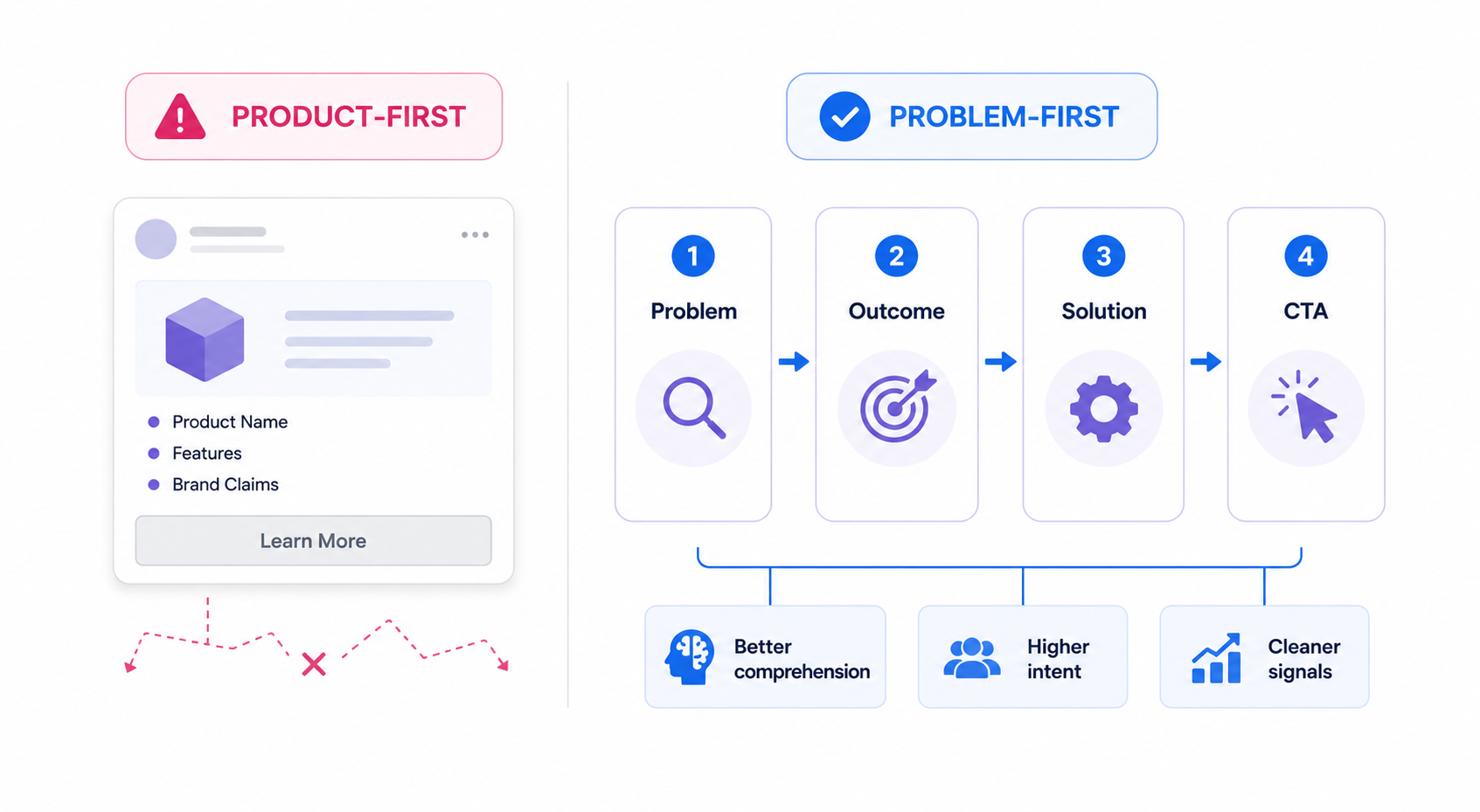
For example, “AI-powered lead routing” is product-first. “Send fewer weak leads to sales” is problem-first. The second version is easier to understand because it starts with a business issue the user can recognize.
A clear cold-audience message should answer three questions quickly:
- Who is this for? The right user should recognize themselves without needing the landing page.
- What problem does it solve? The pain point should feel specific, not abstract.
- Why should the user keep reading? The ad should connect the problem to a useful outcome.
This is why advertisers should align Facebook ad messaging with buyer intent. A cold user needs a different message than someone already comparing solutions.
Solution: Put the message in the right order
Many confusing ads contain useful information. The problem is the sequence.
Cold audiences usually need this order: problem, outcome, mechanism, next step.
Many ads reverse it. They start with a product name, feature, discount, or brand claim before the user understands why it matters.
A B2B ad that says “Automated pipeline intelligence for growth teams” may sound professional, but it is hard to process quickly. A clearer version would be: “Find which leads are wasting your sales team’s time before you increase ad spend.”
That message starts with a recognizable problem. Then the product has permission to explain the solution.
Do not force the first frame to carry every detail. Proof, feature depth, pricing, objections, and comparisons can appear later in the funnel. For cold traffic, the first job is comprehension.
Solution: Rewrite product-first copy into problem-first copy
Most confusing ads start from what the business wants to say.
Clearer ads start from what the user needs to understand first.
Instead of asking, “How do we describe the product?” ask, “What situation would make this offer relevant right now?”
A practical rewrite process looks like this:
- Replace product language with problem language. “AI-powered lead routing” becomes “Send fewer weak leads to sales.”
- Turn abstract benefits into concrete outcomes. “Improve efficiency” becomes “Stop spending on audiences that click but never convert.”
- Cut secondary claims from the first message. If the ad mentions speed, cost, quality, automation, and trust at once, none of them stands out.
- Match the CTA to cold traffic. “See how it works” may fit better than “Book a demo” when the user is still learning.
This does not make the ad basic. It makes it easier to understand.
Clear messaging also helps build trust in the first ad impression. People trust ads faster when they understand the promise.
Solution: Use clarity to improve click and lead quality
A clearer message may not always produce more clicks. That is not a problem.
The goal is not to attract everyone who is mildly curious. The goal is to help the right people understand the offer before they click.
For example, “Get better insights” could attract almost anyone. “For agencies managing multiple ad accounts, find which audiences are wasting budget before CPA spikes” attracts a narrower but more relevant user.
That may reduce total click volume. But it can improve the percentage of visitors who understand the offer, stay on the landing page, and submit with better intent.
This is the tradeoff many advertisers miss. Unclear messaging can make CPL look cheaper at first. Clear messaging can make sales follow-up more efficient because fewer leads need extra qualification.
If you see cheap clicks but weak conversions, check whether your hook is too vague. Vague hooks and mismatched expectations often create activity without revenue. This is why curiosity clicks can destroy campaign efficiency.
Solution: Pair clearer messaging with better audience inputs
Clear messaging works best when the audience has a real connection to the problem.
If targeting is too broad, the ad has to explain more and filter harder. That puts extra pressure on the hook, visual, and CTA. The campaign may still find some good prospects, but it must work through too much low-fit traffic first.
LeadEnforce can help advertisers build more precise audiences from Facebook groups, Instagram followers and engagers, and social profile data. This gives the ad a better starting point because the audience is more likely to understand the problem.
For example, a SaaS company promoting a lead quality offer could test a broad audience against people connected to relevant industry communities or competitor profiles. The second audience gives the creative more context to work with.
That does not replace good messaging. It gives good messaging a cleaner test.
Solution: Check clarity before increasing budget
Before scaling a cold ad, review the message as if you have never seen the brand before.
Do not judge the ad by whether the design looks good. Judge it by whether the first message is clear enough to earn the next action.
Ask these questions before increasing spend:
- Can someone understand the offer in three seconds?
- Does the hook describe a real problem?
- Does the visual support the message?
- Does the CTA fit cold traffic?
- Does the landing page continue the same promise?
If the answer is no, increasing budget will usually scale the same weak signals. The campaign may spend more, but signal quality will not improve.
The best first fix is not a new campaign structure. It is a clearer first message.
Final takeaway
Cold audiences do not ignore ads only because the design is weak. They ignore ads because the message takes too much work to understand.
A strong cold-audience ad makes the problem clear, connects it to a useful outcome, and gives the user a simple next step. That helps Meta collect cleaner signals and sends better-prepared visitors to the landing page.
The best fix for confusing Facebook ads is not adding more explanation. It is making the first message clearer.