Return on Ad Spend (ROAS) improves when three variables align: relevance, intent, and trust. Instagram communities naturally concentrate all three.
According to industry benchmarks:
-
Instagram engagement rates average around 3% for smaller niche-focused accounts (10k–50k followers), compared to below 1% for larger general-interest accounts.
-
Personalized campaigns can increase conversion rates by 20–40% compared to non-segmented campaigns.
-
Ads aligned with user interests and behaviors can reduce cost per acquisition (CPA) by up to 30%.
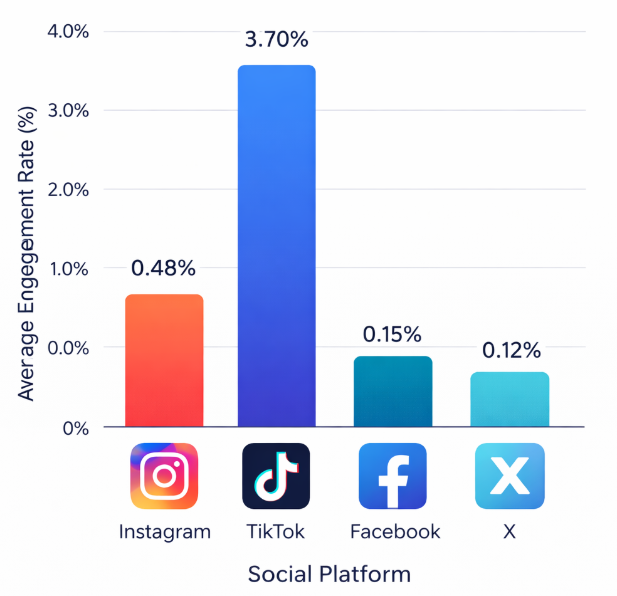
Average engagement rates by platform show Instagram’s relative strength in driving interactions compared to other social networks
Communities on Instagram are structured around shared interests: fitness niches, crypto traders, indie beauty, SaaS founders, eco-conscious shoppers, and more. These users interact with similar content, follow overlapping creators, and engage in recurring conversations. That behavioral clustering makes them significantly more predictable and conversion-ready than broad demographic segments.
Understanding Instagram Communities
Instagram communities are not formal groups like Facebook Groups. They form through:
-
Shared hashtags
-
Creator follow graphs
-
Engagement overlap
-
Comment participation patterns
-
Repeated interaction with niche content
For example, users following multiple plant-based recipe creators, engaging with vegan product launches, and saving sustainability-related content form a high-intent micro-community. Targeting that cluster generates higher relevance scores and lower CPM volatility.
Step 1: Identify High-Intent Micro-Communities
To increase ROAS, move from demographic targeting to behavioral targeting.
Instead of targeting:
-
Women 25–40 interested in fitness
Target:
-
Followers of specific fitness creators
-
Users engaging with HIIT transformation posts
-
People interacting with supplement comparison content
-
Accounts that comment on performance tracking tools
Community-level targeting narrows reach but increases conversion probability. Campaign data consistently shows that smaller but more aligned audiences outperform broader cold segments in revenue per impression.
Step 2: Map Engagement Overlap
High-performing Instagram communities often overlap around 3–7 core accounts. Identifying shared follower relationships helps isolate clusters with strong internal cohesion.
Why this matters:
-
High overlap indicates shared identity
-
Shared identity increases trust transfer
-
Trust transfer increases purchase likelihood
When multiple creators influence the same audience segment, your brand message integrates into an already established trust ecosystem.
Step 3: Personalize Creative to the Community Language
Communities develop their own tone, terminology, and expectations. Ads that mirror that language outperform generic brand messaging.
For example:
-
Crypto audiences respond to performance metrics and data-driven visuals.
-
Beauty communities respond to before-and-after proof and routine breakdowns.
-
SaaS founders respond to ROI framing and workflow optimization.
Campaign testing consistently shows that community-aligned creatives improve click-through rates (CTR) by 15–25% compared to neutral brand creatives.
Step 4: Optimize for Value, Not Just Volume
Higher ROAS comes from higher customer lifetime value (CLV), not just initial purchases.
Community-based targeting often produces:
-
Higher repeat purchase rates
-
Lower refund rates
-
Stronger brand advocacy
Research indicates that customers acquired through interest-aligned targeting can generate up to 2x higher lifetime value than those acquired through broad prospecting campaigns.
Instead of optimizing only for lowest CPA, evaluate:
-
Revenue per community segment
-
Retention by audience cluster
-
Repeat purchase velocity
Step 5: Scale Through Adjacent Communities
Once a high-ROAS community is validated, scale horizontally, not vertically.
Avoid simply increasing budget to the same segment. Instead:
-
Identify adjacent creator ecosystems
-
Expand to related niche hashtags
-
Test overlapping but slightly broader behavioral clusters
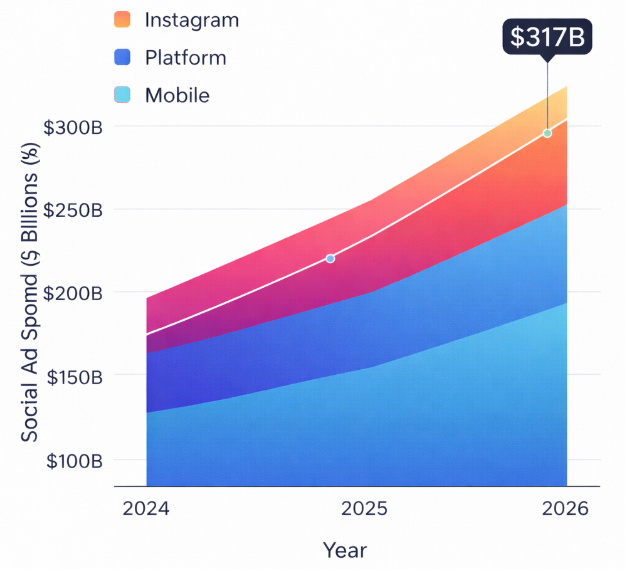
Global social media advertising spend continues to rise, highlighting the expanding investment in precision targeting and community-driven ad strategies.
This preserves relevance while increasing addressable audience size.
Key Metrics to Track for Community-Based Campaigns
To measure impact accurately, monitor:
-
ROAS by audience segment
-
CPA by micro-community
-
Engagement-to-purchase ratio
-
Average order value (AOV) per cluster
-
Retention rate per targeting set
When segmented correctly, it is common to see 25–50% ROAS improvement compared to generic interest-based targeting.
Common Mistakes That Reduce ROAS
-
Targeting only by demographics.
-
Using identical creatives across all audience sets.
-
Scaling budget before validating community-level profitability.
-
Ignoring engagement overlap signals.
Community targeting requires precision and structured testing, but the payoff compounds over time.
Final Thoughts
Instagram is no longer a platform where broad targeting drives sustainable advertising performance. Communities define attention, influence trust, and shape purchasing behavior. Brands that structure campaigns around behavioral clusters rather than generic segments consistently achieve higher ROAS, stronger retention, and better long-term revenue stability.
Precision in community identification, creative alignment, and scaling strategy is what transforms Instagram advertising from traffic acquisition into a predictable revenue engine.