Creative fatigue is one of the most overlooked risks in performance-driven marketing and content production. Teams often notice the problem only after engagement rates, conversion metrics, or campaign efficiency start to deteriorate. By that point, recovery is more costly and time-consuming.
However, creative fatigue leaves measurable signals long before performance drops become visible. Identifying these signals early allows teams to adjust strategy, refresh messaging, and maintain consistent results.
What Is Creative Fatigue?
Creative fatigue occurs when audiences become desensitized to repeated messaging, visuals, or formats. Overexposure reduces attention and engagement, even if the underlying offer remains strong.
According to industry benchmarks, repeated exposure to the same ad creative can reduce click-through rates by up to 20–30% within the first two weeks of a campaign. Additionally, studies show that ad recall declines by nearly 50% when users encounter identical creatives multiple times without variation.
Early Warning Signs of Creative Fatigue
1. Declining Engagement Consistency
Before overall metrics drop, variability increases. You may notice inconsistent performance across similar audience segments or platforms.
What to watch:
-
Fluctuating click-through rates
-
Irregular engagement patterns
-
Higher variance in campaign results
2. Rising Frequency Without Proportional Returns
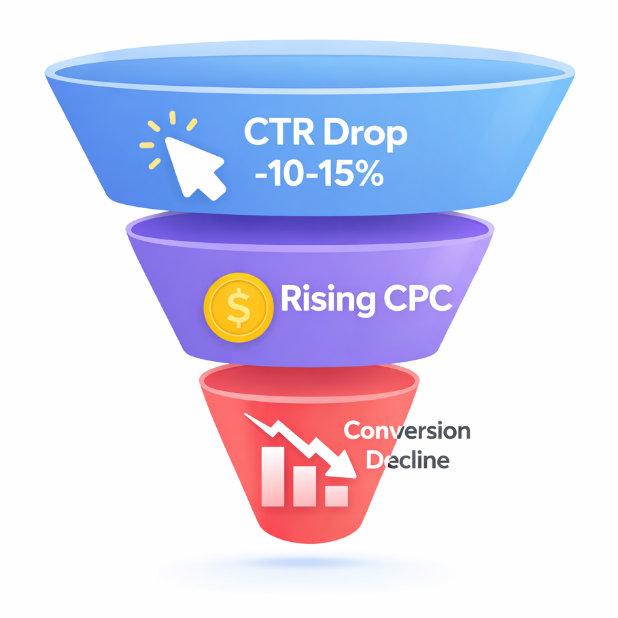
Creative fatigue follows a predictable pattern: early CTR decline leads to rising costs and eventual conversion drops
Ad frequency often increases naturally during campaigns. However, when impressions grow without corresponding gains in engagement, fatigue may be developing.
Benchmark insight:
When frequency exceeds 3–5 exposures per user, engagement rates often plateau or decline significantly.
3. Shorter Attention Windows
Users begin to disengage more quickly, even if they initially interact with content.
Indicators include:
-
Reduced average watch time
-
Lower scroll depth
-
Faster drop-off rates in funnels
4. Creative Performance Decay by Segment
Certain audience segments show fatigue earlier than others, particularly highly targeted or retargeted groups.
Key signal:
Top-performing segments begin to underperform relative to new or broader audiences.
5. Increased Cost per Result (Before Conversion Drops)
Costs often rise before conversions decline. This happens because platforms require more impressions to achieve the same outcome.
Typical pattern:
-
Gradual increase in cost-per-click (CPC)
-
Rising cost-per-thousand impressions (CPM)
-
Stable but fragile conversion rates
Why Early Detection Matters
Detecting creative fatigue early helps maintain campaign efficiency and protects long-term brand perception. Research shows that proactive creative refreshes can improve performance by up to 35% compared to reactive adjustments made after declines occur.
Early intervention also reduces wasted ad spend. Studies estimate that up to 26% of digital advertising budgets are lost due to ineffective or overused creatives.
How to Monitor Creative Fatigue Effectively
1. Track Leading Indicators, Not Just Outcomes
Focus on metrics that change before conversions decline:
-
Engagement rate trends
-
Frequency vs. CTR relationship
-
Scroll or watch behavior
2. Segment Performance Analysis
Analyze performance across different audience groups to identify early fatigue in high-exposure segments.
3. Implement Creative Rotation Cycles
Establish structured rotation schedules for creatives. High-performing campaigns often refresh assets every 10–14 days to maintain engagement.
4. A/B Test Variations Continuously
Even small changes—headlines, visuals, or formats—can delay fatigue. Continuous testing helps identify when performance begins to decline.
Preventing Creative Fatigue Before It Starts
Diversify Creative Formats
Use a mix of formats such as video, carousel, static images, and interactive elements to maintain audience interest.
Refresh Messaging Angles
Instead of repeating the same value proposition, present different perspectives or use cases.
Align Creative with Audience Journey
Tailor creatives to different stages of the funnel to avoid repetition for the same users.
Use Data-Driven Iteration
Leverage performance data to guide creative updates rather than relying solely on intuition.
Suggested Reading
Conclusion
Creative fatigue is not a sudden event—it is a gradual process that can be detected through early signals. By monitoring leading indicators, analyzing audience behavior, and refreshing creatives proactively, teams can maintain performance and avoid costly declines.
Recognizing these patterns early transforms creative management from reactive troubleshooting into a strategic advantage.