
Engagement metrics have become the default compass for digital optimization. Click-through rates, time on page, likes, shares, and scroll depth are often treated as direct indicators of success. However, these signals can be misleading when interpreted without context.
Relying solely on engagement can result in optimizing for activity rather than outcomes—driving teams toward vanity metrics that do not translate into revenue, retention, or meaningful conversions.
The Problem with Engagement-Driven Optimization
1. Engagement Does Not Equal Intent
High engagement does not necessarily indicate high purchase intent. For example, users may spend significant time on content because it is confusing rather than compelling. Similarly, viral content often attracts broad attention but low conversion rates.
A study by Chartbeat found that 55% of visitors spend fewer than 15 seconds actively on a page, yet pages with longer average time-on-page do not consistently correlate with higher conversion rates.
2. Clicks Can Be Misleading
Click-through rate (CTR) is frequently used as a proxy for effectiveness. However, a high CTR can result from misleading headlines or curiosity-driven clicks that fail to deliver value.
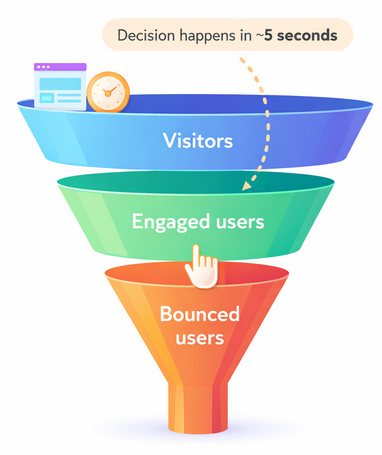
A significant portion of users leave within seconds, meaning engagement metrics often reflect first impressions rather than meaningful interaction
According to industry benchmarks, while average display ad CTRs hover around 0.1%–0.3%, campaigns optimized purely for CTR often see conversion rates drop by up to 30% compared to campaigns optimized for post-click actions.
3. Algorithmic Bias Toward Engagement
Many platforms prioritize content that generates engagement, reinforcing a feedback loop. This leads to overexposure of emotionally charged or sensational content while undervaluing high-intent, lower-engagement assets.
This bias can skew optimization efforts, pushing teams to prioritize short-term interaction over long-term business impact.
4. False Positives in A/B Testing
When engagement metrics are used as primary success criteria in experiments, teams risk validating changes that do not improve core KPIs.
For instance, a variation that increases scroll depth by 20% may simultaneously reduce conversion rate by 5%. Without aligning metrics to business objectives, such outcomes may go unnoticed.
Why Engagement Metrics Persist
Despite their limitations, engagement metrics remain popular due to their accessibility and immediacy. They provide quick feedback loops and are easy to track across platforms.
Additionally, dashboards and analytics tools often emphasize engagement by default, reinforcing their perceived importance.
What to Measure Instead
1. Outcome-Oriented Metrics
Shift focus toward metrics that directly reflect business value:
-
Conversion rate
n- Customer acquisition cost (CAC) -
Lifetime value (LTV)
-
Revenue per visitor
These metrics align optimization efforts with tangible outcomes rather than surface-level interactions.
2. Intent Signals
Identify behaviors that indicate genuine interest or readiness to act, such as:
-
Returning visits
-
Product page depth
-
Form completions
-
Demo requests
Intent signals provide a more reliable foundation for decision-making.
3. Cohort Analysis
Analyze user behavior over time instead of relying on aggregate engagement data. Cohort analysis helps uncover patterns in retention, churn, and long-term value.
For example, users acquired through high-engagement channels may exhibit lower retention rates compared to those from lower-engagement but higher-intent sources.
Practical Steps to Avoid Misleading Signals
Align Metrics with Objectives
Define success based on business goals, not platform defaults. Ensure every optimization effort is tied to a measurable outcome.
Use Multi-Metric Evaluation
Avoid relying on a single metric. Combine engagement, intent, and outcome metrics to gain a comprehensive view of performance.
Validate with Downstream Impact
Before implementing changes, evaluate their effect on downstream metrics such as conversions and revenue.
Segment Your Data
Break down metrics by audience, channel, and behavior to identify inconsistencies and hidden trends.
Conclusion
Engagement metrics are valuable—but only when used in context. Treating them as primary indicators of success can lead to misguided optimization decisions.
By shifting focus toward intent and outcomes, teams can build strategies that drive meaningful results rather than superficial activity.