
Audience segmentation is a foundational component of modern marketing and sales strategies. However, not all segments remain valuable over time. As markets shift, customer behaviors evolve, and data accumulates, some audience segments gradually lose their effectiveness. These are commonly referred to as "dead audience segments."
Dead segments consume budget, distort analytics, and reduce overall campaign efficiency. Identifying and managing them is essential for maintaining a high-performing growth engine.
What Is a Dead Audience Segment?
A dead audience segment is a group of contacts or users that consistently fails to engage, convert, or respond to marketing and sales efforts. These segments may still exist in your database, but they no longer provide measurable value.
Typical characteristics include:
-
Low or zero engagement rates
-
Declining conversion performance
-
High bounce or unsubscribe rates
-
Outdated or inaccurate data
Why Dead Segments Are a Problem
Maintaining ineffective segments leads to several operational and strategic issues:
-
Budget waste: Marketing resources are spent targeting audiences that do not convert.
-
Skewed analytics: Dead segments dilute performance metrics, making optimization harder.
-
Deliverability risks: Repeated outreach to unresponsive contacts can harm sender reputation.
-
Opportunity cost: Time and effort could be redirected toward high-value segments.
According to industry benchmarks, email lists naturally decay by approximately 22–30% per year due to job changes, inbox abandonment, and data obsolescence. Additionally, campaigns targeting inactive users can reduce overall engagement rates by up to 50%.
Key Indicators of a Dead Segment
1. Persistent Low Engagement
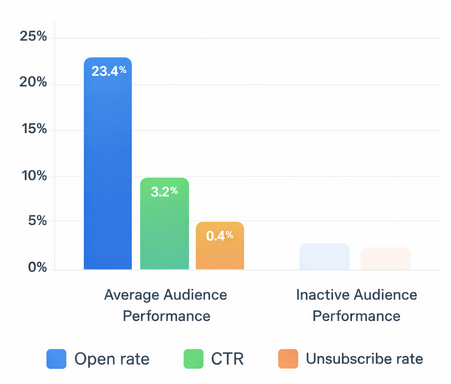
Dead audience segments fall significantly below industry engagement benchmarks
If a segment consistently shows low open rates, click-through rates, or interaction levels over multiple campaigns, it may no longer be viable.
-
Open rates below 10% in B2B email campaigns
-
Click-through rates under 1%
2. Declining Conversion Rates
A segment that previously converted but now shows a steady decline in conversions is a strong candidate for reevaluation.
Track trends over time rather than isolated campaign results.
3. High Bounce and Unsubscribe Rates
An increase in hard bounces or unsubscribes indicates that the data is outdated or the audience is no longer relevant.
-
Bounce rates above 2%
-
Unsubscribe rates exceeding 0.5%
4. Data Staleness
Segments built on outdated firmographic or demographic data lose accuracy over time. For example, contacts who have changed roles or companies may no longer fit your target profile.
5. Lack of Behavioral Signals
Modern segmentation relies heavily on behavioral data. If a segment shows no recent activity—such as website visits, downloads, or interactions—it may be effectively inactive.
How to Identify Dead Audience Segments
Step 1: Audit Historical Performance
Analyze campaign data across a 3–12 month period. Look for patterns in engagement, conversion, and response rates.
Segment-level analysis is critical—overall averages can hide underperforming groups.
Step 2: Compare Against Benchmarks
Use internal and industry benchmarks to evaluate performance. Segments consistently underperforming benchmarks should be flagged.
Step 3: Apply Recency-Frequency Analysis
Evaluate how recently and how often contacts engage:
-
Recency: When was the last interaction?
-
Frequency: How often do interactions occur?
Segments with low recency and frequency are strong candidates for classification as dead.
Step 4: Validate Data Accuracy
Run data enrichment or verification processes to identify outdated or invalid records. Poor data quality often correlates with dead segments.
Step 5: Test Reactivation Campaigns
Before eliminating a segment, run targeted re-engagement campaigns. If performance remains low, the segment is likely inactive.
Reactivation campaigns typically achieve response rates below 5% for truly inactive segments.
What to Do With Dead Segments
1. Remove or Suppress
Exclude dead segments from active campaigns to improve performance metrics and reduce costs.
2. Rebuild With Fresh Data
Replace outdated segments with newly sourced, verified data aligned with your current ideal customer profile.
3. Refine Segmentation Criteria
Reevaluate how segments are defined. Incorporate behavioral and intent-based signals rather than relying solely on static attributes.
4. Implement Ongoing Monitoring
Dead segments emerge over time. Establish continuous monitoring processes to identify and address them early.
Best Practices to Prevent Segment Decay
-
Regularly clean and update your database
-
Use real-time or frequently refreshed data sources
-
Track engagement trends at the segment level
-
Automate inactivity thresholds and alerts
Organizations that implement consistent data hygiene practices can improve campaign performance by up to 30% and reduce wasted spend significantly.
Conclusion
Dead audience segments are an inevitable byproduct of evolving markets and aging data. However, with structured analysis, clear benchmarks, and proactive management, they can be identified and addressed before they impact overall performance.
Maintaining a healthy, responsive audience base is not a one-time effort—it is an ongoing process that directly influences growth, efficiency, and return on investment.